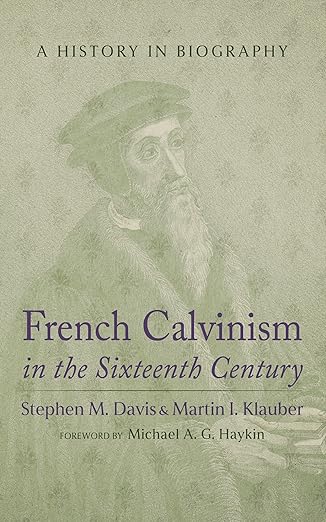
A Brief Book Notice from Books At a Glance
Steve Davis already has a recognized expertise in French Reformation studies (see here, here, here, and here), and now he joins up with Martin Klauber to introduce readers to well-known and lesser-known individuals of the French Reformation. In this excellent book the authors show how God used kings, queens, statesmen, and theologians in the sixteenth century to call France back to the apostolic tradition. These fifteen biographies are selective and seek to cover the period from the beginning of the Reformation in early sixteenth-century France to the Edict of Nantes in 1598 under Henri IV.
Table of Contents
Foreword by Michael A. G. Haykin
Preface
Introduction
Chapter 1 Jacques Lefèvre d’Étaples (c. 1450–1537): Humanist Reformer
Chapter 2 Guillaume Farel (1489–1565): Defender of the Gospel
Chapter 3 Louis de Berquin (1490–1529): Christian Martyr
Chapter 4 Marguerite de Navarre (1492–1549): Guardian Angel
Chapter 5 Michel de L’Hôpital (c. 1505–73): Catholic Peacemaker
Chapter 6 John Calvin (1509–64): Reformed Theologian
Chapter 7 Pierre Viret (1511–71): Pastor and Professor
Chapter 8 Peter Ramus (1515–72): French Humanist
Chapter 9 Gaspard de Coligny (1519–72): Huguenot Admiral
Chapter 10 Théodore de Bèze (1519–1605): Reformer and Scholar
Chapter 11 Pierre de la Place (c. 1520–72): Huguenot Martyr
Chapter 12 Jeanne d’Albret (1528–72): Huguenot Queen
Chapter 13 Louis I de Bourbon, Prince de Condé (1530–69): Huguenot General
Chapter 14 Antoine de Chandieu (1534–91): Silver Horn
Chapter 15 Henri IV (1553–1610): First Bourbon King
Foreword by Michael Haykin
As with so many other academic disciplines, there are a variety of ways of doing and writing history. The approach contained in this volume is one of the main ways that I have taught and written about history in the past three decades, namely, history through the prism of biography. Although I was trained as an intellectual historian in the late 1970s and early 1980s, my approach since the early 1990s has been to focus on the lives of people in all of their fullness and not simply engage with their ideas. This has entailed learning social and cultural history as well as the art of biography.
From the standpoint of Christian historiography, this approach makes sense, for the historical narratives in the Holy Scriptures reveal that God is deeply interested in people. And it was, after all, people for whom Christ lived and died, not ideas. To be sure, ideas—in Christian terms, dogma and doctrine—are important. But it is as they grip the minds and hearts of men and women that these ideas shape history. Without people to put them into practice, they would languish on the shelf, as it were!
The other thing I love about the book in your hands is its subject matter: the French Calvinist tradition, or the history of the Huguenots. I would venture to say that most Anglophone evangelicals are completely ignorant about the knowledge of this tradition and story. Oh yes, they know of Calvin but nothing about his predecessors in the faith and his legacy among French-speaking believers in the sixteenth century. And this really is a shame, for this Reformed tradition has been enormously influential along a number of lines: exegetically and spiritually through the writings of men like Jacques Lefèvre d’Étaples and Pierre Ramus, as well as theologically, through the work of authors such as Théodore de Bèze and Antoine de Chandieu. Moreover, the lives narrated here are some of the most fascinating of the Reformation era. In the hands of a good director, a movie about Jeanne d’Albret or Gaspard de Coligny could be a blockbuster. But I venture to suggest that this book is just as good! A huge thank you to Stephen and Marty for this historical feast!
Endorsements
- William Edgar
One might think a book on French Calvinism is the stuff of historians, and perhaps to be put safely on the shelf with other records of its kind. That would be a grave mistake. As a matter of great significance both the essence of Calvinism and its uniquely French provenance have a decisive influence on the Christian faith of our times. The movement has gone beyond Collin Hansen’s Young, Restless and Reformed to a far broader and arguably more commanding position. This volume will open up the many ways the undertaking has made its influence felt. It’s a must read for anyone wishing to understand our times through a biblical lens.
- Thomas Kidd
French Calvinism in the Sixteenth Century offers a series of compelling biographies of leaders of the Reformation in France, which had one of the most influential yet tragic national traditions within the Protestant movement. I am happy to recommend this important book.
- Joel Beeke
While the Huguenot (or French Reformed) movement largely died out by the eighteenth century because of fierce persecution, the theology of the French Calvinists lives on to this day. Through the life stories of men and women of God who lived their faith, wrote about their faith, and sealed their faith with blood, the authors use the medium of mini biography to show how a group of French laypeople and theologians helped shape early Reformed orthodoxy and piety. Prepare to meet an assortment of fascinating and theologically-astute men and women–such as Gillaume Farel, Marguerite de Navarre, John Calvin, Pierre Viret, and Theodore Beza–who challenge us through their lives, writings, and sufferings to live fully for the glory of the Triune God.