A Book Review from Books At a Glance
by Robert C. Newman
This is an excellent work, a short study of creation as dealt with in Scripture, not only in Genesis 1 and 2, but in all the other biblical passages that mention the subject. It is thus using only God’s special revelation on the subject, but not the general revelation that is also provided by the one true and living God who cannot lie.
My primary interest has been how the two revelations fit together, so my study has mostly been on the interaction of the two realms, being concerned that scientists often don’t know much about religion and theologians often don’t know much about science (particularly as “mainstream” science is dominated by evolutionism and materialism). This is somewhat along the lines of C. P. Snow’s 1959 lecture on the Two Cultures, where scientists don’t know the humanities and those in the humanities don’t know science.
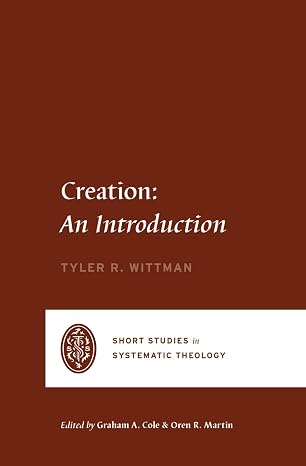
Wittman’s book is currently the latest in the series Short Studies in Systematic Theology, edited by Graham A. Cole and Oren R. Martin, which now consists of twelve titles.
It is especially refreshing to see that the author takes the biblical material as from God and therefore inerrant. He does not try to distinguish between the various ways orthodox Christians view earth’s history and evolution, though he concedes that where science is definitely right it must be consistent with the Bible on creation (p 36). He makes considerable use of insights by theologians throughout church history, both ancient and modern.
Wittman organizes his material as if creation is God’s “song” (p. 1 and throughout), though he concedes this picture is “just a metaphor” (79) and is not to be pushed too far. This follows along the lines of C. S. Lewis in The Magician’s Nephew (3n3) and J. R. R. Tolkien in The Silmarillion (1-2), as well as a substantial number of earlier theologians.
I think that this is well-warranted by Scripture as a whole, though I am not convinced that Genesis 1 is to be understood as such a song. It looks rather more like “poetic prose” (14) as the author notes. Nonetheless, he structures his chapters like this:
- The Song’s Doxological Nature: The Creation Hymn
- God’s Musicality: The Trinity and Creation
- How God Sings: Creation Out of Nothing and the Creator’s Generosity
- The Song’s Melody: Hearing and Receiving God’s Creation Word
- The Frustrated Orchestra: Humans and Other Creatures
- The Song’s Resolution: Creation’s fulfillment in Christ
- “I Will Sing and Make Melody to the LORD”: Gratitude and Sacrifice
As one can see from the chapter titles, Wittman’s book is not only about the creation as an event, but also about creation as the resultant phenomenon, what is often called “nature,” but here emphasizing its character as created.
Wittman’s treatment contains far too much material to summarize in a short review like this. It is packed with insights that are rather astonishing for a “short study.” The first chapter treats the creation hymn (Genesis 1) and the Bible’s material on creation as doxological, that is, that creation praises the Creator. The second chapter treats the involvement of the whole Trinity in creation, and is especially good. Likewise the third chapter on creation ex nihilo has some excellent insights that are unexpected, and the emphasis on the Creator’s generosity is powerful. Chapter four has a nice treatment of creation by the Word, citing both John 1 and Genesis 1’s frequent use of “God said.” Chapter five then notes that humans, by their rebellion, have messed up their part in God’s song, rather as a defective conductor can reduce an orchestra’s performance to chaos. Chapter six deals with Christ’s solution to all this, as his life, death and resurrection resolve the human dilemma, and he becomes the perfect conductor, bringing harmony to all creation. There is much excellent material here. My only objection is Wittman’s comment “There is no idea of cosmic annihilation here” which (if “cosmic” is limited to the earth) seems to deny the statements of 2 Peter 3:7 and 10, which may not refer to the whole universe, but certainly refer to the whole earth and its atmosphere. Chapter seven indicates how we as believers should respond to what God has done, structured under the categories gratitude and sacrifice. Both these have a number of valuable insights. The book ends (other than acknowledgements, a glossary, suggestions for further reading and two indices) with a coda (as befits a piece of music), a translation of Psalm 148 by Tyler’s friend Ethan Jones.
For those who would like to explore the general revelation side of creation, I personally recommend the works of Michael Behe, Stephen Meyer, Fazale Rana, Hugh Ross, David Snoke and Daniel Wonderly.
Dr. Robert C. Newman, Emeritus Professor of New Testament and Christian Evidences, Biblical Theological Seminary (now Missio Seminary); PhD (astrophysics); STM (Old Testament).