A Brief Book Notice from Books At a Glance
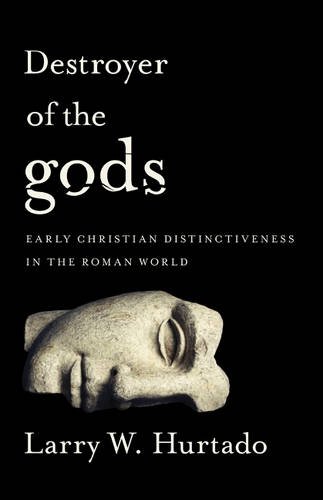
If you think Christianity seems odd in today’s world, imagine how odd it seemed in the ancient world in which it was born. And yet, as Hurtado writes, Christianity “destroyed one world and helped create another” in its place. That’s the significance of his title, Destroyer of the gods. A fascinating look into the life and impact of the early church. See our author interview here. (For a related title, see Michael Kruger’s Christianity at the Crossroads.)
Table of Contents
1 Early Christians and Christianity in the Eyes of Non-Christians
2 A New Kind of Faith
3 A Different Identity
4 A “Bookish” Religion
5 A New Way to Live
Selected Quotes
- “I want to note that these features of early Christianity that made it odd or at least remarkable in the ancient Roman setting subsequently became familiar features of all the cultures in which Christianity was influential. So, in grasping distinctive features of early Christianity, we will also perhaps understand a bit better origins of some things that form part of our thinking as well.” (13)
- “One of the best indications that early Christianity was different in the context of the Roman world is the evidence of how outsider observers at the time saw Christians and their beliefs and practices.” (15)
- “As we have noted, the general pagan reaction to early Christianity seems to have been negative: popular and sophisticated complaints, allegations, ridicule, critique, harassment, and even some state-approved efforts, at least by local authorities such as Pliny, to stamp it out.” (35)
- “I repeat again that converted pagans had no precedent or established justification for withdrawing from the worship of the gods of their families, cities, and peoples…Indeed, the exclusivist stance of early Christianity was so odd, unjustified, and even impious in the eyes of ancient pagan observers and critics that they often accused Christians of being atheists.” (56)
- “So, I contend that this dyadic pattern of belief and practices, involving God and Jesus, marks out the Jesus-movement among the variegated Jewish tradition of the Roman period.” (74)
- “My main point, however, is that early Christianity was characterized by a distinctive pattern of religious beliefs and practices that made it distinguishable in the larger Roman world.” (76)
- “Moreover, as I have emphasized, early Christian religious identity was distinctive in replacing all others for its devotees. It was an exclusive religious identity, defined entirely by their standing in relation to the one God, and was not dependent on, or even connected to, their ethnicity.” (104)
- “To see this unusually firm early Christian linkage of ‘religion’ with everyday behavior, note how much space is given to teaching and exhortation in early Christian writings about how to live…” (155)
- “Early Christianity of the first three centuries was a different, even distinctive, kind of religious movement in the cafeteria of religious options of the time. That is not simply my historical judgment; it is what people of the time thought as well.” (183)