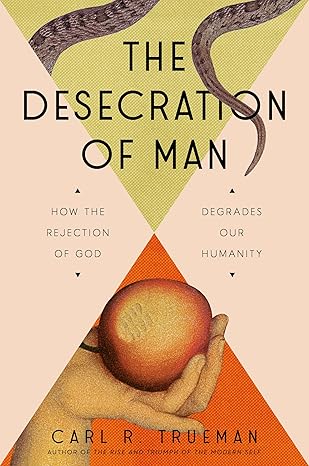
A Brief Book Notice from Books At a Glance
Carl Trueman again contributes to our understanding of contemporary culture. A “must-read” book.
Table of Contents
Introduction: The Madman and the Messiah
1 What Is Man?
2 Making a Path for the Madman
3 The Hour of the Madman
4 Endless Sex
5 What Is Man in an Age of Mechanical Reproduction?
6 The Final Enemy
7 Nihilism Repackaged or Christianity Redivivus?
Postscript
Selected Quotes
- To ask the question “What is man?” is to reveal the staggering nature of what it means to be human even in advance of any answer. No other creature on the face of the planet can ask such a question of itself. (4)
- All three types of desecration—the repudiation of human exceptionalism, the objectification of persons, and the move to self- creation—are an integral part of the modern project. (20)
- The reason for the sudden speed, depth, and ecstasy of this desecration is the profound transformation in the way human beings have come to imagine themselves and their place in the world. (27)
- With this human nature gone, the task of the artist had to move from discovering and revealing meaning to creating meaning. The artist thus takes center stage and becomes a performer. His communal task becomes modeling self-creation, not connecting the audience to traditional values or to the transcendent. (63)
- The area where desecration is most obvious in contemporary Western culture is sexual morality and behavior. Nothing represents the dramatic triumph of modern expressive individualism more than the comprehensive overthrow of older patterns of sexual morality, patterns that were explicitly grounded in a religious understanding of the nature and purpose of sexual behavior. It also lies at the heart of the emergence of modern identity politics. (77)
- If sex has historically been something sacred, surrounded by religious and communal ritual, and has now been transformed into something paradoxically considered a trivial recreation central to personal identity, then death too has undergone an analogous metamorphosis. (147)
- So what is death? Is it an unbearable reality from which we try to hide, or a staple of consumer entertainment, or a standard part of palliative care for the disabled or the depressed? The answer in today’s West is, apparently, all three. And given that death, like birth, is a boundary of life itself, attitudes to it surely reflect our deepest understanding of what it means to be human. (149)
- The truth of Christianity must reshape our intuitions so that our moral limits, our obligations, and our ends dictate how we relate to our bodies, our loved ones, our neighbors, our communities, and the world around us, near and far. (187)
- If desecration is the pervasive problem of our day, then nothing less than consecration is the answer. (209)