Primitive Religion: Evidence That It Was Monotheistic
by Rev. George P. Pierson, D.D.
Editor’s Note: This article is reproduced here from its original publication in Christianity Today, vol.2, number 5 (Mid-September, 1931). This is the original Christianity Today published by Presbyterian & Reformed Publishing Co., Samuel G. Craig, editor. The author of this article had served as a missionary to Japan for forty years. It is an unusual piece that we thought would be of interest to our readers.
As we open the book of Asia and read its most ancient records we become acquainted with two facts, the fact of an original monotheism and the fact of a subsequent decadence. As we open the Greatest Book of Asia we become acquainted with the same two facts, an original monotheism and a subsequent decadence – each of these great books confirming the other.
If we inquire into the cause of this continuing decadence we find it to be the rejection of an original revelation and the appeal to human reason.
Should we further inquire, what has this to do with our day and generation, perhaps the following paragraphs will contribute towards an answer.
The great Asian races of remotest antiquity were manifestly monotheistic. That they subsequently lost their original faith, and, with only human reason, experience and external nature to go by, became pantheistic, polytheistic, even atheistic, we shall endeavor by quotation of expert testimony to show.
The strands of evidence, as far back as we can trace them, converge; they do not fray out into ragged shreds of dreams, ghosts and shadows. Happily we have records of what the ancients of Mesopotamia, Egypt, Persia, India, China, Korea and Japan believed. We are attempting, it should be remembered, to make out the beadlands through the mists of the early dawn, but headlands are there.
Mesopotamia
There is in the theologies of Mesopotamia “an instinct to hold to a superior god.” “Asshur had peculiarly exalted traits which might have been conceived of a god like the God of Israel” Sayce. “Some see in Ilu, the Babylonian supreme deity, the Hebrew EL.” (Ebvard.) “The Akkadian An, heaven, corresponding to the Hebrew EL was the parent of all and An dwelt alone.”
When history becomes more distinct a decline had ensued between the Rivers; polytheism had come into vogue. The boundless realms of nature were thought of as having each its own spirit-ruler – An, of the sky and heaven beyond the visible sky; Ea, of the sea or rather of the primeval deep out of which all things arose; Bel, of the air and the earth beneath – Bel who revealed himself in the sun. Or else a dualism was imagined, as between Merodach, the god of light and order, and Tiamat the dragon of darkness. Or else, as the old Sumerian animism had it, “Each object or force of nature had its ‘zi’ or life that, e.g., made the arrow to fly, the knife to wound, the stars to move. A personality was given these ‘zi’, so that they became spirits most of them harmful – peopling earth and sky. Only magical charms could overcome them, charms known only to ‘shamans’, the sorcerer priests.”
Meanwhile the mass of the people sank into gross superstition. Beneath the earth lay Hades where spirits of the dead flitted about in the darkness like bats with dust their only food. To designate a race Semitic is tantamount to calling it, originally at least, monotheistic. Hebrews, Moabites, Ammonites, Arabians are easily shown to have been worshippers of the One God. Among the Hamite Phoenicians, too, the names of God, Elyon, Shaddai, Adonai, are all of them protests against polytheism. “The ancient races of Phoenicia,” says Philo, “in time of drought lifted their hands heavenward to EL. Him they considered the only God, the Lord of heaven.”
The story of the decline of these nations is what we read as children. What rebuke these nations invited on themselves in multiplying idols, and what disappointment and degradation the worship of their manmade religions induced, is history only too well authenticated.
Egypt
Egypt is not Asia but in ancient relations one with Asia. That the original Egyptians made up of Hametic and Shemitic peoples, with a history as old as Babylon’s, were at first monotheistic admits of little doubt. In the Leyden Museum is kept the record of an extremely ancient Egyptian hymn in which God is called the “One of One.” DeRouge says that the doctrine of the unity and oneness of God existed in the Nile Valley more than 2000 years before the Christian era.
The sacred texts taught that there was a single Being, “the sole producer of all things both in heaven and earth, Himself not produced of any, the only true, living God, self-originated who exists from the beginning.” “The outstretch ‘of His being knows no limits. He cannot be seen. He listens to prayers. He turns His countenance to men according to their conduct. He is alone and there is none beside Him.” He was a pure spirit, perfect in every respect all-wise, almighty, supremely good.
“It should be noted that the above views of the Divine nature were not worked out by sages or philosophers, but seem to have underlain the religion of Egypt from the first.”
Three marked features of the ancient religion in its later waning stages, made the final change into polytheism easy:
- It is a well known fact that a single god had a multitude of names. The Litanies of the god Ra – the supreme god, acting in the sun – contain seventy-five different names under which he was invoked. One entire chapter of the Book of the Dead is devoted to the names of Osiris; it is even thought by some that Ra and OSiris may be identified ‘with one another. Different names easily become different persons.
- Further the gods of the popular mythology were understood to be either personified attributes of the Deity or parts of the nature He had created, Num representing the Creative mind, Ptah the Creative hand or act, Maut matter, Ra the sun, Osiris perhaps divine goodness.
- The rise of polytheism in Egypt has also been explained thus: When Menes brought Egypt together under his scepter, the land was divided into nomes each having its capital town, and each town having its principal god designated by a special name. Although for a while it was always the same doctrine, which appears under different names, namely the doctrine of a single, primeval god of one substance, self existent and unapproachable, yet the descent from different names to different beings was easy.
‘‘The priests themselves,” says Sir G. Wilkinson, “believed in one deity alone and in performing their adorations to any particular member of the pantheon, addressed themselves directly to the sole Ruler of the Universe through that particular form, e.g., Ptah, Amon; as we might address the Deity as Creator Almighty, or other title.” However it was a dangerous practice to Monotheism, for degeneration followed. “The sublimer portions of the Egyptian religions are demonstrably ancient and the last stage, that known to the Greek and Latin writers, heathen or Christian, by far the grossest and most corrupt.” (Renouf.)
Persia
Geographically connected with the Mesopotamian peoples are the wilder of Northern Asia who in backwardness of development at least we may associate with the peoples of Oceanica and Africa. One would look last among such, with their fetishes, totem poles, witch-doctors, and demons, for any trace of monotheism. Much to our astonishment, however, we read that they were primitive pantheists, who saw behind the appearance of things a vague supernatural power recognized as, e.g., “Supervisor,” “Existence,” “Strength” by the Koryaks of North Sibera; the “Sky-spirit, ‘Jok,” by the Alaskan Indians; “Jumbel” by the Laplanders, “Num” by the Samoyeds, “Manito,” “Orenda” by the North American Indians and so on. “The Scythians,” said Herodotus, “worship one god only, the sun, regarded not as a mass of fiery matter but inhabited by an all-seeing, all-sustaining spirit.” One of their eight gods was “Papaeus” which is clearly Father,
“In the whole area of Northern Europe and Asia by the side of the secondary divinities, or rather spirits more or less deified, is found a supreme God, Creator and Preserver of the universe,” says Quatrefages.
That a subsequent gross religion of fear has characterized these backward races for centuries and millennia seems unquestionable. Our only contention here is that there is and persistently has been the idea among these races of a diffused, supernatural, cosmic power; which idea is manifestly an ‘ageless tradition among peoples where tradition is of supreme evidential value.
In the Zend A vesta, the ancient religious record of the Medes and Persians, there are two great persons in constant conflict. Ormazd a real person, the principle of good, and Ahriman a real person, the principle of evil. This would seem to indicate an eternal dualism, and so to argue against a primitive monotheism, but two important facts are to be remembered: Ormazd, though now in conflict, is to come off conqueror; this is practically monotheism. Again in the first two of the Gathas hymns – a part of the Zend Avesta – while it is true that there are recognized two classes of spiritual intelligence, one good, pure benignant, the other, bad, impure, malevolent, they place at the head of the good intelligences a single, perfect Being, but they do not place any single malevolent being at the head of the bad intelligences! They exhibit to us Ormazd as “Creator, Preserver and Governor of the universe, the holy God, the Father of all truth, the Master of purity.”
There appear indeed later a hierarchy of celestial beings and genii presiding over fire and light, air, earth and water, but the farther back you go the simpler and purer Persian theology – Aryan comes; and the nearer you approach Christian the era the greater is decadence observable.
“In a time, far beyond the reach of the usual appliances of human history, in a region somewhere in the heart of Asia there appears the early vision of a family from which go forth towards the East the lords of India, and towards the West the successive races that peopled Europe.” (Upham.)
“What was the religion of this Aryan family before it split to find such different destinies, when they all lived together as a single, simple people? We find,” says Dr. Fairbairn, “two points of radical agreement, the term expressive of the idea of God in general, and in the proper name of God.”
When the grand division of the Aryan race took place – one of the great significant facts of history – the Indo-European migration proceeding Westward became Zends, Persians, Slavs, Greeks, Latins, Celts; Teutons and other families. “The conception of a Supreme Divinity, wise, powerful and good is common to the four great divisions of the Aryan race, Iranians, Hindus, Greeks, Romans.”
Greece and Rome
Special names of gods go no farther back than Homer and Hesiod. Max Muller says
“When we ascend the most distant heights of Greek history, the idea of God as the Supreme Being stands before us as a simple fact.”
Plutarch says of the Romans, “Their early religion was image-less and spiritual. Numa, their religious law-giver, forbade the Romans to represent the Deity in the form of either man or beast, it being impious to represent things divine by what is perishable like images and statues. We can have no conception of God but by the understanding.”
To what degree of decadence Greek and Roman religions fell, Socrates bears witness, stilI more clearly Paul.
India
The sacred books of India, the four Vedas each containing hymns, ritual and philosophy, were written during a period of a thousand years beginning about 2000 B.C. In the first of these books the Rig Veda, are traces of monotheism. “Varuna, besides the loftiest figure in the Hellenic pantheon stands like a god beside a man. Varuna comes near monotheism. The god of the distant, pure, serene heaven, he dwells alone above the highest heaven, primitive Creator, watcher of wrong, guardian of right, loosening the bond of sin.” There are those who identify Varuna with the Persian Ormadz. The religion of the Vedas points to a time when polytheism was nonexistent.
“During the first Vedic period the Indians were conscious that the ‘Adityas’ did not represent a multitude of separate deities but only the fullness of the creative powers of the one God, and that in each of the ‘Adityas’ it was always the one God ,’who was worshipped.” (Ebard.) The teaching of Brahma is not found in the first two stages and sets of sacred scriptures in India. Karma and transmigration are not taught in the beginning of Hinduism.
When the Aryan people – a devout race – came out from the shadow of the awe-inspiring Himalayas into the plains of the Indus, they brought with them a high conception of the deity. The Aryans had had doubtless contact with the old Persians and they in turn were near in time and space to the earliest races we know – those who dwelt between the Rivers.
Whatever of good the Aryan race may have brought to India the establishment of caste (1866 sub-castes), the blighting philosophy of Brahma, and futile formulae and ritual must be charged, against the new religion. All these spell decadence.
Nothing more fearful than the philosophy of Brahm has been conceived by the beclouded mind of man – a vast, cosmic, silent, motionless, dark ocean of be-ness fills all space – Brahm, the impersonal, unknowable, eternal, immaterial, causeless spirit of the universe, abstract potentiality. “Then begins in Brahm a stirring, an awakening of desire. From this emanates the spiritual parts of gods and men and the spiritual Soul that remains the witness and spectator, i.e. God as the Power which acting upon the inchoate mass evolves the Cosmos. Then vast hierarchies of spiritual beings come into existence. Angels and astral beings wholly evil.” From these man has derived the gods and demons of his religions. After all this the universe retraces its course in a great cycle, going into dissolution and finally settling into the dark ocean of being whence it arose, until another round begins, once every 310,040,000,000,000 earth years, man is a part of Brahm. To think of himself as an individual is ignorance, illusion, sin.
Brahmans think in a circle; theists in a straight line. Then atheistic Buddhism arose and attempted to reconstruct Brahmanism but it retained the doctrine of karma, the doctrine that in successive rebirths we must become the sum of all we have done in the previous life. This fatalistic immortality of my guilt-condemned unatoned self is a doctrine only one degree less horrible than that of Brahm. To find a way of escape from the doom and fear of endless rebirths – 8,400,000 there are – is man’s chief end. Buddhism was too hopeless and lifeless to live in India, so it died and Hinduism revived; partly thru the adoption of the triad – Brahma, Vishnu (becoming incarnate in the immoral Krishna) and Siva.
“Hinduism has declined by four descents from its pristine estate and is now in the fourth and debased condition called Kaliyug.”
Meanwhile the mass of the people sank deeper and deeper into cruel superstition.
China
That the original religion of China was monotheistic is evident from documentary evidence.
The Emperor Yao 2357-2255 B.C. built a temple to God. His successor “offered the customary sacrifices to God” which implies such sacrifices had been offered for generations before.
A thousand five hundred years before the time of Confucius who lived about 500 B.C., the word “Shangti” (God) is used in the oldest classics. He is the supreme God of heaven, the supreme Ruler, one and – indivisible, incapable of change. He has no equal and can have no second. He rules absolutely and solely over all in heaven above and earth beneath. He is tolerant and just. By His decrees kings are made and rulers execute judgment. This from the Book of History and The Odes.
The doctrine of the two impersonal principles of nature the Yang (the principle of light, warmth, productivity, life, heaven) and the Yin (the principle of darkness, cold, death, earth) were unknown in those days. There was no image or idol. “There is not a word in the sacred books Shu and Shih about sacrifice to other spirits – not a word indicating that there was one among them equal to or second to or anything more than a servant to Shangti,” says Dr. Legge and he adds emphatically “Five thousand years ago the Chinese were monotheists – not henotheists, but monotheists,” he repeats. Nor is there any trace of this conception of Shangti being, the result of ages of speculation.
But from the age of Confucius instead of the personal Shangti the term Ten, heaven, comes into use with its pantheistic implication.
One thousand five hundred years later still, pantheism prevailing, the supreme and all-inclusive thing became “li,” that is the eternal principle of right and truth.
Much might be written about the good spirits used by the Yang and the evil spirits used by the Yin, about the demons of the mountains, water and ground, about the propitiation of the good spirits to prevent the evil spirits from doing harm, about the system of magic and divination, about the classics based on the Yang – Yin order of nature, the philosophy underlying Confucianism, emperor-worship, ancestor worship, government and family affairs – all constituting a Chinese wall against Christianity; and all, together with the excesses of the popular fear of demons, witnessing to that creeping paralysis of a decadent soul evident in the religious history of other great races as well.
Korea
According to the oldest Korean record in primeval ages there was a divine being named Wanin who was the Creator (chaiso). There is no mention of spirit worship at that time; such worship was introduced at least a thousand years later. The purest religious notion Korea possesses today is “Hananim,” Heaven Master, Lord of Heaven, a being entirely unconnected with either of the imported cults, Confucianism and Buddhism, and far removed from the worship of evil spirits that have terrified and prostrated the people down through the centuries.
Japan
The first deity mentioned in the Kojiki, Japan’s oldest record is Ame-no-mi-nakamushi-no-kami, which means literally the god the Lord of the centre of heaven. It is claimed by a Japanese scholar that “naka” does not imply localization in the centre of heaven but that all things depend on Him, further that he is both immanent and transcendent. He is without beginning or end, increase or decrease. No shrine has ever been erected, to him. From the days before the coming of Confucianism or Buddhism there prevailed, however, animism and local divinities and legion would be too Iowa figure by which to designate the number of later deities through the centuries of decadence.
The Ainu people of Japan are the remnant of what was originally a great prehistoric race. They have no literature – only tradition. Dr. Batchelor, who has rendered this people unique and distinguished service in a half century of devoted missionary work, says they were originally monotheistic. Indeed their word for God, “Pasui Kamni,” the weighty God, who covers or over-shadows, is the name used still for God by the missionaries.
Conclusion
From some such study as we have imperfectly attempted two things must be evident: first, that quite apart from the testimony of Scripture, the ancient races were originally monotheistic; and, second, that in the course of the centuries a continuous deterioration has taken place, this decadence being increasingly notable the more remote from Mesopotamian lands and the nearer to the Christian era we journey.
Man lost his original knowledge, but his insistent religious nature has ever compelled him to search for the lost God. Where else could he search for Him than in the sky, or the air, or the earth, or in himself. It is this unceasing quest that has produced the man-conceived religions of the world, drawn from these four sources.
Nothing in the history of our race is so heart-breaking as the spectacle of man with his weakened reason – weak at its best – with only himself and his environment as fields of search, after age-long world-wide despairing failures, still groping amid his crumbling temples and ancestral tombs for the secret of it all, dying unsatisfied, bequeathing his doubts to his children. “Creative thinking” apart from a Revelation has not been and cannot be a success. Fallen man as a religion maker has been and must be a failure. True religion is made in heaven.
We conclude then that ASia is a demonstration of appalling magnitude of the folly and wickedness of rejecting an’ available Revelation and choosing “reason.” What we know of heaven and all we know of earth witness to the disaster of such a course.
The archangel rejecting the intimate glory of the very presence of God and appealing to his own inexperienced reason, fell from his high estate and became – Satan. Our first parents, rejecting the plain revelation they had from God and leaning to their own understanding, fell and dragged the race with them.
What happened is recorded in Romans 1, that most terrible indictment of our human kind:
- “They knew God” – riginal Monotheism.
- “They glorified Him not as God, neither were thankful” – revelation rejected.
- “They became vain in their imaginations” – reason invoked.
- “Their foolish heart was darkened” – the reasoning faculty atrophying.
- “They changed the glory of the uncorruptible God into an image – the truth of God into a lie – and worshipped the creature” – reason diverted from God to nature.
- “They did not think God worthy to be kept in knowledge. God gave them over to a reprobate mind” – their reason disapproved by God and they rejected.
The books of Asia prove what the Supreme Book of Asia confirms, the necessary disaster involved in rejecting a Revelation and appealing with weakened faculties to nature, experience, imagination – all under the blight of sin.
The men of Asia will rise up in the judgment against our generation; for they seek and have not the knowledge of God, the quickening of the Spirit, the Divine Teacher, while we seem ready to surrender these and start all over again the sad experiment of the unhappy religion-makers of Asia.
* * * * *
The idea of a progressive Gospel seems to have fascinated many. To us that notion is a sort of cross-breed between nonsense and blasphemy. ~ C. H. Spurgeon.
Editor’s Note: See also our Author Interview with Winfried Corduan, about his book, In the Beginning God.
Buy the books
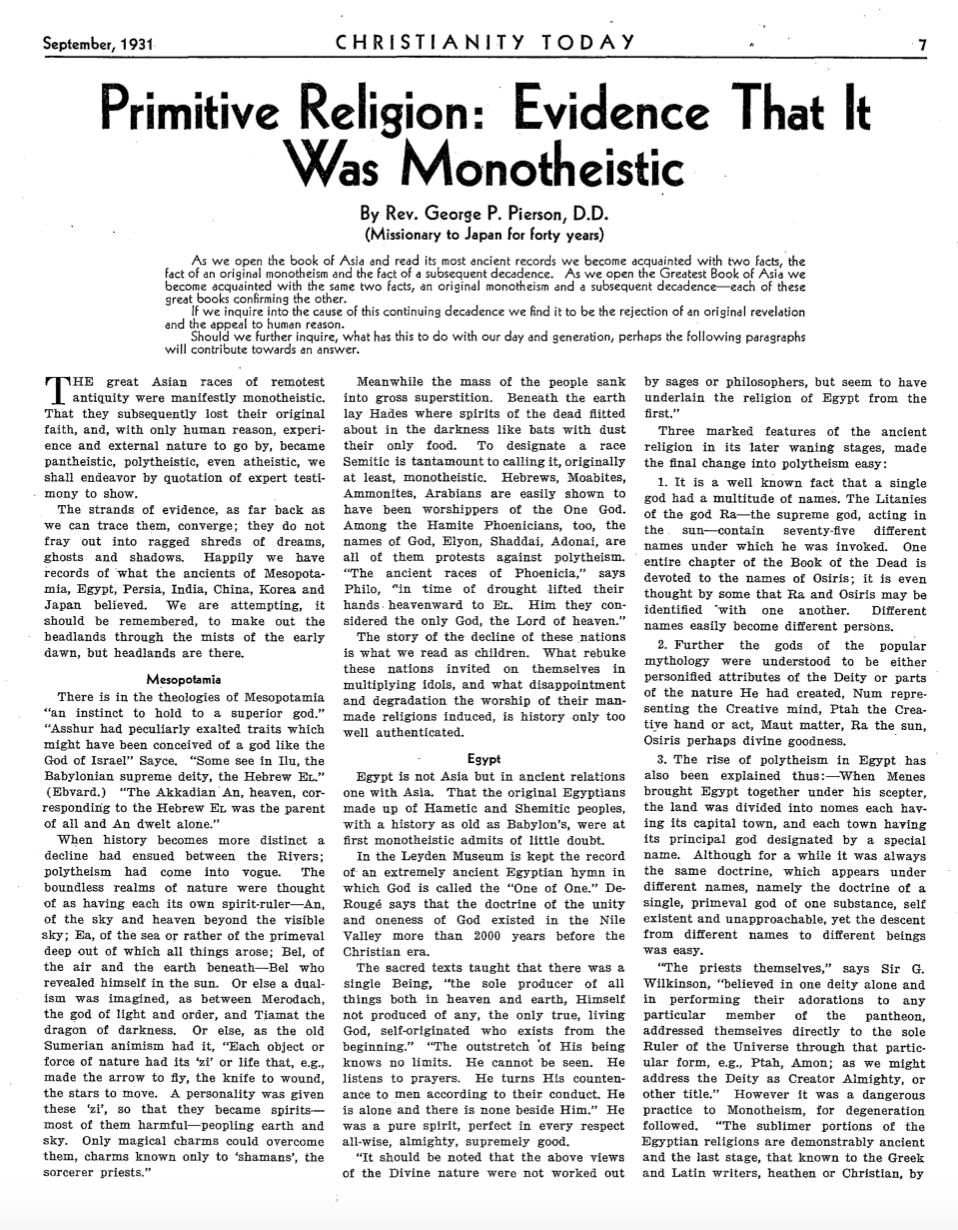
PRIMITIVE RELIGION: EVIDENCE THAT IT WAS MONOTHEISTIC, by Rev. George P. Pierson, D.D.