A Book Review from Books At a Glance
by Matthew B. Tabke
Emmaus Academic and the Aquinas Institute have begun publishing all the extant works of Thomas Aquinas and Augustine in parallel language versions. Having reviewed several of the volumes in the past, I’ll speak briefly about some introductory matters. First, currently all but one of these parallel language editions are the works of Thomas Aquinas. Aquinas was a highly influential theologian who lived from around 1225-1274 AD and is considered the great reconciler of Aristotelian philosophy to the Christian faith. Second, these volumes contain non-critical editions of the original languages they were written in and English translations of those works. For instance, the volume under review contains the Latin of the works it overviews on the left side and the English on the right side. In volumes such as Aquinas’s New Testament commentaries, the volumes contain Greek, Latin, and English versions of the Scriptural text and Aquinas’s commentary in Latin and English below. Third, the only introductory material contained in each volume is a single page detailing where the various texts used came from. The Latin and Greek texts are given a few sentences explaining what version was used, and comments on the English translations of those texts follow. Fourth, the books are beautifully bound with good paper but cost close to $60 each. This means that if a single work is in more than one volume (such as Summa Contra Gentiles printed in two volumes), each volume of the work will cost you $60 unless the works are sold as a group (such as the Summa Theologica).
By way of preliminary assessment, a few things are important to note. The volumes are not critical editions but are still incredibly useful for any scholar who wants to access the original languages of Aquinas’s work. There are no other physical editions I am aware of that contain parallel language versions of Aquinas’s work. The parallel language editions are useful for both those who are attempting to keep up on their Latin and those who need access to the original languages for writing and research. Unfortunately, the works published by Emmaus Academic are quite expensive and they are numerous. Purchasing the entire library of Aquinas will cost well over $1000. The price is however, offset by the quality of the volumes. They are beautiful, sturdy, and likely to last beyond one’s life. It should be noted however, that there is almost no introductory or explanatory material of the works contained within the volumes. The Opuscula I Treatises is the sixth volume I have reviewed in this series and contains by far the most footnotes (a little over 400). While Aquinas does explain what he is writing, the lack of explanatory material by modern authors means any preliminary introduction to Aquinas’s writing must be obtained elsewhere. For a novice of Aquinas, this can make the volumes difficult to navigate. On the other hand, if one is reading Aquinas, they likely know how to obtain any necessary introductory material quite easily.
Now the volume under review is titled Opuscula I Treaties. Presumably there will be several future volumes bearing the name “Opuscula” with a roman numeral, but currently only I and IV are available for purchase. An “opuscule” work is a smaller body of writing such as a letter, a short book, a poem, or a piece of music. The volume under review contains five such works that were not long enough to publish as individual volumes. As the title indicates, these are various treatises Aquinas wrote for a variety of reasons. The five works are (1) Compendium of Theology, (2) On the Principles of Nature, (3) On Being and Essence, (4) On Separate Substances, and (5) On Kingship. Each of these works will be briefly considered in this review.
The first work is the Compendium of Theology. The work is meant to be a summary of the Summa Theologica and like the Summa, was never finished. Compendium is one of the last works Aquinas ever wrote. This detail makes it fascinating to scholars because it contains some of Aquinas’s last words on the subjects it addresses. Aquinas states in chapter 1, “the whole perfection of this present life consists in faith, hope, and charity” (1). These three headings were meant to be the titles of the three sections of the book as Aquinas explains when addressing a man named Reginald, whom calls his “son” (1). Only “faith” and a portion of “hope” are addressed throughout the work, but despite the unfinished nature of the work, many have praised the simplified style of writing. Even as an incomplete work, the book stretches more than 230 pages and contains the careful reasoning readers of Aquinas are familiar with. Aquinas summarizes his thoughts on the divine nature, the Trinity, and a variety of other subjects, thinking through how things must be philosophically for the Scriptures to be true. Concerning Aquinas’s use of Scripture, one will find the references to be fewer and farther between than Summa Contra Gentiles, but he was clearly reasoning by way of Scripture, philosophy, and the Catholic faith. One should note that reasoning through these two avenues means tradition was of high value to Aquinas and so he feels free to explain himself by means other than Scripture at times.
The second work is On the Principles of Nature and is addressed to “brother Sylvester.” Here Aquinas details the philosophical realities underlying our world. Aquinas begins with masterful writing stating how, “some things can be, although they are not, and some things now are” (241). In this statement, he is explaining in a simple manner the philosophical categories of act and potency. A thing that exists is in act and a thing that has not yet come to be is in potency. These concepts explain the twofold nature of existence. Aquinas moves from here to examine the three principles of nature which he suggests are matter, form, and privation. Following the principles, Aquinas details the four types of causes (material, formal, efficient, and final) that give language to the reason things are what they are. Aquinas then deals with the coincidence of causes that make it possible for things to experience more than one cause simultaneously. Finally, the author discusses cause in relation to predication before ending with how we speak of things analogically. The distinctions he draws out in the work are highly important for the discipline of philosophy. This essay will likely serve as a helpful introduction to a variety of philosophical concepts for the novice student. Aquinas speaks clearly, concisely, and carefully about the nature of our world using Aristotelian categories. Little Scripture is used, but if one is hoping for an introduction to philosophical language, On the Principles of Nature is a great aid.
The third work in this book is called On Being and Essence and pairs nicely with On the Principles of Nature. Here Aquinas sets out to explain in plain language what is meant by the terms “being” and “essence.” Aquinas shows how “quiddity” is a substitute for the word “essence,” but that neither “form” nor “matter” are the essence of a thing. Throughout the work, the author interacts with numerous philosophers such as Boethius, Avicenna, Aristotle, and his own Commentary on (Aristotle’s) Metaphysics. The footnotes in the essay offer some explanatory helps, showing especially the modern reference numbers to Aristotle’s works, but they do not seem to be consistently applied to every reference. Aquinas makes no use of Scripture in the essay, but the distinctions he draws out will likely serve as a helpful introduction to a variety of philosophical concepts as with On the Principles of Nature.
The fourth body of writing is called On Separate Substances but is also called On Angels in the translation notes at the beginning of the volume. Aquinas addressed the work to “brother Raynald of Piperno” before explaining his purpose is to “present as best we can the excellence of the holy angels” in writing (285). This work has the most explanatory footnotes by far of the works contained in the volume, thus demonstrating Aquinas’s weighty interaction with other philosophers as well as the inconsistency of applying footnotes in this series by Emmaus Academic. Aquinas writes in his usual nature, reasoning through philosophical concepts and addressing perceived errors while seeking to reconcile his ideas to Scripture. Particularly he begins with a brief overview of philosophers before Plato that reads almost like a history of philosophy, then addresses the opinions of Plato, Aristotle, Avicebron, Origen, and the Manicheans. The final chapter deals with the distinction of angelic spirits which, when coupled to his other considerations concerning spiritual creatures, was part of the reason Aquinas earned the title “angelic doctor.” Aquinas interacts heavily with the writings of the church fathers throughout the work but uses little Scripture until the end.
The final work in the volume is called On Kingship and is addressed to “the King of Cyprus” in two books (357). The author’s purpose in this work is to address the nature of kingship from the Scriptures and the teachings of the philosophers while relying on the help of the King of kings through Whom all other kings rule. This essay will likely be one of the most interesting in the volume to a modern politically minded Western man. In book I, Aquinas addresses what is meant by the name “king” concluding that it is one who rules a city or providence for the common good. He reasons that the rule of one man is more useful than the rule of many because stability will be threatened by the high difference of opinions. Therefore, a kingdom ruled by one king is the best form of government. Alternatively, rule by a tyrant is the worst form of government rather than oligarchy or aristocracy because if a single king is the best form of government, the worst must be a single tyrant. That said, Aquinas suggests the slaying of a tyrant by a private party of virtuous men is not necessarily good because their actions are likely to turn back on themselves and that private party will experience the violence they carried out. Instead, through careful planning, men ought to prepare a man for rule as king so as to instill in him, the values by which he will rule. If a tyrant does rule and needs to be removed, our best recourse is to pray and allow God to remove the tyrant in one of the many ways He is capable of doing. Finally, Aquinas addresses the great reward a king should seek should he reign, noting that spiritual treasures are always superior to earthly.
In book II, Aquinas goes on to address the governmental duties of a king. A king is to be “in his kingdom” like a soul is to be “in the body” and God is “in the world” (387). By these comments, Aquinas means that just as a soul directs the trajectory of the body and God directs the path of the world, so too is a king is meant to direct the movement of the kingdom. Aquinas demonstrates more of his reasoning here by showing how the divine government, which is a kingdom under a king, is meant to model for us that ideal form of government for men. If citizens of heaven are under the divine Kingship of the Lord Jesus, so too ought men to be governed under human kings. Because the king is meant to rule for the sake of the common good, it therefore becomes imperative that he govern by eternal beatitude. In other words, the king is meant to be a heavenly minded individual who seeks to rule from the principles and morals of Scripture. From here, Aquinas ends with four primary governmental responsibilities of a king. It is the responsibility of a king to found a city and make sure it has wholesome air, an abundant supply of food, and a pleasant site. Some of the material in these sections is quite fascinating. For instance, the chapter on wholesome air literally refers to making sure that the location of the city is in a place where it is easy to breath meaning the king ought to take note of such things as the altitude, natural features, and weather patterns around a proposed city site. Another example might be drawn out from the notion that a city should have a pleasant site, suggesting that the city should be built in a beautiful place where life is pleasant so that people will not quickly abandon it, but should not be built in a place that is too beautiful lest men be enticed by pleasures because their senses are dulled. This short work is filled with the meticulous observatory powers of Aquinas’s mind and is one of the easiest essays in the volume to read and understand. Larger audiences will likely find the work pleasurable and fascinating.
In summary, this volume occupies a somewhat unique place. It is hard to recommend it to a particular audience because of the variety of works contained within the book. Students new to philosophy will find the shorter philosophical works On the Principles of Nature and On Being and Essence to be very helpful introductions to some of the terminological distinctions in philosophy. The Compendium of Theology is a helpful shorter version of the Summa Theologica but was left unfinished and so may pose some trouble for those who are hoping for a full summary of Aquinas’s theology. The essay On Kingship is a remarkable work on Aquinas’s view of government but is a particular type of work that doesn’t necessarily fit with the rest. If one is studying Aquinas’s view on angelic beings, they will find On Separate Substances useful. In short, the different works will appeal to various audiences. Therefore, given the expense of the book, the variety of works contained within, and the wide availability of free virtual versions of Aquinas’s writings, it seems more reasonable to suggest this book is for those who would like nicely bound, collectible editions of Aquinas’s writings. The Latin-English parallels are useful for scholarly study, but they are also available on various websites. As such, your need of a book like this will greatly depend on your scholarly needs. The layman will find considerably less value in this work unless they have a strong affinity for Aquinas. My overall suggestion is that a potential buyer consider what works of Aquinas they need exposure to and why when thinking about a purchase. The works contained in this book are valuable and will enthrall the right audience, however, a question remains as to who needs to own a physical copy of this book.
Matthew B. Tabke
Buy the books
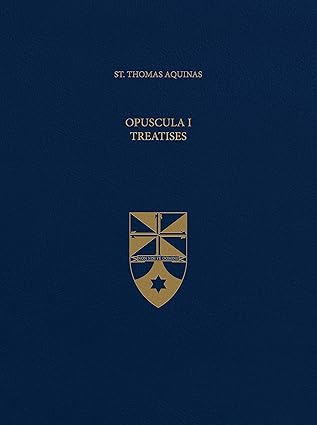
OPUSCULA I TREATISES, by Thomas Aquinas