A Book Review from Books At a Glance
by Matthew B. Tabke
In my review of the fourth volume in this series, I mentioned some important aspects concerning Bavinck’s personal life and the manuscript of Bavinck’s Reformed Ethics. First, Herman Bavinck was a Dutch theologian who had a significant career of academic and political involvement. Much of his career was spent at Vrije Universiteit Amsterdam where he served with Abraham Kuyper. His influence was felt in both the academy and the public sphere. Second, the manuscript of Reformed Ethics was discovered in recent years and appears to be a companion work to Bavinck’s seminal Reformed Dogmatics. Though Bavinck’s Reformed Ethics is an unfinished manuscript, a translation effort was nonetheless undertaken by John Bolt and a team of other scholars.
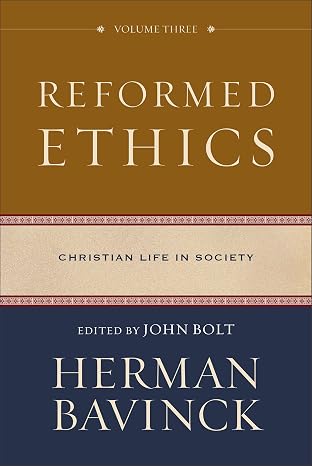
This volume is titled Reformed Ethics: Christian Life in Society. This subtitle appears to have been chosen to deal with the general sweep of information contained in the book. As mentioned above, the preface states plainly, “the manuscript is unfinished” (ix). Bavinck apparently intended his whole work on ethics to have been divided into four “books,” with the last book being unfinished and divided into two English publications by the translation team. In this sense, the English version of volume III is actually the beginning of Bavinck’s “Book IV” with two appendices. The reason for this choice of division has to do with the material Bavinck intended to cover and the unfinished nature of the work which caused the translators to choose a different format. Book IV of Bavinck’s work on ethics was meant to deal with family, society, art and scholarship, state, church, and the kingdom of God and humanity (ix). Because the work was unfinished however, the editorial team opted to collect material from Bavinck’s other works and incorporate it into the sections mentioned in Bavinck’s Book IV outline. This procedure has resulted in two volumes that were based on outlines and filled out with Bavinck’s thoughts on the subjects from his other writings that he was never able to address in his formal Reformed Ethics manuscript.
This “filling out” has resulted in the present volume which contains Bavinck’s material on the family and two appendices titled “Philosophical Ethics” and “Contemporary Morality.” Bavinck left an outline and extensive notes to follow aside from his other works dealing with some of the issues he intended to address. In this way, the work differs from the previous publication Gereformeerde Ethiek prepared by Dirk van Keulen who attempted to edit and annotate the manuscript of Bavinck’s ethics work “as he left it” (xi). While the editorial team who dealt with Bavinck’s ethics work this time around did adopt the approach of van Keulen for some of his work, they also had a fundamental goal of providing Bavinck’s ethical writings for an audience of pastors, teachers, and students (xii). The editors also mention that some of Bavinck’s material may appear dated to the modern reader given as it reflects his thoughts on ethics during the time in which he lived and therefore should be read with discernment.
The chapters of the book consist of about half of the volume’s contents. These chapters deal primarily with the topic of marriage and are titled as follows: (22) Family and Marriage, (23) Qualifications of Marriage, (24) Betrothal and Wedding, (25) Marriage and Family, and (26) Divorce. Bavinck tackles these subjects with a meticulous scholarly approach, drawing out historical interpretation of various Scriptural passages. It is not always clear to a modern reader how difficult the topic of marriage truly is. For instance, is marriage an institution that the church should have authority over and heavy engagement in because it was created by God before the fall, or should it be primarily left to the civil magistrate to deal with the institution of marriage because it is a common grace of God that all human beings are free to experience? Are there particular customs for performing a wedding that are universal and ought to be instituted when the wedding ceremony takes place or is there some cultural flexibility concerning the performance of a wedding ceremony? Furthermore, what are the proper grounds for a Biblical divorce?
Bavinck deals with these questions throughout the work, not necessarily always providing distinct and clear answers on every conversation. For instance, in his chapter on “betrothal and wedding,” Bavinck ends with a section on what takes place after the wedding. After speaking about the wedding customs of his day where couples go on trips and spend the first few nights of their marriage away from home, he mentions that “in the past things were much different and better” (128). The author’s meaning is particularly confusing here because he then proceeds to mention a series of very strange and even sinful past wedding customs detailed by other scholars. These customs include such things as auctioning off a woman of marriageable age, handing women around for sexual engagement by a village until she got a husband, and in some contexts how a woman would give herself sexually to anyone who brought her a present on her wedding night, receiving more honor for the more gifts she received. While these cultural customs are the results of other scholars’ research, the chapter just ends right after these cultural practices are mentioned. Thus, the editors seem to have spoken well concerning the need to read this unfinished manuscript with discernment. One could think Bavinck thought these cultural customs that seem strange and sinful to a modern American were the same customs that Bavinck thought “were much different and better.”
In other places however, the opinions of Bavinck are much clearer. For instance, in chapter 24, after dealing with a series of Biblical passages that speak to marriage, he clearly states, “everyone is duty bound to marry” (23). Bavinck has been building a case that marriage is the norm of human beings throughout the chapter and seems to desire his readers to have a high view of marriage, particularly against the Catholic perspective which tends to exalt celibacy and view sexual contact within marriage as an entirely carnal relationship, void of the Holy Spirit’s presence. Following his position on marriage, Bavinck details the differences between men and women with astonishing precision concerning their physical structure, mental capabilities, and spiritual nature. This section is one of the most beautiful in the book and could provide a much-needed stability for our modern era of sexual confusion. The purpose of Bavinck in providing these observations is again to build a high view of marriage in the Christian mind and draw out the completion of the human picture in the union of marriage. Bavinck states that his observations show “that neither male nor female makes the other sex superfluous…neither alone fully realizes the idea of what it is to be a human being with all its qualities” (26). These very clear statements on marriage and humanity will surely be a great contribution to the conversation surrounding sexuality, gender, marriage validity, and perhaps even human constitution in our modern world.
The book closes with two appendices and an extensive bibliography that Bavinck had amassed. The first appendix is a robust essay with a series of notes and thoughts on the discipline of philosophical ethics. The author introduces the terminology of the discipline before discussing the possibility of philosophical ethics. Bavinck suggests the discipline of philosophical ethics “investigates, assembles, arranges, compares, and explains moral phenomena present in human beings and their world; it describes the rules of human action and omission” (218). He then draws a fourfold distinction between philosophical ethics and Christian ethics demonstrating how the two differ in their intentions. From here, Bavinck speaks about the main forms of philosophical ethics and gives a history of the discipline with evaluations of various thinkers and philosophical theories of ethical practice. These thinkers and theories range from the ancient to those who were somewhat modern in Bavinck’s day. Those who are studying ethics and philosophy will likely find this appendix helpful, though its content is a bit more difficult for the average reader.
The final appendix is focused on contemporary morality and was a document further developed from a lecture Bavinck gave in various places throughout his country. As mentioned above, Bavinck was not only involved in Christian theology, but in the political sphere. Therefore, this essay is written for a more popular audience and omits some of the sources that Bavinck used in thinking through the ethical issues of his day. He first introduces the issue by asking the questions every human ought to be asking such as “what is good? And what is evil?” (328). He then addresses the problem of contemporary ethics facing his society before dealing with the solutions proposed by the moderns of his day. The secularist and scientific worldview has placed ultimate authority for discernment between good and evil in the heart of man and it must be returned to God if a stable society is to be achieved. God’s laws are holy and stem from His holy character. Therefore, there is no definer of morality save the Lord alone.
This book is a helpful work on ethics in the modern world. It is very readable and will serve modern pastors, teachers, and students in thinking through a variety of complex ethical topics, particularly concerning marriage and family. While ethics is not necessarily the topic of choice for a wide readership, the marketing, publication, and author will likely make this work more attractive to a wider crowd than anticipated. It may be that a renewed interest in reading scholarly ethics will stem from Bavinck’s work. The author is an excellent writer who generally states his positions clearly at some point after engaging meticulous scholarly practice. As mentioned already, the work must be read with discernment and it is perhaps true that some of the information will feel dated to the modern reader, but Bavinck’s careful thought is sure to be helpful to a variety of Christians seeking to develop a more robust ethical system.
Matthew B. Tabke