A Book Review from Books At a Glance
by Matthew B. Tabke
Anyone familiar with Herman Bavinck will likely know of his four volume Reformed Dogmatics. John Bolt undertook translation of Bavinck’s monumental work, and the set was released in 2008 for the first time in English. An additional manuscript was recently discovered that seems to be a companion work to Reformed Dogmatics. John Bolt has taken up the mantle of translation once again and worked with the Dutch Reformed Translation Society and Baker to release Reformed Ethics in a subsequent four volume set. These two great projects from one of the most important 20th century thinkers are now available in English. This review is of the final volume of Reformed Ethics.
Herman Bavinck was born in 1854 in Hoogeveen, Netherlands. His father was a minister in the Christian Reformed Church. After his high school education, Bavinck attended the Theological School in Kampen but moved to Leiden to complete his studies to be near Johannes Hendricus Donner who was a prominent preacher in Leiden. In 1880, Bavinck completed a dissertation on the ethics of Ulrich Zwingli at the University of Leiden. A year after graduation, Bavinck returned to the Theological School in Kampen as a professor of Dogmatics. While in Leiden, he assisted in his denomination’s merge with other movements in the Afscheiding (Succession) from the Hervormde Kerk (the denomination of the Dutch royal family). In 1880, Abraham Kuyper founded the Vrije Universiteit Amsterdam (VU, Free University of Amsterdam) and continuously asked Bavinck to join the faculty over the next two decades. Bavinck finally accepted Kuyper’s request and became the Professor of Theology at VU in 1902. Bavinck was educationally and politically involved in the Netherlands until his death in July 1921.
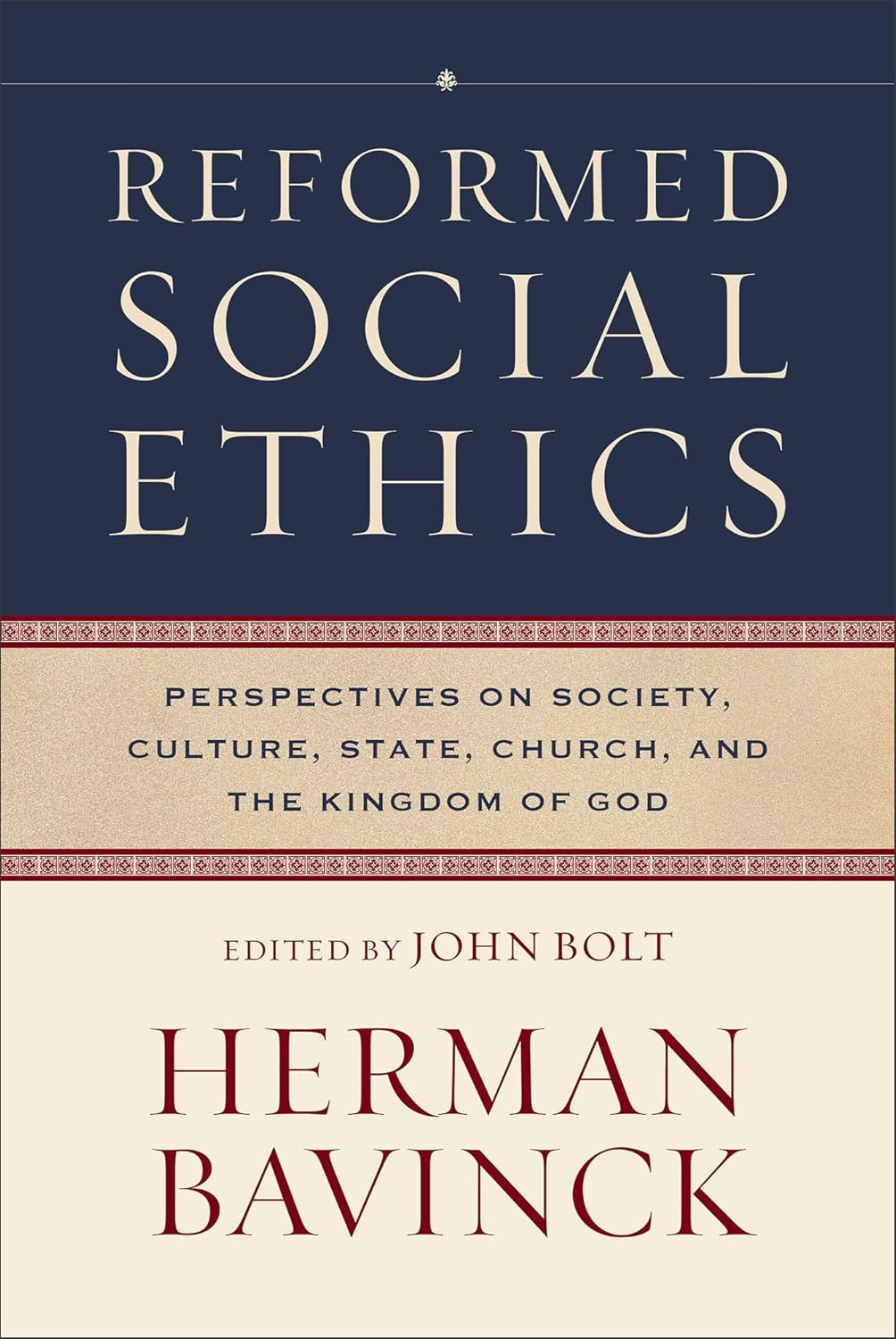
The fourth installment in the Reformed Ethics series is called Reformed Social Ethics: Perspectives on Society, Culture, State, Church, and the Kingdom of God. The five categories in the subtitle represent the five chapters of the book with the only difference being that the “culture” chapter is titled “Art and Scholarship.” In attempting to clarify what this book is, John Bolt states in the preface, “this is not Bavinck’s Reformed Ethics, volume 4, and marketing it as such would have been false advertising” (vii-viii). What Bolt has attempted to do in this volume is set within a narrative framework, several of Bavinck’s ideas concerning the topics in the subtitle. The book is, according to Bolt, a “constructed presentation” of Bavinck’s work and should be read as an “expository interpretation” (viii). Thus, the book functions somewhat like a commentary and somewhat like a story. Bavinck’s own writing appears throughout the work with the ideas connected and contextualized by Bolt’s narrative frame. Font changes clearly indicate Bavinck’s own words versus the commentary by Bolt. Unmarked footnotes belong to the editor, footnotes marked “Bav. note” belong to Bavinck’s original notes, and editor’s notes in other translated works of Bavinck are marked as “ed. note.”
One will notice when reading this book that the chapters are not weighted equally. Bolt has offered a narrative frame to help hold the reconstruction of Bavinck’s thoughts together, but that narrative frame is more or less present depending on the chapter or section of the book one is reading. The first chapter on “society” contains heavy interjection by Bolt, with contextual and narrative comments made on nearly every page. The two appendices, however, consist of a newspaper column on “masters and servants,” and a statement delivered to Christian natural scientists and medical practitioners titled “the right to life of the unborn.” These two appendices are Bavinck’s own words. Heavy framing by Bolt occurs in the chapter on “art and Scholarship” and “the state”; the final two chapters on “the church” and “humanity and the kingdom of God” are almost entirely Bavinck’s own writing.
Bolt claims “the material in this volume is essential for anyone who desires a somewhat systematic summary view of Bavinck’s social ethics” (ix). Bolt is attempting to reconstruct Bavinck’s primary convictions concerning the various categories addressed by the chapters. The idea of reconstruction by Bolt is perhaps one of the most important points to highlight concerning the volume. While much of the material is Bavinck’s own words, the structure of the book is meant to follow an ethics outline that Bavinck left behind. The reason we must understand this book is working from an outline is that some of the material has been pulled from other sources and reproduced within the categories Bavinck intended for his volume on social ethics. As already mentioned, the two appendices in the first chapter are not part of Bavinck’s notes on these topics intended for his volume on social ethics but are writings from a speech and a newspaper column. Bolt indicates his use of other sources very clearly in the chapter on the state where he begins, “Bavinck’s manuscript indicates a planned chapter on the state but provides not a single hint about the intended content” (119). In other words, this chapter on the state is not Bavinck’s formal ethical address of the state in systematic format, but Bolt’s reconstruction of Bavinck’s perspective concerning the state from Bavinck’s other writings on the subject.
The nature of the book need not be cause for alarm by the reader. Bolt has explained carefully throughout the work that the book is not formally Bavinck’s Reformed Ethics volume 4. Instead, readers should understand that the book is a systematic reconstruction of Bavinck’s thoughts on the subjects addressed. These subjects were not chosen arbitrarily but are based off a manuscript outline Bavinck wrote. The subjects Bavinck intended to address are now being addressed not by Bavinck’s original thoughts on these matters, but by Bolt based on the totality of Bavinck’s writings along with some notes contained in the manuscript. Again, it does not seem as though the reader should have any fear of being deceived. The cover of the book does not indicate it is volume 4 of Reformed Ethics and even has a different colored dust jacked than the other volumes. It is perhaps best to think about this book as a companion volume to the first three volumes of Reformed Ethics.
Concerning the content of the volume, Bavinck offers much for the modern reader to consider. Bavinck was one of the most careful thinkers of the modern era and addresses topics cautiously yet clearly. Our modern sensibilities concerning various topics or passages of Scripture will be challenged by Bavinck. The two appendices from chapter one mentioned can serve as examples. Conservative Evangelicals might merrily agree with Bavinck’s perspective on “the right of life of the unborn.” However, we may also become a bit uncomfortable by his essay on “masters and servants” where he suggests texts regarding masters and slaves must be applicable to us today in some way because “if changed circumstances were sufficient for us to dismiss the words of Holy Scripture, then by this same rule, practically the entire Bible would be robbed of its validity” (50). What Bavinck is getting at here is the fact that “Jesus did not come, first of all, to renew families and reform society but to save sinners and to redeem the world from the coming wrath of God,” Jesus “accepts social conditions as he finds them and never tries to bring about a change or improvement in them…He leaves all political and social circumstances and relationships for what they are; he never intervenes in any of this, either by word or actions” (5-6). In other words, Christ’s mission was not to destroy the institution of slavery or elevate women. His mission was not to topple corrupt governments or reduce the amount of poverty. According to Bavinck, Jesus came to save sinners in the midst of a societal structure devastated by sin. Ideas such as these and many others contained within the volume can helpfully challenge the way the modern man views issues such as slavery, equality, Christian interaction with the government, or women’s nature and roles. Bavinck’s thoughts on these issues are careful, consistent, and wise. Many of his ideas may leave us wondering if we have broadened our perspective sufficiently to properly address our modern culture.
Reformed Social Ethics is a helpful volume for our time. Bavinck thought carefully about numerous issues that continue to generate conversation in modern Evangelicalism. He continuously tried to get at the heart of various issues and his thoughts have been helpfully reconstructed in a narrative by John Bolt. This volume will be useful to both the lay-person and the pastor as they consider how to engage with society and culture. The work is easy to read and can even be read as a stand-alone work. I highly recommend Bolt’s work on Bavinck’s Reformed Social Ethics.
Matthew B. Tabke