A Book Review from Books At a Glance
by Michael D. Mock
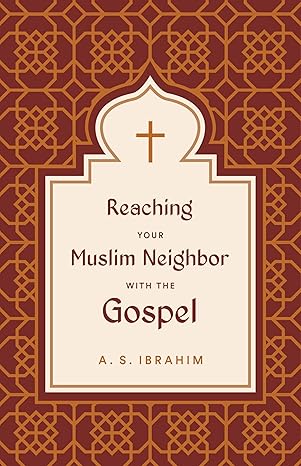
Christ commands his Church to baptize and disciple the nations. But does this call include Muslims? Absolutely yes. But how? This is what Ibrahim’s book is all about. Ibrahim shows the way, as he digs from the deep wells of his personal interactions both with Islam as a system and with Muslims as real persons of various stripes. Ibrahim structures his twelve chapters into two equal and major sections: Understanding Muslims and Islam, and Tools for Evangelizing Muslims.
Part 1: Understanding Muslims and Islam
Ibrahim opens with his own personal experience. He was never a Muslim but instead grew up as a Christian. However, his context differs from that of most Christians to whom he is writing. He grew up in Egypt and “was regularly surrounded by Muslims” (9). He grew up interacting with Muslims, and his home church looked for ways to engage evangelistically with these lost souls. From the very start of his book, Ibrahim displays an infectious optimism, or biblical hopefulness, even saying, “This is a great day for Muslim evangelism” (11). Knowing that many of his readers may not initially share this hope, Ibrahim rests his hope in the sovereign love of God, the power of prayer, and the increasing Muslim disillusionment with Islam and its teachings. Before Ibrahim can help us to engage wisely with Muslims, he teaches his readers about Islam and Muslims.
To lay the groundwork, Ibrahim contrasts Islam versus Islams, highlighting that Islam is not monolithic despite the official pronouncements of many Muslims. Similar to Christian expressions, there are theologically and politically radical Muslims, conservative Muslims, and liberal Muslims. This diversity tends to manifest in different geographical regions. For instance, Islam in the West is less radical, more open to conversation, and less willing to attack its opponents. In fact, Ibrahim labored to highlight how open so many Muslims are to religious conversation. This experience is, ironically, quite different from most (“Enlightened”) Western contexts, in which the two topics off the table of conversation are religion and politics. Muslims embrace these conversations. Ibrahim noted regularly that if we don’t initiate gospel conversations, Muslims will make sure to bring up religion. This is encouraging, since many of us wonder how to begin or transition a conversation into matters of eternal weight. In this sense, evangelism with Muslims may be easier than with other groups. Just talk with a Muslim, and the conversation will naturally provide an opportunity to discuss eternity.
Throughout Part 1, Ibrahim seeks to remind the reader of Christ’s love. This will actually be the emphasis of his gospel-conversations with Muslims. Ibrahim wants us to see, or even recapture, God’s love for Muslims. Ibrahim knows how American Christians may hesitate to have love for Muslims because of what’s been done to our nation in the name of Islam. Nevertheless, leading with God’s love for humans in Christ opens the door to conversations. Moreover, the power of prayer is shown forth time and again in this book, both in instruction and illustration. Ibrahim fills the pages with teachings, testimonies, anecdotes, and illustrations of how God moved conversations and apparently chance encounters to put a rock in a Muslim’s shoe, or to change a Muslim’s heart entirely. It was truly encouraging to read about the many lives God has changed from Islam to Christ, and still the souls that God keeps working on.
Before closing out Part 1, Ibrahim informs our minds of the Muslim mindset. The Islamic worldview emphasizes submission, theocracy (a state-religion unity), communal unity, and Islam’s pursuit of hegemonic superiority. Islam promotes the oneness of God, the path of jihad, and the (disheartening) teaching of uncertain salvation. There are superficial similarities between Islam and Christianity, but upon closer inspection, the two religions differ significantly. This is demonstrated in Ibrahim’s pages through instruction but also a sample dialogue between a Christian and a Muslim (80-81).
Part 1 is a helpful summary of a Muslim mindset. There was one glaring omission, in my estimation. There was no chapter or section on the basic beliefs/tenets of Islam, and here I have in mind the Pillars of Islam. True, some of these worldview commitments were discussed, but the reader would have been helped with a clear, concise summary of the basic beliefs of Islam. He does offer this summary in other books on Islam, but it would not have been difficult to include a summary in this literary contribution, and readers would have appreciated a succinct treatment without having to consult another book.
Part 2: Tools for Evangelizing Muslims
With the worldview foundations laid, Ibrahim fills the next half of his book with tricks of the trade, tips for one-on-one, same-gender evangelism. How do we communicate the gospel to Muslims? Chapter 7 is devoted to the essential elements of a gospel proclamation. The major components are all there: God’s initiation to save sinners, the sinfulness of humanity, separation of sinners from a holy God, Jesus Christ as truly God and truly man as the only way to God, and a call to repent of sin and turn to Jesus Christ for salvation. Ibrahim leans heavily on God’s love for Muslims to draw them to Christ, especially since the attribute of love is absent from Allah’s 99 attributes. Based on his remarks, Ibrahim seems comfortable where others may not be in saying that Jesus loves and died for Muslims. In truth, Jesus does love, and he did die for Muslims, praise be to God. Ibrahim, if I’m reading him correctly, appears to have no problem connecting that love and the death of Christ to all Muslims to whom Ibrahim would speak. Here is where some may part ways and choose instead to speak of God’s love for humanity more in general terms (a la John 3:16). At any rate, Ibrahim has found one-on-one conversations with Muslims to be best carried out with a shared meal. This setting is more relaxed, informal, and lends to open dialogue. Again, prayer is a must, and Ibrahim spends an entire chapter on the blessing and heart-transforming power of intercessory prayer. Christians must not neglect this spiritual discipline for the salvation of Muslims. For this emphasis, Ibrahim’s book must be commended.
When I started the book, I wondered if Ibrahim would address the possibility of God reaching Muslims through dreams. Thankfully, he addresses this feature of evangelism with Muslims (112-116). Ibrahim attempts to strike a balance between validating the experience of many Muslims who recount appearances of Jesus in dreams or visions, and the only way people come to Christ: the hearing of the gospel and the receiving and resting on Jesus Christ alone for salvation (cf. Romans 10). Ibrahim appears more comfortable accepting these experiences than others may be, but it was enheartening to read of his firm commitment to hear and accept Jesus. For example, he writes, “Thus, a dream may introduce Muslims to Christ or call them to follow him, but salvation is by hearing, accepting, and responding to the gospel” (114). Why not throw these dreams out and view them entirely as illegitimate? Fascinatingly, Muslims highly value dreams, and they often base life-altering decisions on them (115). Of course, in some communities, Christian missionaries are few or prohibited, but God has his ways of getting to Muslims when the laborers are few or forbidden.
Chapter 9 is full of questions we can ask Muslims. It was useful to know that Muslims are not offended or attacked when asked questions. They appreciate them. We should be urged to ask questions, and Ibrahim supplies the evangelist with many questions. Chapter 10 highlights particular stories and parables of Jesus that facilitate conversation with Muslims. He leads us to Scriptural paths to walk on with our Muslim friends. Chapter 11 warns us to avoid some of the major pitfalls evangelists tend to fall into when conversing. Ibrahim urges us not to be competitive, not to be intimidated, not to chase rabbit trails, not to get angry, and not to force a decision/conversion (143-146). Ibrahim appreciates our zeal, but he hopes we can evangelize with zeal and wisdom. Chapter 12 continues that theme of wisdom, as he urges us to tread carefully when we bring up the Quran and the prophet Muhammad. Both are essential to Islam, and they can be rather incendiary topics of conversation. To deny the inerrancy of the Quran and to reject the prophethood of Muhammad are fundamental to Christianity, but given their hot-topic nature, addressing these two matters requires much patience and wisdom. Ibrahim offers many ways to handle these sensitive subjects.
Like me, some may be tempted to dismiss his “Final Thoughts” (163-167), thinking Ibrahim has given his readers more than enough to chew on in the preceding pages. To give in to that temptation is a mistake. Here he offers eight more tips. They all help us in navigating conversations, how not to put our foot in our mouth, how to keep the conversation going, and what to emphasize. Finally, true to his heart, his book concludes in a prayer to our Father, a prayer we should pray for ourselves and the souls of Muslims that God brings our way.
Final Remarks
I’ve personally read only a handful or two of books on apologetics to Muslims, but this book is a practical, mind-informing, and heart-warming contribution. Of the books I’ve read, this is arguably the most practical in terms of the how-to of conversations. It’s not heavy on doctrine, but it’s heavy on encouraging illustrations and tools. I don’t think some of my theology aligns with every point that Ibrahim makes, but this mild misalignment was no roadblock for me. His counsel and tips are easily adaptable based on the positions of God’s evangelists as we drive the gospel into the hearts and lands of a lost people. Not a hard read, but a hearty recommendation.
Michael D. Mock