A Book Review from Books At a Glance
by Osbert B. Wei
There is wisdom in learning from those who have gone before you. To improve at a sport, it is wise to hire a coach. When buying something new, it does not hurt to ask others if they have any recommendations from their prior experiences. For those new to pastoral ministry, it is especially wise to learn from pastors who have decades of ministry experience. Jason Allen’s three-volume series, Letters to My Students, is an excellent resource for those interested in learning about the ins and outs of pastoral ministry, everything from sermon preparation to leading wedding ceremonies. Drawing on his many years of pastoral experience, and his current experience leading Midwestern Baptist Theological Seminary, Allen provides counsel to new ministers and encouragement to long-time ministers needing a fresh wind blown into their spirits. Allen’s counsel is very readable, a blessing to those not looking for a dense or complicated read.
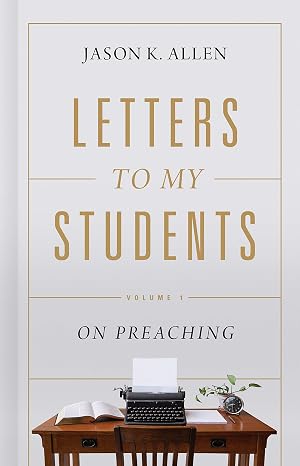
Allen’s first volume, On Preaching, is divided in three sections: (1) Preparing to be a Preacher, (2) Preparing Your Sermon, and (3) Growing in Your Preaching. To begin, the preacher’s call to preach must be assessed. I have heard it said before regarding pastoral ministry, “If you can find anything else to do, do that instead.” The call to be a preacher is a weighty matter, and the young man evaluating his suitability for the task should approach it with seriousness. Allen proceeds to contend for expositional sermons, counseling the developing preacher to trust that God’s Word can speak for itself. Allen writes, “Biblical exposition lets the text speak, which lets God himself speak” (p. 46). By preparing expositional sermons, the authority of God’s Word is respected, and the preacher’s ministry is simplified. In the same vein, the preparation of the sermon should be driven by the need to understand the text in its context. Allen reminds his readers, “Remember, a text cannot mean something now that it never meant” (p. 67). As the preacher studies the text during his sermon preparation, the sermon outline can be shaped. The use of illustrations, a strong introduction and conclusion, intentional transition sentences, and key words stem from the main point of the text being preached. Expository sermons can be delivered differently, depending on the preacher’s personality and context, but the meaning of the text must remain the same. Allen concludes his first volume by encouraging preachers to always be growing. The Apostle Paul exhorted Timothy, “ Preach the word; be ready in season and out of season; correct, rebuke, and encourage with great patience and teaching” (2 Tim 4:2, CSB). Preachers can grow in their personal study, discernment of when and how to address a cultural issue, and their zeal for the Great Commission (Matt 28:18-20). Ultimately, preachers are stewards of what God and others have invested into their lives, so they must not waste what has been invested in them for gospel ministry.
Allen’s second volume, On Pastoring, is a practical treatment of the life of a pastor. In twelve short chapters, Allen expresses his admiration for pastors, their high calling and level of accountability, and provides guidance on aspects of church ministry such as church membership, administering the Lord’s Supper, conducting baptisms, and officiating weddings. Much of Allen’s discussion of study and sermon preparation echoes what he covers in his first volume on expositional preaching, reinforcing his commitment to teaching preachers the need to preach the text. Although, while pastors are typically viewed as merely preachers, Allen instills courage in his readers by teaching them that they are the worship leader of the congregation. The pastor should approach planning Sunday services with seriousness. Allen writes, “Sunday morning is the one hour a week the pastor must get right…For the pastor, every Sunday is Super Bowl Sunday” (p. 110). A pastor is the leader of his flock, and how the pastor carries himself will have a trickledown effect to the congregation. Accordingly, the pastor must stay faithful and lead himself in accordance with Scripture. Allen’s second volume is a helpful guide for reminding pastors of their biblical duties and a manual for strengthening their work.
Allen’s third and final volume, On Life and Doctrine, is a selective look at key principles that must drive the preacher’s family and ministry. Allen emphasizes the importance of holding to Scripture’s inerrancy and sufficiency, the need to stand firm on the exclusivity of Christ for salvation amidst a culture that teaches unbiblical ideas (especially regarding anthropology), and the need to rest in God’s sovereignty. Allen then reminds his readers to cherish their family and their church, all the while implementing the spiritual disciplines in one’s personal life. While being caught up in ministry to the church, it is easy to overlook ministry to your family and not spend quality time with them. However, ministry to the family precedes ministry to the church. Paul writes to Timothy, “If anyone does not know how to manage his own household, how will he take care of God’s church?” (1 Tim 3:5, CSB). Furthermore, Allen honestly discloses it is easy to be discouraged when trying to love the church, considering there are some difficult and draining people in it. But God’s plan is the church (Matt 16:18). Allen writes, “In Scripture, we see a straightforward reality: a call to the ministry is a call to ministry in or for the church. The church isn’t a setting for your ministry or a platform for your ministry, it is your ministry. The members of a church aren’t beneficiaries of your ministry, they are your ministry” (p. 138). Allen concludes his book by encouraging preachers to heed Paul’s counsel: “Preach the word; be ready in season and out of season” (2 Tim 4:2a). Despite what culture thinks about the pastor, he must continue to preach God’s Word, whether he feels like it or not.
As one who is going into the ministry, I devoured Allen’s books. I could not put them down. His discussions on expository preaching, the importance of being present with church members in difficult times, the challenge to cherish your family and church, and so much more, leaves me grateful to have picked up his three volumes as I learn how to be a faithful minister of the gospel. While Allen’s chapters may leave you wanting more at times, the brevity of his writing is still a great benefit for those looking for an introduction or refresher to the biblical foundations of pastoral ministry. After reading Allen’s books, I am left wanting more, but perhaps that is not a bad thing. Pastors must be life-long learners, and Allen’s work has encouraged me to continue learning about the ins and outs of ministry. I am confident his work will encourage you as well.
Osbert B. Wei