A Book Review from Books At a Glance
by Osbert B. Wei
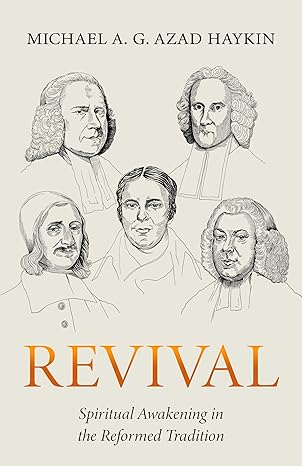
As a PhD student preparing to write my dissertation, I was privileged to read Revival by Michael A. G. Azad Haykin. Haykin’s book is suitable for academics, pointing researchers to crucial resources in the Reformed tradition, and applicable to all Christians, calling them to fervent prayer because prayer precedes revival. While Revival is an exhortation to all Christians, those less academically inclined may encounter difficulties understanding the immediate application to the contemporary church from this study of revival in the Reformed tradition. Nonetheless, Haykin’s brief treatment of revival will whet the appetite of Christians seeking renewal in the present age.
Haykin attempts to provide a template, or guiding principles, of revival by studying two revivals in the eighteenth century: “the transatlantic Great Awakening in the mid-eighteenth-century Anglo-American world and the revival of the Particular Baptists in the British and Irish archipelago” (p. xi). Accordingly, the book is divided into two parts, each examining one of the respective revivals, its key figures, and the need for revival at the time.
In chapter one, Haykin recounts the longing for revival during the Reformation and the English Puritans. The Puritans believed in the Holy Spirit’s necessary work in all aspects of their lives, especially revival (p. 2). Haykin portrays four accounts of revival in the Puritan era, showing various Puritans’ prayerfulness and faithful ministries. Despite the occurrence of revivals in the Puritan era, the Puritans longed for something more. However, they would not witness the desired nationwide revival in their time (pp. 11-15).
Chapters two through five detail the need for revival among the British in the eighteenth century and study three key individuals during the Great Awakening: George Whitefield, William Grimshaw, and Jonathan Edwards. The eighteenth century witnessed the birth of the Enlightenment, a time which elevated human reason to the extreme, lacked reverence in the church, and experienced widespread sin in society. Additionally, the Church of England marginalized the Puritans, spiritual leaders at the time labeled “Nonconformists” (p. 22). While the era was dark regarding lifestyle and the sidelining of the Puritans, it was also filled with revival, specifically in Wales and Scotland. Haykin proceeds to provide his short studies of three individuals:
- Whitefield was a powerful, open-air preacher who had been accused of being overly enthusiastic in his preaching. Nevertheless, Whitefield taught thousands of times from the time of his conversion to his death. Haykin provides four conversion stories to illustrate the power of Whitefield’s teaching, including the story of Robert Robinson, who wrote “Come, Thou Fount of Every Blessing” (p. 48).
- Grimshaw, though a less familiar revival leader, ministered at the same time as Whitefield and John and Charles Wesley (p. 62). Haykin examines the conversion of Grimshaw, a minister’s life formerly characterized by godlessness, to a preaching ministry driven by justification by faith in Christ alone. John Owen’s book on justification served a major part in reviving Grimshaw’s dead spirituality, even causing heat encounters, “an uncommon heat” Grimshaw physically experienced when opening Owen’s book (pp. 59-60).
- Edwards deeply loved and meditated on God’s Word. He preached at a time when material wealth and godlessness were the norm (p. 77). Once named “The Theologian of Revival” by Martin Lloyd-Jones (p. 69), Edwards faithfully preached the Scriptures, specifically justification by faith, leading to the First Great Awakening (1740-1742) (p. 80).
Like the book’s first part, chapters six through nine establish the need for revival among the Particular Baptists and examine two individuals who uniquely contributed to the revival: Andrew Fuller and John Sutcliff. Before detailing the revival among the Particular Baptists, Haykin highlights Edward’s book A Treatise on Concerning the Religious Affections (1746), a book he claims is “one of the richest books on Christian spirituality” in church history (p. 87). Further expressing Haykin’s appreciation for Religious Affections, he states, “In [Religious Affections] we find Edwards’s most exhaustive and penetrating expositions of the nature of true Christian spirituality, a spirituality in which both heat and light are vital, and a spirituality that is rooted in Scripture” (p. 88). Then, Haykin summarizes Edwards’ twelve signs of a true, biblical revival (pp. 83-98).
The Particular Baptists proliferated in the 1700s (p. 99). However, the Church of England persecuted them for not following their laws (p. 100). Due to their convictions of tethering to Scripture, the Baptists were challenged to reconcile the state and local churches, as depicted in the New Testament (p. 107). Despite these challenges, Haykin notes the spiritual vitality in these times, preparing for a revival by God soon to come. Studies of Fuller and Sutcliff follow:
- The impact of Fuller in Baptist history deserves further study. Fuller advocated for countering the High Calvinistic teachings of his day, a belief that emphasized God’s sovereignty in saving individuals at the expense of church evangelistic efforts. Haykin writes, “it was through [Fuller’s] rebuttal of High Calvinism that made his most distinctive contribution to the revival of the English Particular Baptists” (p. 116). Additionally, in response to Baptist congregations who were content with forming healthy churches and meeting the minimum requirements to get into heaven, Fuller challenged churches to missions and evangelism, the need to call all sinners to repent and convert to Christ.
- Sutcliff, a Baptist and friend of Fuller and the missionary William Carey, contributed to Baptist revivals through fervent prayer. Sutcliff passionately modeled the truth that prayer precedes revival (p. 138). Even though God powerfully used Sutcliff and his prayer movement, Haykin recounts how even Sutcliff regrets not praying enough throughout his life (p. 146).
Haykin concluded his book by providing eight theses on revival (pp. 147-149):
- The History of the Church is a History of Revival and Times of Declension.
- Revival Is a Work Grounded in the Sovereignty of the Holy Spirit.
- When God Determines to Revive His Church, He Begins by Stirring up His People to Pray for What He Will Do.
- Times of Revival Are Attended by a Solid Commitment to the Bible as the Word of the Living God, Infallible and Unerring.
- Genuine Revival Is Always Attended with Faithful Preaching of the Scriptures.
- Revival is Accompanied by Theological Renewal, for the Holy Spirit Is Ever the Spirit of Truth.
- Spirit-Wrought Revival Always Impacts the Societal Context of the Churches That Are Being Renewed and Revitalized.
- Revival Is a Christ-Centered Experience.
Haykin’s book provides researchers with a wealth of resources for further study and passionately calls Christians to fervent prayer. Though researchers like me are better suited to read Haykin’s historical treatise, this book is a powerful reminder that the same God who responded to the prayers of his people in the eighteenth century desires to breathe fresh life into the church today (p. 147). Per Haykin’s intent to “stoke the passion, as it were, for the presence of Christ’s Spirit of revival” through this book study of two revivals in history (p. xi), twenty-first century Christians must fervently call upon the Lord in prayer if they desire to witness revival in the church. One does not need to be a researcher to understand that.
Osbert B. Wei