A Book Review from Books At a Glance
by Patrick Sawyer
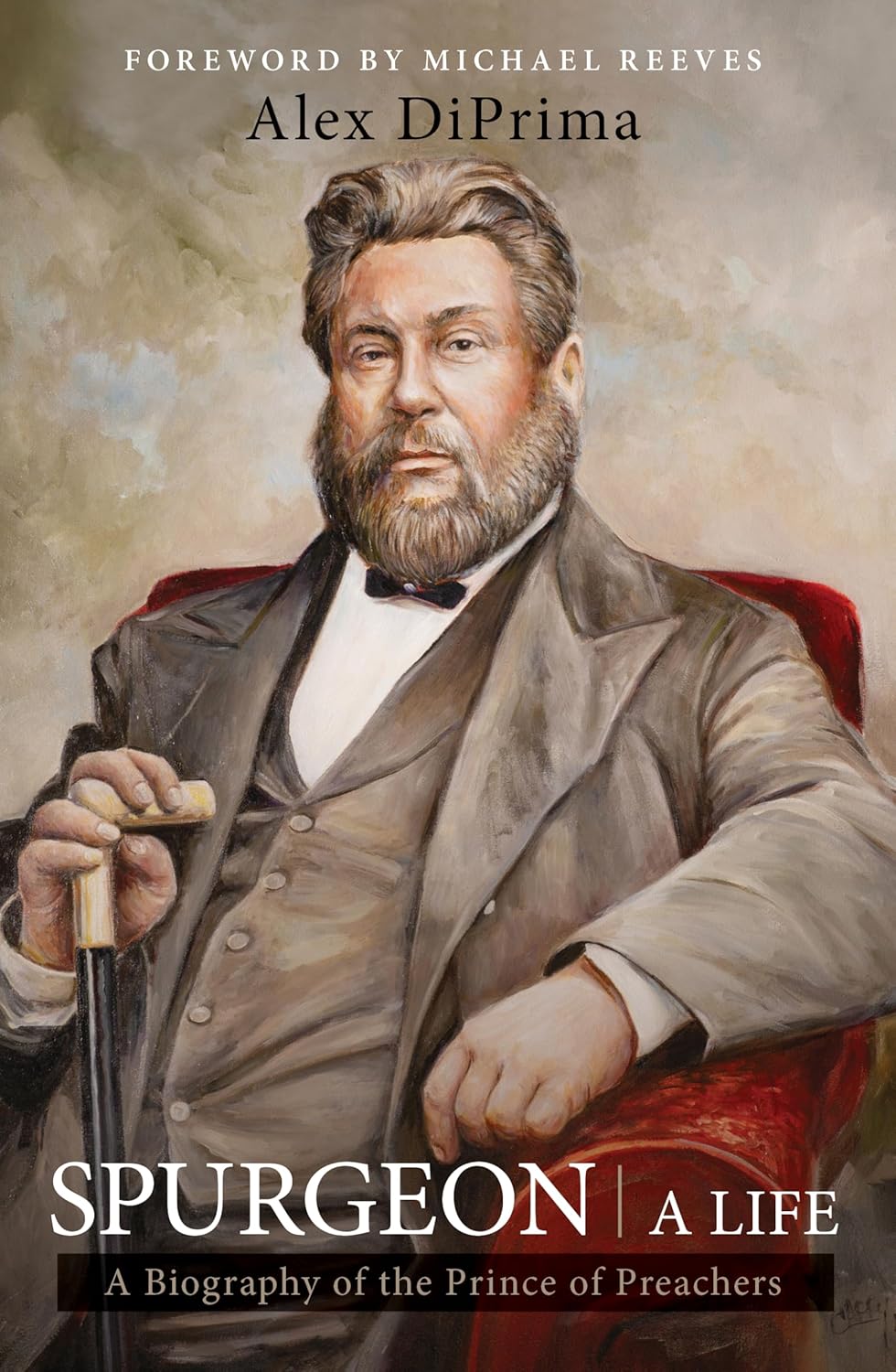
I recently was able to visit London and the Metropolitan Tabernacle. Even though it is not the original building, it still has the scent of the former pastor Charles Haddon Spurgeon. Above the pulpit are the words, “Look unto me and be ye saved all the ends of the earth.” This was the life and ministry of Charles Spurgeon. He was always looking unto Jesus Christ and he was always pointing people to Jesus. If you are a Baptist, reformed, both or just a Christian, chances are you have heard of Charles Spurgeon. When it comes to the history of Baptist preachers, Spurgeon might be the most well-known and admired among Christians today. Alex DiPrima states, “Spurgeon is a figure who towers over many others in the long line of godly men throughout Christian history. His storied preaching, copious writings, and millions of devoted followers are a testament to his extraordinary legacy. One need only consider some of the astounding statistics related to his life and ministry to appreciate the singular place Spurgeon holds among church history’s greatest preachers” (3). In Spurgeon: A Life, author Alex DiPrima seeks to provide a new portrait of the life and ministry of Charles Spurgeon by providing more accurate facts about his life and ministry as well as provide new studies and data that are now available (16).
As someone who has read numerous biographies on Charles Spurgeon, why would I highly recommend (and I do) this new and excellent biography by DiPrima? Because DiPrima does a great job of providing a quick and concise snapshot of the life and ministry of Spurgeon. If you want to learn about Spurgeon or want to learn more about him, you can read numerous Spurgeon biographies (which there are a lot of great ones), or you can read DiPrimas and I feel you will put the book down having a good understanding of Spurgeon’s life and ministry.
DiPrima does an excellent job of providing a quick snapshot of Spurgeon’s life and ministry. His ministry really began around the age of 5 or 6 when he began consuming the thoughts of the Puritans. He started preaching at the age of 15 and started his first pastorate at 17. Spurgeon’s preaching was very powerful and attractive, which led to the growth of every church he would pastor. DiPrima states, “During his lifetime, Spurgeon was estimated to have preached to over ten million people” (5). Spurgeon was very passionate about serving the community, caring for orphans, raising up pastors, and planting churches. Spurgeon also published roughly 150 books, a monthly magazine called The Sword and the Trowel and now there are over seventy volumes of his sermons published. If you summed up Spurgeon’s life and ministry in one word it would be Christ. He loved Jesus and was very passionate about pointing people to Christ. He had a deep desire and love for lost people to come to know the gospel of Jesus Christ and be saved. He was a preacher devoted to one message – the good news of the gospel of Jesus Christ. Personally, he was devoted to God’s Word, prayer, godliness and good works. DiPrima states, “In over forty years of public ministry, he lived entirely free from any form of moral scandal, and in 130 years since his death, his faithfulness testimony has never been stained or brought into disrepute” (11).
DiPrima does an excellent job of revealing highlights and joys of Spurgeon’s life and ministry, which was filled with lots of joy. One of the greatest joys of his life was his love of and marriage to Susie Thompson. They met in 1853 and were married on January 8, 1856. Susie played a large part in his life and ministry. One of her greatest accomplishments in ministry was starting a book fund. Susie would send young pastors excellent study material to help equip them for ministry and preaching. Spurgeon had a powerful preaching ministry. His preaching was Spirit-led and Christ-centered. DiPrima reveals “His preaching attracted scores of people from all over London who were eager to hear the gospel preached as they had never heard before” (83).
During Spurgeon’s ministry, he had a passion for serving the community. In 1867, he started the Stockwell Orphanage for orphan boys and girls. DiPrima states, “By the 1880s, the total number of active ministries operating out of the Metropolitan Tabernacle reached sixty-six. They included ministries that provided education for children, subsidized housing for widows, care for the disabled, food for the hungry, clothing for the needy, and evangelistic outreaches to the lost” (246.).
Spurgeon was passionate about raising up pastors and church planting. During his ministry, he planted 187 churches across Britain. By the time of his death, almost half of the churches in London were founded by Spurgeon (197). In 1857, Spurgeon started the Pastors’ College, which was created out of his desire to raise up men for future ministry. From the start of the college until his death, he trained up 863 men. By the time of his death, these graduates made up around 20 percent of all Baptist ministers in England and Wales (184).
DiPrima also does an excellent job of revealing the hard times and sorrows of Spurgeon’s life and ministry. He suffered greatly during his lifetime. He suffered from chronic kidney disease, which would eventually be the main cause of his death in 1892. He suffered from gout, causing him bouts of severe pain. DiPrima states, “These twin trails of kidney disease and gout frequently forced Spurgeon out of the pulpit and required him to pursue seasons of extended rest and recuperation” (213). Spurgeon also suffered from depression. Spurgeon’s darkest days were not the result of his physical ailments but from his spiritual depression.
Spurgeon also suffered great hardships during his ministry. The first hardship DiPrima focuses on took place early in Spurgeon’s ministry. In 1856, the New Park Street Chapel decided to build a large, more accommodating building, which would become the Metropolitan Tabernacle, but while the church was being built, they decided to move their services to a local music hall. During the first service on October 19, 1856, as Spurgeon was preaching there were multiple shouts of “fire”, which led to chaos and people rushing out of the building. This would eventually end with 7 deaths and twenty-eight injured. This tragedy would plunge Spurgeon into a deep depression and cause him to experience panic attacks, which almost forced him to quit the ministry.
The second hardship DiPrima reveals is the Downgrade Controversy. This controversy would put Spurgeon against the Baptist Union as well as evangelical circles broadly. Spurgeon fought against what he believed was doctrinal errors creeping into these circles. DiPrima reveals there was an influence of new scientific theories and liberal theological movements (252). Spurgeon also fought against severe doctrinal errors, such as the denial of the inspiration and infallibility of Scripture, the denial of the substitutionary nature of Christ’s atonement, the denial of eternal punishment, as well as the affirmation of universalism (258-259). The result would lead to Spurgeon resigning from the Baptist Union. Some believed he never got over this controversy and they also believed his health suffered from it.
I would highly recommend Spurgeon: A Life for anyone who wants to learn about or more about Charles Spurgeon. DiPrima does a great job of providing a quick but very concise snapshot of the life and ministry of Spurgeon. I believe he does an excellent job of taking you through a historical tour of Spurgeon’s life: his early life, his conversion, his call to ministry and his death. He also takes you on a tour of his ministry: his preaching, pastoral ministry, his passion for evangelism and the Great Commission as well as his ups and downs.
DiPrima does an excellent job of revealing how the life and ministry of Spurgeon have encouraged and impacted Christians throughout history. He states, “Throughout the generations of the church, many Christians will highly esteem him for his searching and penetrating preaching, for his evangelistic zeal, for his earnest devotion, for his vigorous experimental piety, for his pastoral tenderness, for his compassionate benevolence, for his moral courage, for his undaunted leadership, for his unflagging integrity, for his unshaken conviction, for his evangelical catholicity, for his warm love for family and for his faithful witness to the end. He was indeed, a burning and shining lamp” (288).
DiPrima also does a great job of helping Christians and ministry leaders learn how to navigate the ups and downs of the Christian life by looking into the life and ministry of Spurgeon and how he was able to embrace both the hard times and great times through his faith and trust in Jesus Christ. No matter what happened in Spurgeon’s life and ministry, good or bad, his faith and trust were always in the Lord Jesus Christ. Philippians 4:11-13, “Not that I am speaking of being in need, for I have learned in whatever situation I am to be content. I know how to be brought low, and I know how to abound. In any and every circumstance, I have learned the secret of facing plenty and hunger, abundance and need. I can do all things through him who strengthens me.” Paul tells us not to be content with our circumstances, good or bad, but to always be content in Christ. This was the life and ministry of Charles Spurgeon and this is a good example of how we are to live our lives as Christians—always being content with Christ.
Patrick Sawyer