A Book Review from Books At a Glance
by Ryan M. McGraw
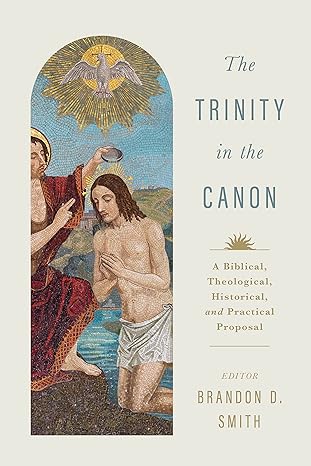
Thankfully, the recent growing appetite for Trinitarian theology appears unabated. However, Trinitarian dogma is the church’s attempt to express who the God of Scripture is. While deep historical studies of Trinitarian theology and recovering precise distinctions clarifying the doctrine against errors are becoming legion, believers need to recover the biblical foundations of Trinitarianism as fully as possible. Studying Scripture without dogma handicaps our ability to see who God is, but studying dogma without Scripture risks turning sound doctrine into extra-biblical tradition. The bulk of the fifteen chapters in this volume draws readers through the biblical witness to the Triune God, both instilling confidence that the Trinity is integral to the Christian Bible, and demonstrating why the Trinity is the heart and soul of the Christian gospel. Though devoting little attention to the Old Testament, this volume takes a great step forward in bringing classical Trinitarianism back into conversation with the biblical witness.
Sometimes multi-author volumes are markedly uneven in quality. In this case, however, all the essays harmonize well, offering solid and unified content. The editor even notes that every author couched his or her contributions in classical Trinitarian categories independent of the editor’s plans (2). Setting the tone for the book, the two essays in part one (Bray and Pierce) trace the nature of Trinitarian thought in the early church and in modern scholarship. Comprising the bulk of the work, chapters three through twelve explore the divine revelation of the Trinity progressively through the canon of Scripture. Pierce, in a way, sets the tone for the book by reducing all approaches to the Trinity into Augustinian and Thomistic categories, which she takes to mean arguing towards the Trinity through the canon versus arguing from the Trinity to everything else. These approaches, however, are complementary rather than competitive, and subsequent chapters alternate between them. Though condensed into a single chapter, Heath Thomas’s contribution on the Trinity in the Old Testament (ch. 3) offers a useful hermeneutical guide to learning what to look for in relation to signs of an exegetical pressure towards the Trinity in the OT (74-75). Going beyond key authors like Fred Sanders and Scott Swain, he seeks to give readers a clearer path towards an OT Trinitarian view than many recognize (72). The OT thus “veils and unveils the Triune identity and attributes of God” (82). Chapter four, on Matthew, starts with credal reflection and then explores Matthew’s witness to the Trinity (84), thus following a Thomistic rather than Augustinian model, to borrow Madison Pierce’s taxonomy from chapter two. Though his reference to Christ’s “double sonship” (87), of David and of God, could be theologically sloppy, he carefully steers clear of importing adoption into Christ’s personal identity. He devotes the most attention to the “little studied” topic of the Holy Spirit in Matthew’s gospel (91), drawing out both explicit and implicit references to the Spirit. Pennington adds a great statement about how God communicates himself through narrative theology in Scripture as the primary way of God’s self-revelation, which is a needed corrective for merely looking to “propositions and abstractions” (107). Interestingly, Westminster Larger Catechism 11, summarizing long-used theological categories for identifying the deity and personality of the Son and the Spirit, already approximates what Pennington seeks to do in following Matthew’s narrative. The question states, “The Scriptures manifest that the Son and the Holy Ghost are God equal with the Father, ascribing unto them such names, attributes, works, and worship, as are proper to God only.” Without showing awareness of the long tradition on this point, Pennington approximates such categories nonetheless (e.g., 110-111 for works and worship). It is somewhat surprising that Pennington does not include the transfiguration among his key Trinitarian texts (103), since most early church and pre-modern theologians paralleled the Son, Father, and Spirit as cloud to the Son, Father, and Spirit as dove in Christ’s baptism. The modern Catechism of the Catholic church even standardizes this reading in modern Roman Catholic theology.
Chapter five directs attention to Mark, which is sometimes “overlooked in dogmatics” (115). Here Matthew Emerson makes the four categories for the deity of each person (as summarized in WLC 11) more overt by appealing to early church pro-Nicene theologians who used them (120). So Scott Swain does in chapter seven (195-196). Because many modern scholars have removed all Trinitarian references from their interpretations of Mark, chapter five is particularly piercing and insightful. One useful feature is the author’s extensive citations from early church fathers in relation to various texts in Mark, giving insight into early church hermeneutics. He also explains “prosopological” and “partitive” exegesis as “hermeneutical tools” (136) to read gospel texts about the divine persons (136-142). By the end, he shows that though Mark’s Trinitarian theology is often neglected, he meets the canons of both ancient and modern Trinitarian reading strategies (148). Lucas Stamps, in chapter six, adds Luke’s witness to the Trinity, arguing that the NT does not merely provide the raw data for the later doctrine of the Trinity (150), but that Augustine’s teaching on inseparable operations, processions, and missions helps readers make sense of what is already in the text (151). He shows profoundly that Luke’s trinitarian theology is “woven together throughout the drama of the Gospel” and that the patristic doctrine of the Trinity was not an “imposition” on the text (176).
Scott’s Swain’s substantial chapter (ch. 7) on John’s Gospel occupies nearly fifty pages of the volume. Perhaps above all others, this chapter is a superb example of the proper intersection between exegesis and historically informed theology. Keith Whitefield then advances the story of the Trinitarian acts of salvation through the book of Acts in chapter eight. In chapter nine, Fred Sanders illustrates in his characteristically superb and gripping style how the Trinity is foundational to Paul’s soteriology, serving as a presupposition behind all that he had to say about the gospel (245-247). Thomas Schreiner then tackles the Trinitarian theology of Hebrews, both exegetically and in light of how the early church used Hebrews in Trinitarian debates. Showing how modern shifts away from reading the “catholic epistles” as a unified collection of books have affected interpreting them (312), Darian Lockett re-examines these epistles through triadic patterns, personal relations, and reception history (313). He concludes ultimately that we see the Trinity in this corpus primarily in relation to the nature of Christ, the economy of redemption, and the perseverance of the saints (341). Contributing substantially to studying the Trinity in these books, Lockett both lays a solid foundation and leaves room for expansion, bypassing James, for example. Capping off part two, Brandon Smith gives a concise and careful exegetical and dogmatic summary of the Trinitarianism of the book of Revelation (ch. 12), constituting a concise byproduct of his larger, more substantial monograph on the topic.
Tackling practical issues in the life of the church (preaching, liturgy, and apologetics), the final three chapters (part 3) synthesize and apply Trinitarian doctrine to believers. Chapter thirteen presents a biting invective against the absence of robust Trinitarian orthodoxy, and the presence of heresy, in evangelical preaching (372). In a somewhat shocking turn, he pins Trinitarian decline on Boethius definition of person as “an individual substance of a rational nature” on the grounds that this formula forsook the analogical meaning of personhood (375). Yet this point is hard to swallow given that most subsequent authors cited, explained, qualified, and amended Boethius’s definition to reflect the analogical use of language for God. Equally surprising in this vein is the fact that the author omits shifting definitions of personhood post-Enlightenment in outlining modern subordinationist and submission viewpoints (384). Historically, Christ had two wills because he had two natures, implying that will belonged to nature rather than to person. Yet the precise error of modern eternal subordination views is that they attach will to person rather than to nature. Boethius actually gave earlier theologians a way out of this conundrum in ways that are often lost in modern discussions through ignorance of the medieval Trinitarian tradition. Despite some deficiencies along such lines, this chapter offers a damning invective against the dearth of evangelical sermons on the Trinity over the past two hundred years or so, including ample evidence backing up Yarnell’s claims. Anticipating objections, he wrote, “I know this call for doctrinal reformation in the pulpit comes across as strong, but please be patient with my boldness. The contemporary church has reached a crisis point, and the question is whether we who inhabit pulpits will proclaim fully the God we are called to glorify, or whether we will be swayed away from the sublime heights of orthodox dogmatics” (387). This statement is a good summary of the thrust of the entire book, which drives readers to see the Trinity in the Bible and to read and preach the Bible from the standpoint of the Trinity. Chapter fourteen then pulls the Trinity into public worship, largely via 1 Peter, and chapter fifteen applies Trinitarian theology judiciously to apologetics.
Occasionally, some of the authors abuse trinitarian categories in statements such as, “the triune God fulfills his mission” (227). So, Lockett implicitly assigns a mission to the Father (321-322; “the missions of three persons in redemption.” See pg. 330). Other authors in the volume, however, rightly remind readers that the Father has no mission, and that the missions of the Son and Spirit commence with their sendings at the incarnation and Pentecost. As modern missiology books increasingly incorporate the Trinity into the theology of missions, it becomes increasingly important to recover the proper use of the term mission in historic Trinitarian theology in order to avoid confusion. Mission used to entail sending, while today it often means simply a goal. More substantially, on page twenty-two (fn 28), Gerald Bray makes the rather shocking assertion that if ancient Christians knew about modern concerns over sexism, then they “would have probably conceded the point” about using terms like “mother” and “daughter” instead of merely Father and Son in the Trinity. While it is true that we cannot, strictly speaking, import sexuality or gender to God (or to the angels, for that matter), original sources make it unimaginable that the church fathers of the first four centuries would have regarded Father-Son language as relatively indifferent when they wrote so much to the contrary. In general as well, Bray’s lack of attention to the Apostolic and Nicene Creeds, relying only on Basil extensively with passing references to Augustine, and none to Gregory the Great and Gregory of Nyssa, is surprising from a historical viewpoint.
For readers desiring to rediscover the robust biblical foundations both of Trinitarian doctrine and Trinitarian thought patterns, this book is an excellent introduction. Its authors do not make us choose between exegesis and dogma, but skillfully intertwine both clearly and convincingly. Those digesting this material will start picking up patterns of thought so that they can learn to go and do likewise as they prayerfully read the word of God, looking for the God of the word.
Ryan McGraw
Greenville Presbyterian Theological Seminary