A Book Review from Books At a Glance
by Ryan M. McGraw
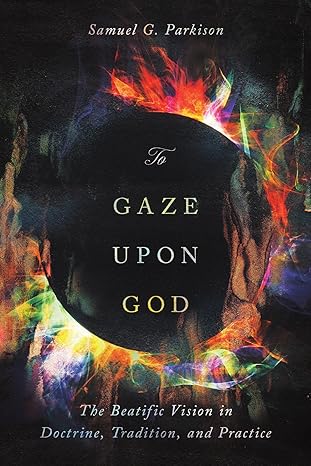
Union with God is life, and seeing God in Christ is life’s goal. Historically, the beatific vision factored heavily in the foundation of the study of theology (prolegomena), slanting the entire system of Christian doctrine, and the whole path of Christian living towards the Trinity. This is another way of saying that theology and ethics were about God and all things in relation to God, making divine glory both the theoretical and practical aim of everything Christians believe and do. Despite this fact, the beatific vision has suffered partial eclipse in modern Protestantism, displacing the Christian God with impoverished summaries of Christian doctrine and scientific exegesis. To Gaze Upon God shows the church both what she has lost and what she hopes to gain by recalibrating her focus on God in Christ. Parkinson offers readers rich biblical reflection on the beatific vision, with a listening ear attuned to what the church has learned and said about the subject, aiming ultimately to displace ourselves from the center of the Christian life by replacing us with God’s manifested glory through Christ in the Spirit. All Christians should read this superb book, praying that the Spirit would reshape their conceptions of how the goal of Christianity determines everything along the path to glory.
Hans Boersma, himself a significant author on the beatific vision, calls this book “easily the best primer on the beatific vision today.” The content of the book vindicates this lofty assessment. Chapters one and two are foundational to the remaining four chapters in that they depict what the beatific vision is, tracing the idea of seeing God throughout Scripture via theophanies, eschatology, and the incarnation. Opening with the question, “What makes heaven heaven?” (1), he answers persistently, “What makes heaven heaven is the enlightening and enlivening presence of God himself” (51). By far the largest chapter (ch. 3) examines pre-Reformation views of the beatific vision. Coupled with chapter four, seventy-six pages of the book are devoted to historical investigation, comprising “a major portion of the book” (8). Following on the heels of his assessment of abuses of sola scriptura at the outset of chapter two, he notes that sola scriptura demands keeping the fifth commandment by honoring past Christian teachers (22). Because we are like students in class learning from more experienced teachers, Parkinson adds, “I believe we ought to have a deferential instinct toward tradition, and therefore part of my justification for retrieving the lost doctrine of the beatific vision is its historical pedigree” (23). The beatific vision should grip readers’ attention because “the beatific vision is one of the few doctrines that can truly boast ecumenical status” (1). While most of this historical material is descriptive rather than evaluative, Parkinson makes an exception for Gregory Palamas, partly because the author is otherwise bent towards Western writers and a modern Protestant audience (2, 8), and partly due to perceived problems in Gregory’s thought (99). His critiques of Palamas’ mystical theology are both incisive and biblical, showing that Palamas’ increasingly popular essence/energies distinction does not gain a foothold in Scripture (99-103). Among other subjects treated, Parkinson’s attention to Thomas Aquinas and John Owen on the place of Christology in the beatific vision is particularly clear and helpful (127-131).
If chapters one through four root the beatific vision in Scripture and history, then chapters five and six pull this biblical and historical teaching into the life of the church. Parkinson rightly highlights a modern “lack of interest in the beatific vision” among Reformed Protestants, citing as samples two recent substantial treatments of eschatology (Graham Cole and David Hohne) that barely glance at the topic. Concerned with “retrieval,” chapter five usefully intertwines Christian views of the beatific vision with a Reformed gospel, including a robust defense of justification by Christ’s imputed righteousness by virtue of union with Christ (159). This chapter also tackles thorny issues such as whether Christ had beatific knowledge on earth (via Thomas Joseph White’s defense of Aquinas on this view; 170-171), siding with the classic Reformed “theology of union,” which taught that though Christ’s knowledge of God was unique due to the hypostatic union, he gained beatific knowledge of God through living by faith and obedience under the law (172-175). Yet through union with Christ, “the saint comes to participate in Christ’s own beatific vision” (169). This chapter also includes the weighty assessment that, as “twin sisters…biblical fundamentalism and theological liberalism share common blood” (140). Parkinson means that both restrict exegesis to grammar and history, sidelining a hermeneutic that looks primarily for the glory of God in biblical texts. He is likely right that modern hermeneutical methods have contributed to the decline of the beatific vision in theology and Christian living. Chapter six, accordingly, draws attention to influences of the beatific vision on the Christian life in vitally important ways. The beatific vision as the goal of theology reminds readers that “theology is practical by definition” (178), but not merely by adding application for day-to-day living. Instead, seeking to see God reorients everything else we do (179). Parkinson demonstrates this fact by pulling the beatific vision into prayer, corporate worship, missions, sanctification, suffering, and friendship. Finally, his postscript, written from the standpoint of the author’s current ministry in the Middle East, concludes that making the beatific vision the goal of theology makes theology appeal to all humanity equally, and not merely to Western Christians (214).
Two additional practical points from chapter six are worth singling out. First, the Christological bent of the beatific vision should shape preaching. Parkinson writes, “If the local church gathers around the Word to see in it the glory of God in Christ, such glory must be set plainly before them in the sermon…[Preachers] have not truly proclaimed the Scripture if they have not proclaimed how it radiates Christ’s beauty” (185). This exhortation reminds preachers that Scripture sets a theological agenda for preaching, which precedes, and sometimes trumps, the assumptions behind merely expounding and applying consecutive texts. Second, contemplating God’s glory in Christ is a more effective means of sanctification than merely striving to break and change habits. Parkinson notes a friend who overcame a pornography addiction precisely by discovering the attractive power of the beatific vision (198-199). Today, few people struggling with pornography or other indwelling sins connect meditation on and pursuit of the glory of God and radically changing their trajectories in life. Yet what we desire and meditate on most is what shapes our practices most. The frequent absence of Christology, Trinitarian theology, and the beatific vision in sanctification mark a black hole continually drawing people away from Christ towards indwelling sin. Restoring a Godward meditative view of Christian living is the way out that most Christians don’t know to look for. Combined, Parkinson’s counsel on preaching and sanctification can work in tandem to reset the church’s trajectory in vital ways.
At risk of derailing the overwhelmingly positive tone of this view, Parkinson’s treatment of baptism, while not affecting the core of the book, raises some significant questions about the kind of retrieval theology he does so well in this book. He asserts rightly that baptism is not merely our confession of faith or “individualistic self-expression” (186), also citing Robert Jamieson on baptism being the “initiating oath-sign of the new covenant” (187). Yet he adds that baptism is “an enacted vow” (188) disabling a Baptist from getting entirely away from treating baptism as our profession of faith rather than as a sign and seal of God’s promises, which require our profession of faith. Moreover, Parkinson asserts that baptism “formally ushers his elect into the local expression of Christ’s body” (188) which raises the question as to whether hypocrites are visible church members in any sense. If they are not, then how are they subject to the discipline of the church as the elect are? By contrast, Westminster Confession of Faith 28.1 notes more properly that baptism is the “solemn admission” to the visible church, and Larger Catechism 62 defines the visible church as consisting of all who “profess the true religion, and of their children.” Removing the non-elect from church membership undercuts the concept of apostasy to some extent, since, being mere unbelievers and not church members, there is nothing to apostatize from other than an outward faulty, insincere profession of faith. Yet apostates trample Christ underfoot, count the blood of the everlasting covenant by which they are sanctified “a common thing,” and insult “the Spirit of grace” (Heb. 10:29). In outward connection to Christ through the church, they deny “the Lord who bought them” (2 Pet. 2:1), which is why “it would have been better for them not to have known the way of righteousness, than having known it, to turn from the holy commandment delivered to them” (v. 21. NKJV). All sacraments are signs and seals of God’s promises rather than of our own, whether the tree of life, circumcision, sacrifices, the Passover, baptism, or the Lord’s Supper. Shifting the weight of the sacraments towards divine promises does not prove infant baptism in itself, though it makes room for it. Yet Parkinson’s view of baptism only admitting the elect to the church precludes it by a faulty definition of the sacraments. Given his “deferential instinct toward tradition” (23), it is surprising that Baptist retrieval theologians like Parkinson do not feel more of the weight of the fact that almost the entire “Great Tradition,” and most Protestants outside America, has uniformly retained the practice of infant baptism. If the “ecumenical status” of the beatific vision draws attention to the doctrine, then so does the ecumenical status of infant baptism, at least for most of church history.
To Gaze Upon God masterfully reminds us that salvation is a means to an end rather than an end itself. Salvation in Christ is the way back to God, who is the chief end and highest good of all things. Christianity divorced from the beatific vision is anemic. Restoring the beatific vision to its rightful place is transformative. Read this book to find out why.
Ryan McGraw
Greenville Presbyterian Theological Seminary