A Book Review from Books At a Glance
by Thomas Haviland-Pabst
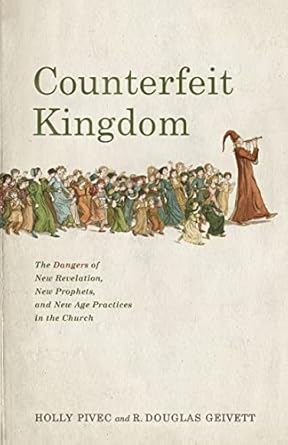
This book, written with the combined efforts of Holly Pivec and R. Douglas Geivett, addresses the movement known as the New Apostolic Reformation or NAR for short. Pivec holds a master’s degree in apologetics from Biola University and works as a writer, speaker, and author. Geivett teaches at Biola University and Talbot School of Theology. The authors have written other books addressing the subject in view such as A New Apostolic Reformation?: A Biblical Response to a Worldwide Movement (Lexham Press, 2018).
The book consists of ten chapters, a conclusion and an appendix addressing the use of miracles by the NAR movement. The discussion of each chapter derives its understanding of the NAR movement from the firsthand experience of the authors as well as other people who were once a part of NAR. In addition, various books by authors of the movement are cited and engaged with as are public statements made on relevant websites, videos on YouTube, and articles.
The first chapter tells the tragic story of a family who, leaning on NAR teaching, refuses for six days to admit that their daughter, Olive, had passed. Sadly, because the parents believed so strongly that she would be raised from the dead, this event went public and was followed by various news outlets such as USA Today. The authors write that the purpose of this book is “to give their stories,” the stories of those who have been damaged by NAR churches, “a voice” in order to “expose the movement and its practices” (p. 15).
In the second chapter, the authors orient the readers to two leaders of the NAR movement, a self-designated ‘apostle,’ Bill Johnson and “his right-hand man” (p. 17), self-described ‘prophet,’ Kris Vallotton. Both of these men belong to Bethel Church in Redding, CA and, as such, Bethel features heavily in the pages of this book as what appears to be the fountainhead for the NAR movement worldwide. With grace and humility, the authors provide reasons why each of them has concerns regarding the NAR movement. For Pivec, her husband, prior to their marriage and even as they were dating, belonged to the movement so it was not merely an academic interest in deviant, sub-Christian movements but also something she had personal experience with. For Geivett, he is concerned when the Christian message “is garbled and [even] completely distorted” (p. 28); for him, NAR is one example of this concern coming to fruition.
Chapter three exposes how NAR is closer to occult practices than the NT teaching on spiritual gifts with practices analogous to telepathy, psychic readings, and tarot cards. Chapter four demonstrates how the so-called prophecies of this movement fail the fulfillment test of Deut. 18:20-22 as numerous prophecies have proven not to have come true or, perhaps even worse, are not even in line with what prophecies even are according to Scripture. Chapter five gives attention to six tactics employed by this movement to facilitate spiritual abuse. These include twisting Scripture, the use of euphemisms such as “alignment” and “spiritual covering” to describe leadership practices that if described directly would be offensive to most Christians, and the use of threats to “silence their critics” such as “Touch not the Lord’s anointed” (p. 93). The sixth chapter provides thirteen signs of a counterfeit or false revival such as (1) a distorted gospel which adds to the gospel the message that Christ’s “followers” will “take dominion over the earth” (p. 105), (2) “revival hotspots,” which are places that God is especially pouring out his Spirit accompanied by supernatural miracles and prophecy; and (3) “[a] [d]iminished Jesus” (p. 115), who performed his miracles as a man not as God.
The seventh chapter helpfully discusses and critiques the Passion Translation, noting three major reasons for rejecting this translation: (1) Simmons, the ‘translator’ of the Passion, lacks the qualifications for such a task, approaching, in this reviewer’s view, something akin to Mormonism with ‘mythical manuscripts’; (2) the Passion adds to God’s word, which the authors demonstrate by comparing the Passion with NIV, ESV, and NKJV; and (3) lying behind this ‘translation’ is an implicit NAR agenda. Chapter eight discusses the problems with the worship music disseminated by Bethel. Here, the authors argue that church leaders and pastors ought to be careful about utilizing Bethel’s music because said music often draws into the NAR movement. The ninth chapter discusses their unbiblical approaches to supernatural healing such as the NAR conviction that “it is always God’s will to heal every sick or emotionally suffering person” (p. 172). Chapter ten discusses ways to protect your children against the NAR movement. The concluding section of the book warns church leaders to be alert to NAR taking over your church and encourages such leaders to be aware of the signs of NAR influence.
There are a number of strengths to this book. As was already mentioned, all the claims about NAR are substantiated by reference to books and articles by NAR authors as well as testimonies of people who have experienced the movement firsthand. This is especially important when dealing with a movement that refuses to allow for critical feedback and even silences and shames those who would do so in their midst. In addition, the authors write with a healthy blend of truth and love. This is not a hobby horse for the authors. There are reasons to be concerned and to warn others of the problems with this movement. Also, while this book is not exhaustive (otherwise they wouldn’t be writing more books on the NAR movement), it is thorough and a great starting point for anyone desiring a sound, biblically informed look at NAR. Lastly, this book not only exposes the problems with the NAR movement but also offers some positive advice for those moving away from NAR and for those seeking to protect against its influence.
This is a sobering and, in many ways, sad book, especially given the growing influence of churches like Bethel. One negative of this book is that it was repetitive at points which felt at times like the negative of an already negative book was overemphasized (though it is understandable given the many issues of the NAR movement). Another quibble is that neither of the authors clearly identified what their own positions are on the supernatural spiritual gifts of miraculous healing, tongues and prophecy. While the reader may get a sense of what they do not believe and piece together their overall position based on statements found throughout the book, it would have been helpful if they had identified what they do believe about the gifts in order to circumvent any claim by a potential reader that they are only taking issue with NAR because they are cessationists (this is a problem I dealt with when recommending the book to someone influenced by NAR). Obviously, rejecting this book’s findings because the authors may be cessationists is a red herring. However, it still would help the pastor or church leader in reading and/or recommending this book if it is known upfront that this is not some kind of hit piece or smear campaign not founded on reality or the actual teachings of NAR leaders.
To conclude, this book ought to be read by any lover of Christ’s church who wants to see Christ’s bride continue to grow in Christlike maturity and not be tossed around by false teaching and ungodly practices.
Thomas Haviland-Pabst