A Book Review from Books At a Glance
by Thomas Haviland-Pabst
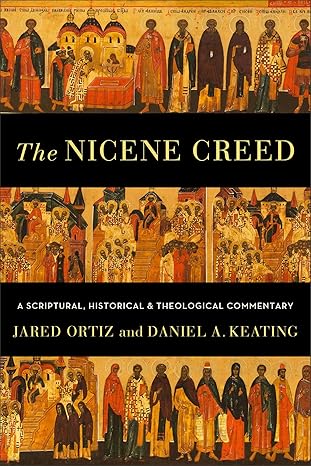
The authors Jared Ortiz, professor of religion at Hope College, and Daniel Keating, professor of theology at Sacred Heart Major Seminary, have provided a rich feast on one of the most important and foundational creeds of the Christian church: the Nicene Creed. The authors’ stated aim is to offer a commentary on the Nicene Creed to deepen the reader’s understanding of the faith and how to live it out. This work, then, is directed toward “preachers, teachers, and other thoughtful Christians” (p. 11) who would benefit from such study for their own edification.
The book is divided into six chapters, with each chapter corresponding to a particular part of the Nicene Creed. So, chapter one explores belief, given the phrase “I believe” that opens up the Creed. Chapter two gives attention to God the Father, building on “one God, the Father Almighty.” Chapter three focuses on God the Son in his divinity (“in one Lord Jesus Christ … begotten, not made … through whom all things were made”). The fourth chapter’s discussion is centered on God the Son incarnate (“For us men and for our salvation, he came down from heaven, and by the Holy Spirit was incarnate of the Virgin Mary … for our sake he was crucified”). The fifth chapter focuses on the Holy Spirit (“in the Holy Spirit, Lord, the giver of life”). The last chapter, which is titled ‘Life in the Trinity,’ walks the reader through the doctrine of the church (“in one holy, catholic, and apostolic church”).
Following these chapters are two appendices. The first appendix places the Creed of Nicaea (325), the Nicene Creed from the Council of Constantinople (381), and the Apostles Creed (7th cent.) side by side in columns for ease of comparison. The second appendix places the Latin and Greek versions of the Nicene Creed (hereafter, the Creed) in respective columns for comparison. The authors also provide a glossary of key terms to assist the reader or student. Here, definition is provided for such “apostolic succession,” “doxology,” and “subordinationism.”
Each chapter follows the same basic order, namely, a three-part commentary (Scriptural, Historical, and Theological) with three different sidebars peppered throughout: “Witness to the Tradition,” “Lex Orandi,” and “Contemporary Issues.” For instance, in the first chapter, ‘Witness to Tradition’ consists of quotes from Augustine on the faith of infants and the authority of the Catholic church, to fill out the discussion on the nature of faith and the Creed’s affirmation of belief “in the … Church,” respectively. In the sidebar ‘Lex Orandi,’ the hymn “What Wondrous Love is This” (p. 45) enhances the discussion regarding the unity of the Father and the Son, and the so-called ‘problem of evil’ is discussed in a ‘Contemporary Issues’ sidebar in connection with their exposition of creation ex nihilo.
It must be noted, at the outset, that this is an explicitly Roman Catholic take on the Nicene Creed. This especially comes to the fore in their discussion of the last part of the Creed. Thus, they can write, “Protestant Christians have a real though imperfect communion with the Church” (p. 181). As such, the necessity of apostolic succession, the primacy of Rome and so the papacy, and the regenerative effects of baptism (and, by implication, the validity of the seven sacraments of the Roman Catholic church) are affirmed and expressed by the authors.
Given this significant weakness, the question is raised: how would this book benefit a Protestant reader? To begin with, the authors’ attempt to ground their commentary on the Creed in Scripture, theological reflection, and tradition offers a clear glimpse into the strongest articulation of a Catholic understanding of Nicene orthodoxy.
Beyond this, when one compares this volume with the fine commentary on the Creed written from a Protestant perspective by Phillip Cary (Lexham Press, 2023), the strengths of Ortiz’s and Keating’s work come to the fore. First, in terms of structure and accessibility, the aforementioned sidebars which supplement the running commentary bring together the three strands of commentary in a way that will serve the student.
Second, the sheer depth of Ortiz/Keating on the Creed outclasses Cary’s work. One example of this is their comparative exegesis of the Latin and Greek versions of the Creed and the fruit of this comparison. An instance of this is their discussion of the differences between the Latin and the Greek of the Creed, “I believe” and “We believe,” respectively, as well as the omission of “in” in the Latin phrase “I believe in the one … Church” (hence, “I believe one … Church”). This difference, the authors argue, could reflect the recognition that the church is both a creature of God and possessing a divine origin. While Cary does make mention of this difference in passing, the attentiveness of Ortiz/Keating to the different texts of the Creed throughout invites the reader to engage with the historical documents in a trenchant manner, attuned to their reception history.
Also, Ortiz and Keating cover the same ground as Cary but also go beyond it by bringing in the three strands throughout their commentary. In their respective discussions of “We/I Believe, while Cary briefly explores the meaning of faith and historical and practical explanations for the divergence between the Latin and Greek, the authors’ commentary is significantly broader in depth and breadth. To demonstrate this assessment, by making plain that faith is not relegated to a feeling or subjective opinion but is, rather, what “gives us access to the ground of all reality” (p. 16) as well as their survey of the meaning of faith in Hebrew, Greek, Latin and English, and, in light of these, the “polyvalent” (p. 22) nature of the word ‘faith’ given its reference to God’s faithfulness, the fidelity and obedience of the believer and inseparable connection to baptism, to name a few, displays a level of commentary not found in Cary’s work.
It’s important to note here that the page count for Cary’s book is almost equivalent to that of Ortiz and Keating. Put simply, Ortiz and Keating accomplish more in the same space than does Cary and, as such, this alone establishes the value of the work despite its clear Catholic leanings. Moreover, the brevity and clarity of their defense of such essential points of doctrine as the Trinity, the necessity of the incarnation, the hypostatic union of Christ and the full divinity of Christ as well as the ways they connect the Creed to such bedrock doctrines demonstrates why the Creed has stood the test of time and why it is still worthy of deep study and reflection.
In summary, despite speaking with an explicit Catholic voice, the breadth and depth of their threefold commentary on the Creed still make this a worthwhile contribution to literature on the Creed. Perhaps the presence of this book will encourage more Protestant and Reformed writers to match or even exceed the strengths of this book.
Thomas Haviland-Pabst
Montreat College
Asheville, NC