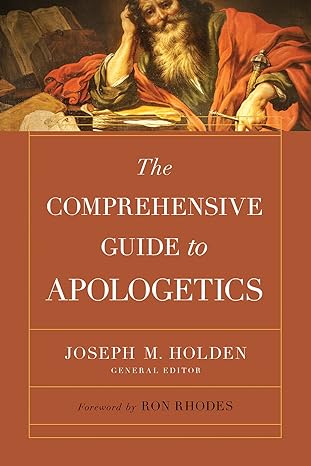
A Brief Book Summary from Books At a Glance
by Steve West
Table of Contents
Preface: The Battle for Hearts and Minds
Part One: Questions About Apologetics and Truth
1. What Is Apologetics and Why Do We Need It? Norman L. Geisler
2. What About a Short History of Apologetics? John Warwick Montgomery
3. What Are Some Apologetic Approaches? H. Wayne House
4. What Is the Overall Apologetic Task? Don Deal and Joseph M. Holden
5. What Is the Relationship Between Faith and Reason? Mark M. Hanna
6. What Is Truth? Richard G. Howe
7. How Can We Know Truth? Richard G. Howe
8. What Is Conversational Apologetics? David Geisler
9. How Can We Make Apologetics Culturally Relevant? Miguel Angel Endara
10. What Is the Holy Spirit’s Role in Apologetics? Ed Hindson
Part Two: Questions About God
11. Why Does God Seem “Hidden”? Natasha Crain
12. What Are the Classical Proofs for God’s Existence? Richard G. Howe
13. What Are Some Other Arguments for God’s Existence? Thomas W. Baker
14. If God Exists, Why Is There Evil? Clay Jones
15. Canaanites, Crusades, and Catastrophes—Is God a Moral Monster? Douglas E. Potter
16. How Can a Loving God Send People to Hell? Douglas E. Potter
Part Three: Questions About Jesus
17. Who Is Jesus? Josh McDowell
18. Is There Evidence That Jesus Really Existed? Gary R. Habermas and Benjamin C.F. Shaw
19. Are the Gospel Accounts Reliable? F. David Farnell
20. What About the Alternative “Gospels”? H. Wayne House
21. How Do We Know That Jesus Is God? Ron Rhodes
22. Is There Evidence That Jesus Rose from the Dead? Gary R. Habermas and Benjamin Shaw
23. Did Christianity Copy Earlier Pagan Resurrection Stories? Edwin A. Yamauchi
24. Why Is It Important That Jesus Rose from the Dead? Phil Fernandes
25. How Did Jesus Use Apologetics? Patrick Zukeran
Part Four: Questions About the Bible
26. Are the Old Testament Manuscripts Reliable? Walter C. Kaiser Jr.
27. How Do the Dead Sea Scrolls Show the Reliability of the Old Testament Text? J. Randall Price
28. Does Archaeology Confirm the Historical Reliability of the Old Testament? Steven Collins
29. Were the New Testament Manuscripts Copied Accurately? Don Stewart and Joseph Holden
30. Is the Qur’an’s Text More Reliable Than the Biblical Text? Jay H. Smith
31. Does Archaeology Confirm the Historical Reliability of the New Testament? Brian Janeway
32. What Is the Internal Evidence for the Historical Reliability of the New Testament? H. Wayne House
33. Are There Contradictions in the Bible? Norman L. Geisler
34. What Would a Trial Lawyer Say About the Claims of the Gospels? Christopher P. Burke
35. Can Prophecy Be Used as Evidence That the Bible Is Reliable? Patty Tunnicliffe
Part Five: Questions About Science and Faith
36. What Is the Scientific Case for Intelligent Design? William A. Dembski
37. How Do We Respond to Objections to Intelligent Design? Casey Luskin
38. What Are the Top 10 Scientific Problems with Evolution? Casey Luskin
39. What About Darwin’s Doubt and the Chances of Information Emerging from Random Mutations? Stephen C. Meyer
40. How Should Christians Think About the Origins of the Universe? J.T. Bridges
41. Do We Have a Privileged Planet? Guillermo Gonzalez
42. Do Science and the Bible Conflict? Terry Mortenson
43. What Is the Relationship Between Science and Faith? Terry Mortenson
44. Has the Christian Worldview Had a Positive Impact on the Development of Science? Casey Luskin and Stephen C. Meyer
45. What Is the Scientific Evidence for Adam and Eve? J.C. Sanford
Part Six: Questions from Christians, Seekers, and Skeptics
46. Is There Any Evidence of Life After Death? Gary R. Habermas and Benjamin C.F. Shaw
47. Is It Reasonable to Believe in Heaven (and Hell)? Randy Alcorn
48. Is Jesus the Only Way to God? Phil Fernandes
49. Are Christians Intolerant and Narrow-Minded? Dillon Burroughs
50. Why Is It Important That Jesus Died on the Cross? Terry L. Miethe
51. Is Christian Belief Just Psychological Wish Fulfillment? Denise Ostermann
52. Are Miracles Possible? Richard G. Howe
53. Is It Okay for Christians to Doubt? Terry L. Miethe
54. How Do We Reason from the Scriptures with Cultists? Ron Rhodes
55. Is the Trinity a Contradiction? Ed Hindson
Part Seven: Questions About Worldviews
56. What Is Philosophy, and Why Is It Important? Richard G. Howe
57. What Is Agnosticism, and What Is Its Essential Flaw? Richard G. Howe
58. What Is Materialism, and What Is Its Essential Flaw? Mark M. Hanna
59. What Is Rationalism, and What Is Its Essential Flaw? Richard G. Howe
60. What Is Scientism, and What Is Its Essential Flaw? Douglas E. Potter
61. What Is Moral Relativism, and What Is Its Essential Flaw? Sean McDowell
62. What Is Postmodernism, and What Is Its Essential Flaw? Mark M. Hanna
63. What Is Atheism, and What Is Its Essential Flaw? David R.C. Deane
64. What Is Pantheism, and What Is Its Essential Flaw? Patrick Zukeran
65. What Is Monism, and What Is Its Essential Flaw? Dillon Burroughs
66. What Is Panentheism, and What Is Its Essential Flaw? Christopher Travis Haun
Part Eight: Questions About Apologists of the Past
67. Who Was Justin Martyr? William E. Nix
68. Who Was Augustine? William E. Nix
69. Who Was Anselm? Ralph MacKenzie
70. Who Was Thomas Aquinas? Norman L. Geisler
71. Who Was Blaise Pascal? Terry Glaspey
72. Who Was William Paley? Terry L. Miethe
73. Who Was C.S. Lewis? Terry Glaspey
74. Who Was Cornelius Van Til? David Haines
75. Who Was Francis Schaeffer? Terry L. Miethe
Summary Note
This book consists of 75 chapters, each of which puts forth an answer to a particular question. Each answer is concise but usually runs 4-6 pages. In order to give a picture of the type of material the book contains, the following summary presents a sample selection of the book’s chapters.
Summary
Foreword & Preface
God has commanded us to engage in a defense of the faith, and thus defending the faith must be something God, in his wisdo,m can equip us to do. Scripture is filled with admonitions to reason, know the truth, and refute errors. The need for apologetics has never been greater, and the range of issues is vast. This is a war for hearts and minds. As C.S. Lewis observed, good philosophy must exist because bad philosophy exists: we must not leave the vulnerable without helping them. This book contains 75 chapters, each written by an expert, that will help equip the saints to answer questions and contend for the faith.
Q #1 What is Apologetics and Why Do We Need It?
From the very beginning, the church met theological and philosophical objections to the faith. Apologetics is the giving of a reasoned defense for truth. Today, the challenges have never been greater, but thankfully there has also been great growth in Christian apologetics. Apologetics shows why Christianity is true, and also refutes objections to it. It is pre-evangelism, preparing the way for the gospel. God commands apologetics, and the world needs answers and the defense of the truth. We need to dismantle wrong ideas and deal with doubts. God has given us reason as a tool to test and know the truth, and we must use reason to love God with all of our minds and to justify our beliefs. Before we can believe in something, we must believe that it is true. The testimony of many believers shows that apologetics played a crucial role in their conversion.
Q #5 What is the Relationship Between Faith and Reason?
The relationship between faith and reason is often a contentious topic for debate between secularists and Christians. Often, faith is defined as blind faith or believing in spite of a lack of evidence, but this is not what real faith is. Without logic and objective reason, we couldn’t know anything. The answers to life’s ultimate questions are revealed by God, and they do not violate logic. All through Scripture there is an appeal to reason for grounding faith. Faith is contrasted with sight, religious works, and mere assent, but it is never contrasted with reason. Faith has both subjective and objective aspects; it is commitment and trust, in line with evidence rather than against it. “Reason is a God-given capacity to seek truth and to acquire general knowledge.” Rational reflection on evidence should lead us to truth. Sin corrupts us, but it does not destroy our ability to use logic. Faith is the reasonable response of trusting God, and this is supported by logic and evidence. . . .
[To continue reading this summary, please see below....]The remainder of this article is premium content. Become a member to continue reading.
Already have an account? Sign In