A Brief Book Summary from Books At a Glance
by Steve West
Table of Contents
1 The Basic Deception
2 The Myth of Neutrality in the Media
3 St. Peter, St. John, and Mother Theresa Versus the Boston Globe
4 The “Wall of Separation”: The Myth of Neutrality in the Law and Politics
5 The Collapse of Moral, Cultural, and Sexual Attitudes: The Failure of Humanistic Double-Think
6 Science, Medicine, and the Politics of Death
7 Sexual Mores, the Family, and the Myth of Neutrality
8 A Time for Anger in the Arts
9 A Time for Misbehaving
Appendix: Abortion
Summary
Chapter 1: The Basic Deception
Our times are such that anyone with a moral conscience should be outraged. Those who speak about tolerance are incredibly intolerant towards all who disagree with them. Deceit abounds, and it is tied to evil agendas and political manipulation. Labels are placed on people to insult and dismiss them, rather than to aid in finding truth and furthering discourse. Christians are cast by the media as bigots, backwards, and uneducated. Liberals are presented in positive terms, while those who stand for traditional morality are cast negatively. It is acceptable to disparage Christians in a way that is not accepted for any other social group or demographic. The media claims objectivity yet treats moral issues with obvious slants. Since there is no transcendent moral standard they appeal to, they often apply double-standards depending on their support or opposition to an issue. There is no logic or consistency in how they frame moral issues: they are relativists only when convenient.
Media tries to cultivate a false image that they are objective and neutral, but this myth of neutrality is an illusion. This myth of neutrality can be seen in the misrepresentation and revisionist history that tries to keep even religious thinking—or thinkers—out of politics and public policy. In media reporting, Christians are often caricatured and misrepresented. All law is an imposition of morality on others, and a restriction on the morality of some. The myth of neutrality makes Christians feel like they cannot impose their views on others, while secular humanists are busy imposing their views on society. If Christians had been silenced in history, a myriad of positive social goods would never have been actualized, and many harmful practices would still be occurring. Ultimately, everyone has a religion: secularism is also an ideology and religious view. Christians must not believe that they are the ones who must be silent; followers of Christ have the same rights to speak up as any other citizens. One of the great problems today is that secularists are trying to make it impossible for social issues to even be discussed or debated. . . .
[To continue reading this summary, please see below....]The remainder of this article is premium content. Become a member to continue reading.
Already have an account? Sign In
Buy the books
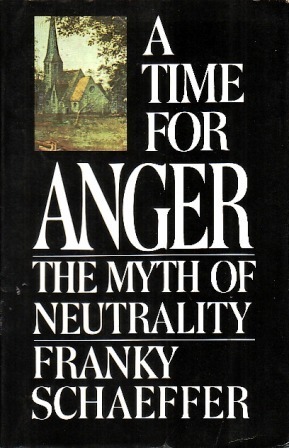
A TIME FOR ANGER: THE MYTH OF NEUTRALITY, by Franky Schaeffer