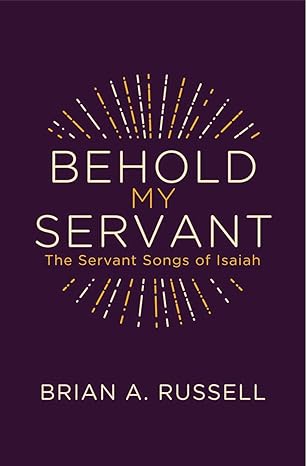
A Brief Book Summary from Books At a Glance
by Steve West
Table of Contents
Introduction
- The First Servant Song: Jehovah introduces His messianic Servant (Isa. 42:1-9)
- The Second Servant Song: The Servant’s calling and work (Isa. 49:1-7)
- The Third Servant Song: His suffering for righteousness’ sake (Isa. 50:4-11)
- The Fourth Servant Song I: His path to glory will be extreme suffering (Isa. 52:13-15)
- The Fourth Servant Song II: His good news will encounter unbelief (Isa. 53:1)
- The Fourth Servant Song III: He will be despised and rejected by men (vv. 2-3)
- The Fourth Servant Song IV: The vicarious nature of His sufferings (vv. 4-6)
- The Fourth Servant Song V: The majestic silence of His submission (v. 7)
- The Fourth Servant Song VI: His penal death and honourable burial (vv. 8-9)
- The Fourth Servant Song VII: The will of the Lord shall prosper in His hand (vv. 10-11)
- The Fourth Servant Song VIII: Exalted as Victor and Intercessor for His people (v. 12)
Summary
Introduction
The prophecy of Isaiah divides naturally into two parts, and the second part (chapters 40-66) contains a fascinating collection of texts often called The Servant Songs (42:1-9; 49:1-7; 50:4-9; 52:13-53:12). In these songs the Lord’s Servant and the Lord himself accomplish his plans and purposes, and the prophecies can only be fulfilled by Jesus Christ. In the Gospels we see that Jesus saw himself as the Servant in these passages. He quoted from them and alluded to them: they were part of how he understood his identity and mission. The writers of the Gospels also explicitly claim that Jesus is the one who fulfills the songs. Sermons in Acts make the same connection, as does Paul in his epistles. In speaking to the Ethiopian eunuch, Philip taught him that Jesus was the one of whom Isaiah wrote in 52:13-53:12. The theology of Isaiah 53 is deeply embedded throughout the entire NT. In Isaiah’s context, the Servant Songs are given against a backdrop of idolatry and apostasy. Israel and Judah would experience judgment and exile, but God would still act to redeem them through his Servant. He would bring them home, give them freedom, destroy idols, and meet their needs. In contrast to lifeless idols, the living God would send his Servant to save. In the Servant Songs, the only name used for God is Yahweh, the sovereign, independent, ruler of all things who will always be faithful to his promises.
Chapter 1: The First Servant Song: Jehovah Introduces His Messianic Servant (Is. 42:1-9)
Isaiah 40-66 is referred to as the Book of Consolation, and comfort is a dominant theme throughout. Before God sent his people into exile as punishment for their sins, he provided them with this incredible message of hope and comfort. God promised to send his Servant who would bring forth and establish justice on earth (i.e., in truth he would accomplish God’s righteous plan to God’s glory). This task would require supernatural strength, so the Servant is filled and empowered with God’s Holy Spirit. In the Gospels we see that Jesus was conceived by the Spirit, grew in the Spirit, and was empowered and led by the Spirit in all his earthly life and ministry. In utter contrast to the ways of the world, God’s Servant is humble, gentle, and quiet. He does not bully or assert himself at the expense of the weak; he is compassionate and caring.
Even though he was surrounded by sinners he never sinned. In fact, he was always righteous, obeying God’s moral law perfectly. He is given as a new covenant to the people. His mission was to Israel but also to the whole world, where he served as a light in the darkness. Rather than being accepted, he was rejected and crucified, but even though he went to death he faithfully and humbly followed God. The text begins with, “Behold my Servant.” This call is not merely to look, but to use our fullest concentration to see and understand. Looking to the world and idols is to behold lies and darkness, but beholding Jesus as he is brings us into eternal life and truth. . . .
[To continue reading this summary, please see below....]The remainder of this article is premium content. Become a member to continue reading.
Already have an account? Sign In