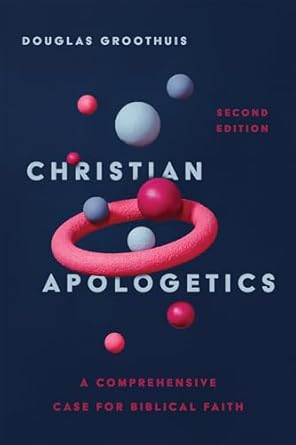
A Brief Book Summary from Books At a Glance
by Steve West
Editor’s Note: Doug Groothuis’s Christian Apologetics has seen wide use for some years, and now it is available in its second edition. We offer here a summary of selected chapters to acquaint our members with this book.
Table of Contents
Introduction: Hope, Despair, and Knowing Reality
Part One: Apologetic Preliminaries
1 The Biblical Basis for Apologetics
2 Apologetic Method: Evaluating Worldviews
3 The Christian Worldview
4 Distortions of the Christian Worldview—or the God I Don’t Believe In
5 Truth Defined and Defended
6 Why Truth Matters Most: Searching for Truth in Postmodern Times
7 Faith, Risk, and Rationality: The Prudential Incentives to Christian Faith
Part Two: The Case for Christian Theism
8 In Defense of Theistic Arguments
9 Original Monotheism
10 The Ontological Argument
11 Cosmological Arguments: A Cause for the Cosmos
12 The Design Argument: Cosmic Fine-Tuning
13 The Argument from Beauty
14 Origins, Design, and Darwinism
15 Evidence for Intelligent Design
16 The Moral Argument for God
17 The Argument from Religious Experience
18 The Uniqueness of Humanity: Consciousness and Cognition
19 Deposed Royalty: Pascal’s Anthropological Argument
20 Doubt, Skepticism, and the Hiddenness of God
21 Jesus of Nazareth: How Historians Can Know Him and Why It Matters—by Craig L. Blomberg
22 The Claims, Credentials, and Achievements of Jesus Christ
23 The Atonement: Stating It Properly
24 The Atonement: Defending It
25 Defending the Incarnation
26 The Resurrection of Jesus: Prolegomena on Miracles
27 The Resurrection of Jesus: The Evidence
28 In Defense of the Church
Part Three: Objections to Christian Theism
29 Religious Pluralism: Many Religions, One Truth
30 Apologetics and the Challenge of Islam
31 The Problem of Evil: Dead Ends and the Christian Answer
32 Lament as Apologetic for Christianity
Conclusion: Take It to the Streets
Appendix 1: Hell on Trial
Appendix 2: Apologetic Issues in the Old Testament—by Richard S. Hess
Summary
Introduction
Hope as a phenomenon exists in the universe—because there are people who hope—but is hope grounded in anything? Is there hope for the universe itself? Do our lives actually have meaning? Many people ignore these questions and reject the search for truth, but truth is vital to who we are and for all that matters. It is possible to put our hope in a lie, so we must zealously search for truth, being willing to test and compare different worldviews. An excellent case can be made that ultimate truth is found in the God of the Bible and in the gospel of Jesus Christ. The Christian worldview can withstand rigorous scrutiny, and it provides us with intellectual, existential, emotional, social, and spiritual truth. It can satisfy both our minds and our hearts, and its truth can be lived out in the world.
Chapter 1: The Biblical Basis for Apologetics
Christian apologetics deals with the questions of whether Christianity is true, rational, and worth believing and living out. Both the apologetic arguments deployed and the character of the apologist are essential for the task. The Greek word apologia refers to a defense, and Christian apologetics is a defense of our faith and hope in Christ (1 Peter 3:15). Apologists should show that Christianity is rationally true and subjectively appealing. Theology provides the conceptual content of apologetics, so skill in interpreting Scripture and knowing the doctrines of the faith is vital. We need to read Scripture using proper hermeneutics in order to understand its message, and we also need to study prayerfully and humbly. Apologists must be good philosophers, since they need to investigate issues rationally and make logically coherent arguments. Only the gospel saves, but many people have been opened to the truth of the gospel by apologetic arguments and philosophical reflection.
Jesus taught us to love God with all of our minds, and he is a tremendous example of an apologist and philosopher. In the Gospels, we often see Jesus using logic and reason to make positive points and to refute his opponents. Many of the NT authors also make philosophical points. In Acts, we see arguments from Scripture that Jesus is the Messiah, and arguments from nature and history for the reality and existence of God. At Mars Hill, Paul is a model apologist, presenting the truth about God, building bridges and finding common ground with his hearers, and then moving them to the gospel of Christ. “Humility is the cardinal virtue of the apologist (and every Christian).” As we grow in our knowledge of apologetics, it is equally vital to grow in our Christlikeness, virtue, and love. We need to deeply engage in prayer and be aware of spiritual warfare. For a person to convert, they need to be intellectually convinced of the truth, but they also need to make a whole-hearted commitment. Mental belief and trust in Jesus (i.e., faith) go together. Apologists must listen well to the people they are talking with, since there are an enormous number of views and perspectives in the world. . . .
[To continue reading this summary, please see below....]The remainder of this article is premium content. Become a member to continue reading.
Already have an account? Sign In