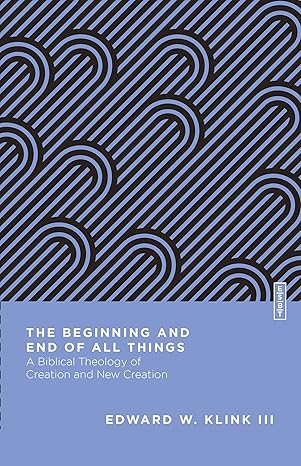
A Brief Book Summary from Books At a Glance
by Steve West
Table of Contents
Introduction: God’s Creation Project
1 Creation’s Covenant
2 Creation’s Curse
3 Creation’s Confusion
4 Creation’s Country
5 Creation’s Cry
6 Creation’s Christ
7 Creation’s Cross
8 Creation’s Congregation
9 Creation’s Commission
10 Creation’s Consummation
Conclusion: Pastoral Reflections
Discussion Questions
Summary
Introduction
It seems that many Christians only think of the doctrine of creation in terms of the origins of the world. Creation is much more than origins: it is essential to God’s plan in history and eschatology. Scripture’s narrative takes us from creation to new creation, and new creation is the goal of all things. Unfortunately, many Christians have a reduced view of the biblical doctrine of creation because they are focused on debates about science. There has also been a focus on soteriology that has missed the connection between creation and redemption which leads to the consummation. Some types of Christianity have failed to maintain balance between the inner heart and external world, which has resulted in disregard for the physical world. The Western church has also had a truncated view of eschatology which has not kept the biblical perspective on creation’s relationship with the eternal state. These failures to uphold Scripture’s teaching on creation have led to illegitimate divisions being placed between the spiritual and physical, where Christians try to have a rich, virtually disembodied spiritual life. This, in turn, leads to a failure to protect the created world as part of God’s teleological goal rather than merely a means. Part of our role as human beings is to care for God’s creation, working for culture-making and justice.
Soul-saving is not the entirety of the Christian’s calling in this world. Creation is not merely the beginning of God’s story; it is the story. God created everything for himself, and Eden was created as a special temple-sanctuary. The world is a place for God to dwell with his people; it is for worship and has had an eschatological dimension from the very beginning. Human beings were created as God’s image-bearers to work as priests, kings, and prophets under God. The abundance of the goodness and bounty of God overflows in his creation. Sin challenges God’s purposes in creation, but in redemption he reconciles and restores all things. Jesus Christ is central, both revealing and fulfilling God’s purposes in creation. He is the necessary second Adam who succeeds at his calling and vocation, fulfilling all of God’s creation-purposes. It is in the consummation and new creation where God’s ends are completed and the whole earth is the Holy of Holies. All of creation will exist in the presence of God and his glory will cover all of it.
Chapter 1: Creation’s Covenant
Genesis 1-2 is a difficult text to interpret, and discussions surrounding it have become very polemical and political. Often wrong answers are derived from the text because the right questions are not being asked and people interpret it according to their own agenda. Because of our debates on origins, too often people have focused on the manner of creation rather than its meaning—this is a great error since the meaning of creation is far more important in the text. Genesis 1-2 answers four questions: how (origins), and who, what, and why. Beyond the scientific question, Scripture addresses the metaphysical questions. The opening of Genesis is also the prologue for the whole Bible and needs to be read as such. It provides interpretive significance for the canon, giving us the who (characters), what (plot), and why (purpose). We can debate how God made the world, but it is far more essential to understand who God is, who human beings are, what God’s intentions are in the world, and why God created it the way he did.
The creation account looks back to the beginning, but also establishes the narrative trajectory that goes to consummation. Genesis 1 establishes God as the independent Creator of all things; he is not like anything else. It is only through his revelation that we can know him. God designs and shapes the world to be as he wants it to be. God’s Spirit hovers over the waters, witnessing to God’s power and presence in covenant with creation. The world is designed as a temple-sanctuary for God (note the parallels between creation and the tabernacle design). Human beings were created to be prophets, priests, and kings, existing as God’s sons to declare his glory. Genesis 2:1-3 describes Sabbath, and this is the goal of creation under God. Genesis 2:4-25 is not a second account of creation: it complements Genesis 1. It establishes that the God of creation is the Lord of the covenant, and he provides all that is needed. “The ultimate goal of God’s creation project is God’s desire to dwell personally with his creation, specifically with his people.” . . .
[To continue reading this summary, please see below....]The remainder of this article is premium content. Become a member to continue reading.
Already have an account? Sign In