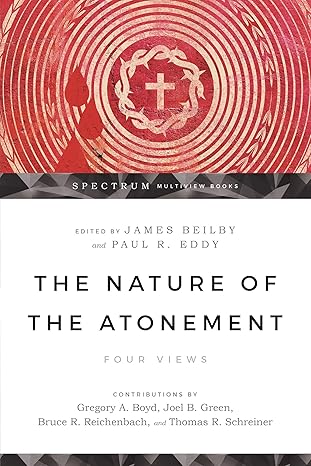
A Brief Book Summary from Books At a Glance
by Steve West
Table of Contents
The Atonement: An Introduction: Paul R. Eddy and James Beilby
1 Christus Victor View: Gregory A. Boyd
Penal Substitution Response
Healing Response
Kaleidoscopic Response
2 Penal Substitution View: Thomas R. Schreiner
Christus Victor Response
Healing Response
Kaleidoscopic Response
3 Healing View: Bruce R. Reichenbach
Christus Victor Response
Penal Substitution Response
Kaleidoscopic Response
4 Kaleidoscopic View: Joel B. Green
Christus Victor Response
Penal Substitution Response
Healing Response
Summary
Note: This book contains four essays and twelve responses (one response per essay for each of the other contributors). To give adequate space to each of the essays, the responses are not summarized.
Chapter 1: Christus Victor View
God solved a host of problems through the cross of Christ. Among this rich variety there is the provision of atonement, forgiveness of sins, reconciliation, the revelation of truth, healing from sin, and the defeat of the devil. Given the multiplicity of things that are accomplished at the cross, it is not surprising that the church has developed various models of the atonement. Although some advocate leaving the plethora of interpretive options to stand by themselves, it is natural for us to seek a principle or model that unites the various aspects of the atonement into one coherent whole. The Christus Victor model dominated the church for its first 1000 years, and this model can coherently incorporate the insights of the others.
Even before the incarnation, death, and resurrection of Jesus, Scripture reveals the reality of God’s battle with the forces of evil. Evil powers are depicted as rebel gods, hostile waters, and cosmic monsters, and they have turned the cosmos into a war zone. In the intertestamental period, apocalyptic writings focus far more on angels, demons, and gods than is the case in the Old Testament Scriptures. This is the milieu in which Jesus and his followers lived, and they engaged in spiritual warfare with Satan and his hosts of darkness. Satan was the god of this age who held the world in his powerful sway, and Jesus came to destroy the devil’s evil empire. During his earthly ministry, Jesus taught the truth, healed, and liberated people from their bondage to demons. Paul taught that our real battle was not against flesh and blood but against evil spiritual powers, and he firmly believed that the only hope for victory was found in God’s work in Jesus Christ. For Paul, sin was not first to be understood in an individualistic way, but was a power that held both groups and individuals in bondage. Given this reality, only God could rescue people and break the power of the cosmic forces of evil—and this is what Christians believed he did in the work of Jesus Christ.
The Reformers focused on how individual sinners could be justified before God, but this was not the major concern in the first century. For Paul and first-century Jews, the central concern was how people could be freed from the oppression of evil powers, and it was in these categories that Jesus’s followers interpreted the significance of his work. The New Testament witnesses that “the central thing Jesus did” was destroy the works of the devil and set free those who were captive to evil and the fear of death. The first messianic prophecy (Gen. 3:15) revolves around a promise that the Messiah will crush the serpent, and messianic promises often include the Messiah ruling and reigning over all his vanquished enemies. Jesus’s cosmic victory over the powers of darkness is a pervasive theme: the kingdom of God has triumphed and the kingdom of Satan has been defeated. . . .
[To continue reading this summary, please see below....]
The remainder of this article is premium content. Become a member to continue reading.
Already have an account? Sign In