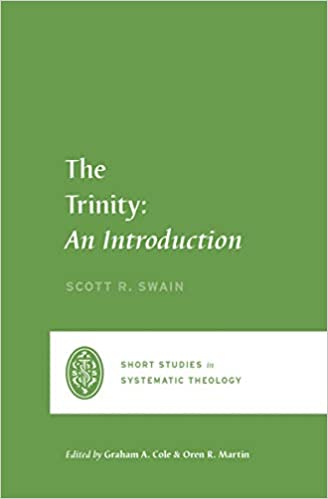
A Brief Book Summary from Books At a Glance
by Steve West
Table of Contents
1 The Bible and the Trinity: The Basic Grammar
2 The Bible and the Trinity: Three Types of Texts
3 The Simplicity of God
4 God the Father
5 God the Son
6 God the Holy Spirit
7 The Shape of God’s Triune Work
8 The End of God’s Triune Work
Summary
Introduction
Christians rightly praise the triune God in all kinds of circumstances and on all kinds of occasions. We praise him for his glory and greatness, and for his works. He is the great Creator and has redeemed us by the blood of Christ. We praise him because he reigns, has filled us with his Spirit, and is bringing us to a glorious eschatological reality. We praise the one who is Father, Son, and Spirit. We praise him who is our Father through the Son, in the Spirit. In baptism we use the triune name: there, the God who is our Father seals us through the Son by the Spirit. The blessed Trinity in his being and works is the principal subject matter for systematic theology. Scripture is the norm and highest authority for our theological formulations, so this study aims to provide a basic grammar of how Scripture speaks of the Trinity. It also aims to shape us to be more fit receivers of these doctrinal truths so that we can respond to God as we ought. We want to increase our fellowship with the blessed Trinity. Studying the Trinity is both rewarding and challenging, but it is also dangerous and easy to fall into error. Nevertheless, God has revealed himself to us as triune, and he wants us to know him as he really is.
Chapter 1: The Bible and the Trinity
God presents himself to us in Scripture as triune. He is one God in three persons: the Father, the Son, and the Spirit. The OT provides glimpses of this mystery, with God creating by his Word and Spirit, and with passages where we overhear God speaking to his anointed Son. The meaning of these mysteries and riddles is revealed in the NT when God sends his Son into the world and the Spirit is poured out. NT texts bring out the significance of OT texts (e.g., John 1:1-3 & Gen. 1:1-3; Ps. 2 & Heb. 1; Ps. 110 & Mark 12:35-37). Explicit trinitarian texts include the scene of Jesus’s baptism, the triune name for baptism, various blessings in the epistles, and benedictions in the name of Father, Son, and Spirit. Galatians 4:4-7 describes the climax of God’s redemptive work with the climax of his triune self-revelation. It is Scripture that teaches the doctrine of the Trinity—creeds and confessions attempt to express these biblical truths.
A major part of our task is learning how to read the Bible’s own trinitarian grammar. To do so, it may be best to start with the baptismal formula at the end of Matthew 28. There we are told to baptize into one name (singular), and that name is Father, Son, and Holy Spirit. The first point to notice is that NT trinitarian discourse always maintains that God is one. He is not merely the best of all gods: he is in a class by himself, and there is none other. He alone is the sovereign Lord over all things. The second point of biblical grammar for the Trinity is that this one God is identified as Father, Son, and Spirit. Given that there is only one God, these three are not three gods; they are one. The third point is that Father, Son, and Spirit are identified with the one God, yet they are differentiated from one another based on their personal names. They are not distinguished by differences in nature, but by differences in their personal relations (i.e., “relations of origin”). The Father originates from no one. The Son is generated by the Father. The Spirit proceeds from Father and Son. The Father has no personal origin and is the source of the personal origins of Son and Spirit. . . .
[To continue reading this summary, please see below....]The remainder of this article is premium content. Become a member to continue reading.
Already have an account? Sign In