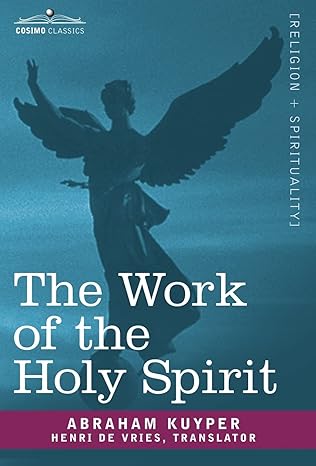
A Brief Book Summary from Books At a Glance
by Steve West
Editor’s Note
Abraham Kuyper’s famous three-volume work on the work of the Holy Spirit remains a classic, holding high acclaim in its first publication with a Foreword from B.B. Warfield. We don’t know why it took us so long to feature it here on Books At a Glance, but we’re eager to provide this summary of volume one today!
Table of Contents
1 Introduction
2 The Creation
3 Re-Creation
4 The Holy Scripture of the Old Testament
5 The Incarnation of the Word
6 The Mediator
7 The Outpouring of the Holy Spirit
8 The Apostolate
9 The Holy Scriptures of the New Testament
10 The Church of Christ
Summary of Volume One
Chapter 1: Introduction
We need divine guidance when learning about the Spirit, because the Spirit lies deep within the mysteries of God. Scripture must be our source for knowing the Spirit, since we can confuse the activity of our own spirits for the Holy Spirit. People provide contradictory accounts of their personal experiences, can misinterpret them, and filter them through personal and national proclivities and tendencies (e.g., different cultures are far more emotionally expressive than others). Certain theologians, preachers, and laypersons have enormous influence in particular locales, and they shape how people think of the Spirit. These things are too deep to be taught to us by mere mortals: ultimately only the Spirit can teach us about himself. We must turn to Scripture, but even there we find that there is not as much material about the Spirit’s work as we may wish for our study. The OT is largely silent, and the NT rightly focuses far more attention on Christ. Part of the Spirit’s work is to reveal Christ clearly to us.
“The work of the Holy Spirit that most concerns us is the renewing of the elect after the image of God.” But this work is one link in a long chain. In order for this to occur, the Spirit needed to be active in the incarnation and work of Christ. He needed to prepare for Christ in the OT; he needed to make human beings in the image of God; he needed to be active in the creation of the universe. The chain of his work also moves forward: the Spirit will be at work in the eschatological consummation. What all of this means is that our place in election is not the Spirit’s chief concern; his chief concern is that God be justified and glorified in all his works. The vindication of God rather than the salvation of man is the focus of the work of the Spirit. God’s indwelling works are eternal and one, but his external works of creation, redemption, and sanctification are associated with different persons of the Trinity. It is far more important for people to have experienced the works of God than to be able to parse them in-depth, but it is good for us to grow in our understanding of the operations of the triune God. A basic principle is that the power to bring forth comes from the Father; the power to arrange from the Son; and the power to perfect from the Spirit. In the persons of the Trinity, the Father generates, the Son is generated, and the Spirit proceeds from both. The Spirit works to lead people to the fullness and perfection of their nature. . . .
[To continue reading this summary, please see below....]The remainder of this article is premium content. Become a member to continue reading.
Already have an account? Sign In