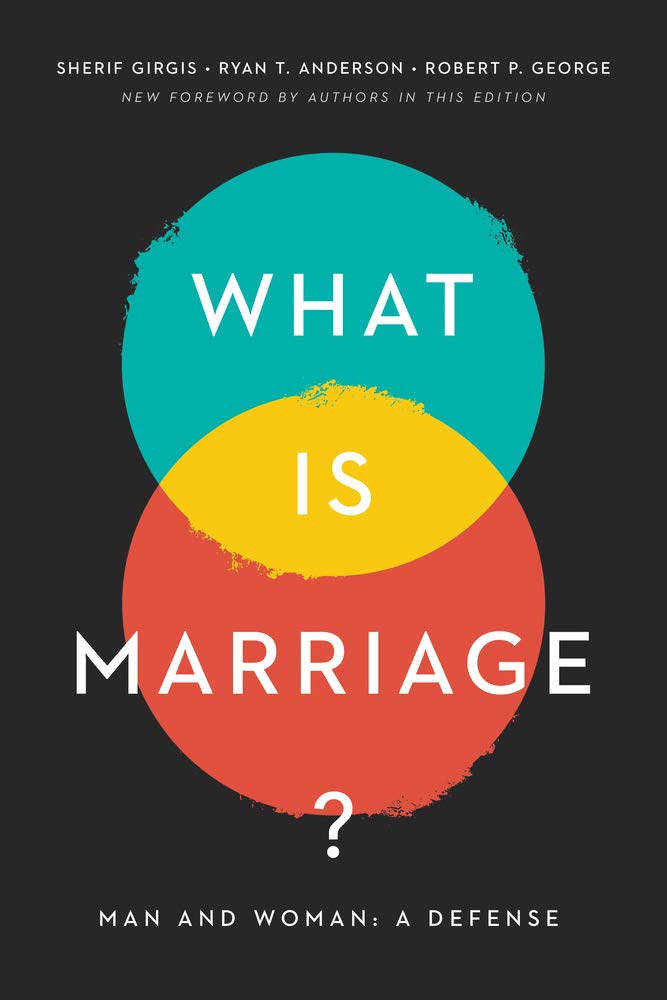
A Brief Book Summary from Books At a Glance
by Steve West
Table of Contents
Introduction
1 Challenges to Revisionists
2 Comprehensive Union
3 The State and Marriage
4 What’s the Harm?
5 Justice and Equality
6 A Cruel Bargain?
7 Conclusion
Appendix: Further Reflections on Bodily Union
Summary
Introduction
The debate about same-sex marriage is really more about the nature of marriage itself than it is about issues of homosexuality. Our civilization’s historical view of marriage has been the conjugal view, where marriage is a monogamous, lifelong covenant and comprehensive union in bodily, emotional, and spiritual bonds that is to be upheld with love and faithfulness. This marital love is to flow out into wider family life and is foundational for society. Currently, a new, revisionist view of marriage has emerged. This second view reduces marriage to a feeling of love, where each partner seeks their own emotional fulfillment, and where the marriage lasts so long as the feeling is present. For many, the feeling trumps everything else, and current spouses and children are sacrificed if necessary to establish an emotional relationship with another partner. In contrast, the conjugal view of marriage is a comprehensive union which is marked by sexual intimacy that is permanent and exclusive. It prioritizes the welfare of children and thus is a public good. The revisionist view is neither heterosexual nor homosexual: the sex of the partners is irrelevant given its understanding of marriage. The current debate about same-sex marriage is a challenge to the traditional conjugal view of the nature of marriage itself.
“Marriage is, of its essence, a comprehensive union: a union of will (by consent) and body (by sexual union); inherently ordered to procreation and thus the broad sharing of family life; and calling for permanent and exclusive commitment, whatever the spouses’ preferences.” Marriage is a moral good and is good for society. Since marriage is so good for society and the welfare of children, the state has an interest in supporting it (unlike in the case of nonmarital relationships like friendships). If the state recognizes same-sex marriages, marriage itself will be misunderstood and redefined in ways that are negative for individuals, families, and society at large. The conjugal view of marriage can be defended, and thus same-sex marriage rejected, without talking about the morality of homosexual sexual acts. It is vital to recognize that the argument is about the nature of marriage rather than the morality of homosexual practice.
Chapter 1: Challenges to Revisionists
Although we can think of a number of ways to have a good life, there are certain basic human goods that must be present for human flourishing. Friendship and marriage are both goods, but they are not identical. Revisionists are wrong in their view about what marriage is; there is an objective nature that marriage has which must be recognized. Revisionists reduce marriage to a special relationship, but they cannot define what makes marriage more than chosen companionship. The state has an interest in marriage because marriage is a sexual relationship that is to be monogamous. The state has no right to set the terms for friendships, but it does have a right to set certain terms for entering into marriage, and also for ending it.
Marriage and family are essential for strong structured relationships in a society in a way in which friendship is not. Marriage is ordered along family life, not just around emotional attachment. Given revisionism, the state has no more interest in marriage than in friendship. Sex is not merely about emotional connection or feeling good; it consummates a marriage, so non-sexual friends or blood relations cannot be considered spouses. There is something about sex that unites two people into one in a way that nothing else can. This complementarity also requires that the sexual partners be one man and one woman. Recognizing same-sex relationships as marriage eviscerates the state’s ability to avoid recognizing many other relationships and arrangements as marriages. Rejecting a conjugal view of heterosexual, monogamous marriage renders marriage formless, and thus pointless. . . .
[To continue reading this summary, please see below....]The remainder of this article is premium content. Become a member to continue reading.
Already have an account? Sign In