A Brief Book Notice from Books At a Glance
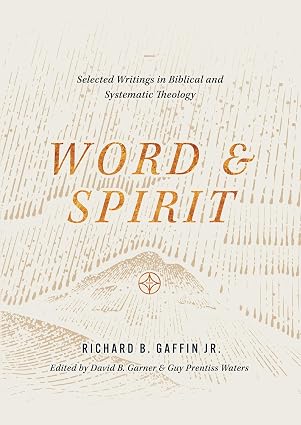
This book is a treasure – a collection of forty-one shorter essays from Richard Gaffin of Westminster Theological Seminary. A must-have, must read resource!
Table of Contents
Part 1: Hermeneutics, Biblical Theology, and Systematic Theology
1 The Redemptive-Historical View
2 “For Our Sakes Also”: Christ in the Old Testament in the New Testament
3 Systematic Theology and Biblical Theology
4 Biblical Theology and the Westminster Standards
5 Biblical Theology at Westminster Theological Seminary
6 Systematic Theology and Hermeneutics
7 Redemption and Resurrection: An Exercise in Biblical-Systematic Theology
8 The Vitality of Reformed Systematic Theology
9 Introduction to Redemptive History and Biblical Interpretation
10 The Place and Importance of Introduction to the New Testament
Part II: Theology of Hebrews and Paul
11 The Usefulness of the Cross
12 “Life-Giving Spirit”: Probing the Center of Paul’s Pneumatology
13 “The Obedience of Faith”: Some Reflections on the Rationale for Romans
14 Paul the Theologian: A Review Essay
15 Paul as Theologian: A Review Article
16 Atonement in the Pauline Corpus: “The Scandal of the Cross”
17 The Priesthood of Christ: A Servant in the Sanctuary
Part III: Scripture, Epistemology, and Anthropology
18 Epistemological Reflections on 1 Corinthians 2:6–16
19 Speech and the Image of God: Biblical Reflections on Language and Its Uses
20 The New Testament as Canon
21 “All Mankind, Descending From Him. . .”?
22 Translator’s Foreword to Adam in the New Testament
23 No Adam, No Gospel
Part IV: Pneumatology
24 The Holy Spirit
25 The Work of the Holy Spirit
26 The Holy Spirit and Eschatology
27 Pentecost: Before and After
28 Tongues Today?
29 What about Prophecy and Tongues Today?
30 A Cessationist View
Part V: The Law of God, Soteriology, and Eschatology
31 The Work of Christ Applied
32 “For Us and for Our Salvation”
33 Calvin’s Soteriology: The Structure of the Application of Redemption in Book Three of the Institutes
34 Union with Christ: Some Biblical and Theological Reflections
35 Justification and Union with Christ: Institutes 3.11–18
36 Justification and Eschatology
37 Justification, Faith, and Works: Calvin on Ezekiel 18:17
38 “More Than That”—Christ’s Exaltation and Justification
39 Westminster and the Sabbath
40 What “Symphony of Sighs”?: Reflections on the Eschatological Future of the Creation
41 Theonomy and Eschatology: Reflections on Postmillennialism
Selected Quotes
- According to its self-witness the Bible provides documents that more properly have God as their author than the fully engaged human authors and editors integrally involved in their production. Unlike any other texts, God is ultimately accountable not only for their content but also for their syntactic-semantic form and the plurality and specificity of the words used. (28)
- Biblical theology is indispensable to systematic theology because biblical theology is regulative of exegesis. This insight of Professor Murray, which at a first glance may not seem to address directly the relation between biblical and systematic theology, provides the key to understanding not only that relationship but the true significance of biblical theology itself. (65)
- Taking a very large view and surveying biblical studies as a whole over the past century, it is fair to say that few developments, if any, have had such a far-reaching impact as preoccupation with the eschatology of the New Testament writers, a preoccupation which has eventually come to dominate New Testament studies. (175)
- The dethroning of the power of sin is unquestionably at the heart of Paul’s theology of the cross. (273)
- The outpouring of the Spirit that took place on Pentecost completes Christ’s once-for-all work for the church’s salvation. Therefore, the whole church—one, holy, catholic, and apostolic church at all times and in every place, not just one or other denomination—is the Pentecostal church. (425)
- The stress in this paper has been on the redemptive-historical, Christological difference Pentecost makes, and that we must not confuse historia salutis apples with ordo salutis oranges. (468)
- “The riches of Christ,” according to the apostle Paul, are “unsearchable” or, as we may also translate, “fathomless,” “boundless” (Eph. 3:8). The work of Christ, manifesting as it does “the manifold wisdom of God” (v. 10), is so multifaceted that in its totality it cannot be known fully or exhaustively. At the same time Paul’s prayer for the church reflects his confidence that by the power of the Spirit it will comprehend these multiplex and ultimately unfathomable riches in something of their full dimensions, that it will in fact “know the love of Christ that surpasses knowledge” (vv. 18–19; cf. v. 16). What is bounded by incomprehensibility may also be known, truly and adequately. (651)