A Book Review from Books At a Glance
by Thomas Haviland-Pabst
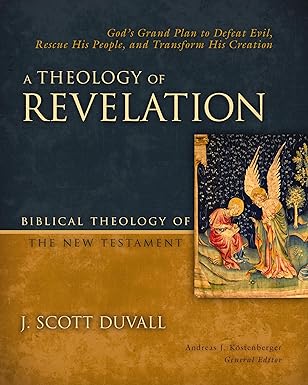
Duvall, professor of New Testament at Ouachita Baptist University, with this theology of Revelation has provided a welcome addition to the Biblical Theology of the New Testament series, edited by Andreas J. Köstenberger.
The book is divided into five parts. The first part discusses “introductory issues” (p. xiii). Here, the description of the first part as covering introductory issues is somewhat misleading as some readers may think of, for example, An Introduction to the New Testament by D. A. Carson and Douglas Moo (Zondervan Academic, 2005) which discusses many of the same things this theology of Revelation covers for each book of the NT, though of course not to the same degree. Quite simply, it is an introduction to A Theology of Revelation, not to the book of Revelation after the manner of Carson and Moo’s Introduction.
The second part situates the book of Revelation in its historical context. Specifically, the authorship and dating of Revelation as well as the occasion and purpose are discussed. Contrary to much critical scholarship, Duvall takes the position that the apostle John wrote the book of Revelation. Along with the majority of scholars, he makes the case for a late date, “around AD 95, during the reign of Domitian” (p. 41), though he is careful to add that good arguments can be made for an early or late date. However, he also adds that whether one affirms an early or late date does not have much bearing on the text. On this score, more familiarity with the work of contemporary (partial-)preterist interpreters, such as the two-volume commentary by Kenneth Gentry, Jr. (The Divorce of Israel [The Chalcedon Foundation, 2024]), would have called into question his assessment regarding the inconsequentiality of dating for interpretation.
Regarding the occasion, after some helpful discussion, he offers this summary: “the social setting [of the seven churches in Asia minor] … presents the church with two dominant challenges: pressure and persecution on the one hand or assimilation and compromise on the other” (p. 54). The purpose of Revelation, Duvall argues, is to provide a “vision of hope” since “God is on his throne and Jesus rather than Caesar is Lord” (p. 55) as well an encouragement to persevere in the faith and a warning to those who would turn away from Christ under various pressures.
The third part, which is over two-hundred pages and consists of seven chapters, gives attention to “literal-theological foundations for the theology of Revelation” (p. 59). Thus, the genre, text and canonical status and function of Revelation, its grammar and symbolic language, the use of the OT in Rev, and the literary structure are covered. Following this, Duvall provides a detailed discussion of the various main interpretations of Revelation as well as a brief (roughly hundred page) commentary on the book.
Duvall helpfully argues for Revelation as a “mixed or hybrid genre” (p. 72) book, consisting of apocalyptic and prophetic elements as well as an epistolary frame. He rightly contends that apocalyptic and prophetic genres are not easily distinguished but rather the former is a form or, with G. K. Beale, intensification of prophecy. Moreover, he makes the sound assessment that “[t]extual criticism in Revelation … is more complicated than in the rest of the [NT]” (p. 81), as a brief comparison of the UBS4 and UBS6, and their respective commentaries, will demonstrate. Duvall helpfully reminds the reader that we grasp the meaning of the symbolic language of Rev not by looking at current events but rather by connecting it with OT/Jewish and Greco-Roman imagery that John and his readers would have been familiar with. Like many recent evangelical interpreters, Duvall follows G. K. Beale’s lead on Revelation’s use of the OT, adding that typology is the broader category in which these uses ought to be placed.
Commenting on whether the literary structure of Rev. ought to be understood as “[c]hronological progression or literary recapitulation,” Duvall pushes against an either/or approach. He writes, “Revelation seems to spiral forward [i.e., progression] as events are repeated [i.e., recapitulation] to some degree but with ever increasing intensification” (p. 132). While Duvall’s desire for a ‘both/and’ regarding this question is commendable, we suspect that readers will tend to stress and emphasize one over the other, depending on their broader interpretative strategies regarding Rev.
This is seen in Duvall’s later discussion of the four main views of Revelation: preterist; historicist; idealist; and futurist. With a number of other scholars, Duvall takes an “eclectic view,” which “draws on the strengths of the various views while trying to avoid their weaknesses” (p. 144). However, he notes that even an eclectic approach could still have a particular leaning, citing two eclecticists who move in different directions, namely, G. K. Beale in an idealist direction and Grant Osbourne in a futurist one.
Turning to the fourth part of the book, he elucidates key theological insights offered by Revelation such as God, Jesus Christ, the Holy Spirit, salvation, the church, worship, discipleship and God’s judgment against evil.
At this point, the reader may notice something peculiar. Even though this book is titled A Theology of Revelation, only about half of the book is in fact focused on the theological themes of Revelation, properly speaking. Aside from the hundred-page commentary on Rev., the bulk of the content gave attention, in expansive form, to the same ground that would be covered in an introduction to the NT. Thus, the title of the book as well as of the series is a bit misleading. Yes, a theology of John’s Apocalypse is offered and a good one at that. But it is so much more than a theology of Revelation. It is better described as a handbook of Revelation as it covers so much ground and, in many ways, all things being equal, could easily be the primary resource one consults on the book, especially for a busy pastor or Sunday school teacher. Does this mean that it replaces the need for introductions to the NT or commentaries on Revelation? Of course not. But it does mean that by labelling the book A Theology …, certain expectations are in place, namely, that this book, in the manner of, say, Richard Bauckham’s earlier The Theology of Revelation, would be primarily focused on the theological themes of Rev., with only brief attention given to introductory matters in the vein of the aforementioned volume by Carson and Moo.
In sum, for any serious student of Revelation, get this book and read it. Will every serious scholar of the book agree with everything? No. But, as something like a handbook, it gives the reader a comprehensive look at Revelation. In addition, by focusing on such themes as discipleship and worship, Duvall demonstrates that Revelation is eminently practical and thus he helps us to resist the temptation to relegate Revelation to obscurity in our own lives and in our churches. Duvall’s clarity of thought and expression commend a continued reading of Revelation in the strongest of terms.
Thomas Haviland-Pabst