A Brief Book Notice from Books At a Glance
Table of Contents
1 The Christian War against Economics
2 What is Economics?
3 Some Basic Economic Concepts
4 The Theory of Subjective Economic Value
5 The Market
6 Capitalism I
7 Capitalism II
8 Socialism
9 Christianity and Marxism
10 True and False Liberation Theology
11 Interventionism
12 The Great Depression I
13 The Great Depression II
14 Social Security
15 Money, Mammon, and Wealth
16 Poverty in America
17 Third-World Poverty
Selected Quotes
- “Unfortunately, many Christians act as though the only thing that counts is intention. But when good intentions are not wedded to sound theory, especially sound economic theory, good intentions often result in actions that produce consequences directly opposite to those we planned.” (9)
- “The market that I’ll be discussing in this chapter is the set of procedures or arrangements that prevail throughout a society that allows voluntary exchanges. In one sense, the market is the framework of customs and rules within which specific voluntary exchanges in specific markets take place.” (47)
- “Capitalism is that economic system in which people are encouraged to make voluntary exchanges within a system of rules that prohibit force, fraud, and theft.” (69)
- “Capitalism is quite simply the most moral system, the most effective system, and the most equitable system of economic exchange.” (80)
- “Liberation theologians do more than promote a synthesis of Marxism and Christianity; they often attempt to ground the radical political and economic changes they seek on their interpretation of the Bible.” (102)
- “A true liberation theology will also recognize that deliverance from poverty requires a rejection of Socialist measures that ignore the creation of wealth. And a true liberation theology will never support a totalitarianism of the Right or the Left.” (113)
- “Even though money is a social institution that can be the source of much good, it—like anything else in God’s creation—can be turned into an idol. It is when this happens that money becomes mammon. On the view being suggested here, what should concern the believer is not money (something necessary for economic exchange) but improper attitudes towards money.” (162)
- “Some poverty—perhaps a great deal of poverty—is not explicable in exclusively economic terms because it has a cultural, moral, and even a religious dimension.” (194)
Buy the books
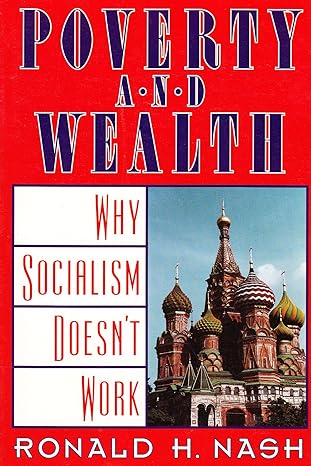
POVERTY AND WEALTH: WHY SOCIALISM DOESN'T WORK, by Ronald H. Nash