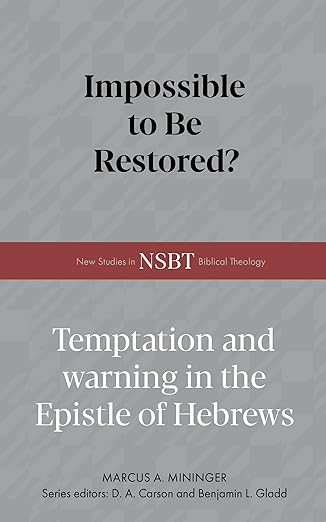
A Book Review from Books At a Glance
by Ardel Caneday
Mininger correctly looks to the text of Hebrews, rather than to speculative ideas, to determine what prompted the unnamed author to write the epistle/sermon for its recipients. He explores the author’s own categories, rhetoric, and theological framework to identify the original readers’ situation that Hebrews addresses.
Two crucial questions govern his focus on the readers’ temptation and the writer’s warnings: (1) What specific temptation did the first readers encounter? and (2) What warning does the author issue in response to that temptation? Mininger addresses the first question in Chapter 2, adopting the traditional view that the temptation Hebrews counters is a return to the forms of old covenant religious life and worship. He correctly states that the problem is not simply a return to “Judaism” as a religion, but a redemptive-historical retreat from the new covenant to the old, using it as the defining basis for one’s relationship with God.
On the second question, he argues that Hebrews addresses the specific attraction the old covenant held for the first readers, namely, withdrawing from Christ Jesus and returning to the old covenant’s foundational structures—repentance from dead works, ritual washings, laying on of hands, resurrection, and judgment (Heb. 6:1-2). Crucial to Mininger’s thesis is the question of whether apostatizing from their Christian confession brings permanent results so that “it becomes impossible to repent, be forgiven, and be restored to Christian fellowship and salvation” (p. 13). This gets to the core of Mininger’s contention concerning how to understand the intense expressions in Hebrews 6:4-6, “that it is impossible for those who have fallen away from Christ to be restored to repentance” (p. 14).
In Chapter 3, Mininger surveys eight explanations of Hebrews 6:4-6 in his quest to develop what he believes is “a more persuasive, alternative interpretation” (p. 39). He rejects all eight views, claiming they “betray key weaknesses that make them unpersuasive” (p. 39). All eight views concerning Hebrews 6:4-6 derive from focusing on the same question: “Is it possible for someone once saved to apostatize and perish?” Though it becomes apparent that Mininger does not perceive it, this same question governs his own handling of the text, leading him to his unique explanation of what is impossible, for whom it is impossible, and why it is impossible. Thus, the book’s title, Impossible to Be Restored? Temptation and Warning in the Epistle of Hebrews.
In Chapter 4, Mininger argues that exegetes have failed to distinguish the imagery of a prolonged milk diet (Heb. 5:12-6:1a) from that of “re-laying a foundation” (6:1b-2), because they accept both as referring to “the elementary doctrine of Christ.” He isolates the two imageries, the first speaking of “mere immaturity” and the latter of “the risk of destruction” (p. 71). He contends that the imagery in Hebrews 6:1b of “not re-laying a foundation” is not a restatement of Hebrews 5:12-6:1a. Instead, it “implies starting all over from the ground up,” building an “essentially different kind” of structure (p. 66), rebuilding their religious identity on the earlier old-covenant foundation of repentance, faith, washings, laying on of hands, resurrection, and judgment (Heb. :1b-2).
Then, Mininger points to another list of religious experiences in 6:4-5—“having once been enlightened, having tasted the heavenly gift, having partaken of the Holy Spirit, and having tasted the good word of God and the powers of the age to come”—all speaking of transitioning into experiencing the new covenant. Thus, Hebrews admonishes readers, as new covenant members, to move forward and warns against going backward (p. 72).
In Chapter 5, Mininger contends that “repentance” (metanoia), which appears twice in Hebrews 6, occurs in the first list of religious experiences under the old covenant (Heb. 6:1b-2). He excludes repentance, mentioned in Hebrews 6:6, from the second, which concerns religious experiences under the new covenant spoken of in Hebrews 6:4-5. Mininger claims this second mention refers to repentance under the old covenant, which “a person cannot be restored to after experiencing the items mentioned in the second list and then falling away, as 6:6 states” (p. 74).
Though he concedes that “the two lists are related to each other in the author’s argument,” he contends that the experiences in Hebrews 6:1b-2, taken as an aggregate, are “primarily associated with the old covenant within the thought-world of Hebrews . . . in direct contrast to the new covenant” (p. 85). Mininger’s argument is dense and difficult to grasp because his exegesis has no familiar antecedents. He views the impossibility of restoration to repentance in Hebrews 6:6 not within the Christological framework of the new covenant, concerning restoration to Christ, but within a “very generic, non-Christological” framework of the old covenant, concerning a right standing with God (p. 91). Mininger unpacks his unique reading of the text in the next two chapters.
Chapters 6 and 7 constitute the core of Mininger’s thesis with two foci: (1) falling away by trying to return to the old covenant, and (2) the impossibility of being restored to repentance. He claims Hebrews sketches two strongly contrasted profiles in 6:1b-2 and 6:4-5. The first is “a list of old-covenant beliefs and practices” more broadly described “theologically” (p. 85; emphasis added), and the second is a list of new-covenant experiences framed “Christologically” (p. 90; emphasis added). He sees faith as common to both the old and new covenant eras. Yet “the very generic, non-Christological mention of ‘faith in God’ in Hebrews 6:1 certainly fits much better with this letter’s descriptions of faith during the old-covenant era than that of the new” (p. 91; emphasis added). This is to say that “faith in God” does not feature the “Christological content of new-covenant faith . . . but instead remains entirely at home in the content of the old era” (p. 91; emphasis added), even if belief during the old covenant shared “much in common” with belief in the new era (p. 91).
Mininger grounds his claim on Acts 19:1-7, where “a message of repentance spoken by John the Baptist . . . is specific to the old covenant alone in clear contrast to the new” (pp. 98-99). He reasons that John’s disciples benefited from the message of repentance and faith, but it was “inadequate for life in the new era of apostolic preaching” (p. 99). He fits this “distinctively old-covenant meaning of repentance” into “Hebrews’ language and argumentation” that draws “a striking contrast between the lists in 6:1b-2 and 6:4-5” (p. 99). Mininger unpacks this contrast: the first “is strongly and sometimes exclusively associated with the old covenant in Hebrews;” the second “is all distinctively connected to the new covenant in Hebrews (p. 100). So, Mininger confines both mentions of repentance in Hebrews 6:1b, 6 to the old covenant’s domain, isolating a repentance “that is specific to the old covenant alone in clear contrast to the new,” as he appeals to Acts 19:1-7 (pp. 98; emphasis original).
Thus, he argues that the warning in Hebrews 6:6 does not speak of the impossibility of being restored to repentance in relation to Christ Jesus after falling away from him. Instead, because the original readers of Hebrews were tempted to withdraw from the new covenant and retreat to the old, the warnings in both Hebrews 6:4-6 and 10:26-27 mean that anyone who rejects Christ “after receiving knowledge about the new covenant no longer has old-covenant sacrifices still available . . . as a means through which to relate rightly to God” (p. 109).
Mininger appeals to the use of “again” (palin) in Hebrews 6:1 (“not lay again”) and Hebrews 6:6 (“impossible to restore again”) as proof that it is impossible to be restored again to repentance “after experiencing new-covenant enlightenment and then falling away” (p. 112). What is the impossibility warned against? He adopts a unique explanation: Hebrews warns that what individuals have “experienced by entering into the new covenant and its blessings brings about a decisive change in their situation that makes a return to the arrangement of the old era and its provisions impossible” (p. 116). Restated, what is impossible is “to go back repentantly to the old covenant alone and have a right standing before God by re-laying a foundation that uses only old-covenant materials” (p. 116). That option “is simply not a viable possibility” (p. 117).
Mininger insists that the “impossibility of repentance does not mean the impossibility of returning to Christ to receive forgiveness again and through him after falling away” (p. 119; emphasis original). He contends that the warning of Hebrews 6:4-6 means only that “someone who falls away from Christ cannot return to right standing with God through the old covenant alone in distinction from the new” (p. 119; emphasis added). He contends that whether anyone who apostatizes “can return to Christ again after falling away does not seem to be something that Hebrews comments upon directly” (p. 119), thus adopting a unique position. Stated as plainly and clearly as I understand it, Mininger contends that the impossibility of being restored to repentance does not refer to returning to Christ Jesus. Instead, since the old covenant is redemptively defunct and its sacrifices no longer atone, one cannot be restored to a right relation with God by repenting under that covenant.
Chapter 8, “Relating the covenants,” is refreshing after slogging through Mininger’s unique and confusing explanation of Hebrews 6:6. He correctly insists on a deep continuum between the old and new covenants with a redemptive-historical contrast from a good covenant to a better one. The covenantal contrast is not between “works and grace but between grace and grace” (p. 124; emphasis original). The old covenant prepared for and anticipated the new with its God-appointed tabernacle, arrangements, sacrifices, priesthood, etc. Even the individual examples of faith, before the new covenant era, “looked forward to . . . what new-covenant believers also seek and will receive, namely dwelling in the eternal, heavenly country or in the city built by God” (p. 127).
The redemptive continuity with historical contrast between the covenants prompts Mininger to inquire concerning the need for Hebrews to warn readers “not to return to reliance on the old alone” (p. 128). The answer, he explains, is that God designed the old covenant as purposefully preparatory to the new, which is why it was “inherently temporary and salvifically inadequate from its inception” (p. 130). Thus, he argues, to depart from the new covenant and return to the old would be abandonment of the covenant “that provides the full, permanent cleansing of the conscience before a holy God, which is necessary for being perfected and avoiding ultimate judgment” for the lesser covenant which God gave, designed only to foreshadow what it could never provide or achieve on its own. Such a turn would be to embrace earthly shadows and not the heavenly realities, a turn “inherently tragic and fatal” (p. 132). One need not agree with Mininger’s explanation of the warning to acknowledge that this is a solid and substantive expression concerning the biblical-theological relationship of the two redemptive-historical covenants.
God arranged the covenants in a progressive, redemptive-historical order. Old covenant believers genuinely knew and obeyed the Lord, were rightly related to him through repentance and faith, and were blessed by observing God’s gracious provisions bound up with that covenant. Thus, there is forward movement from the old to the new, but any effort “to move backward from faith in the new covenant to faith in the old only” is diametrically contrary to God’s design (p. 134; emphasis original).
He rightly insists that to retreat to the old covenant shadows from the heavenly substance they figured, or to regard the shadows as if they were the heavenly substance, means that one forsakes God’s Son, whom he sent to make full atonement for sin (Heb. 6:6). To turn away from the one whom all the old covenant sacrifices foreshadowed constitutes apostasy. God designed the old covenant as a promissory codicil to his covenant with Abraham, conveying assurance of its coming climactic fulfillment (p. 135).
Consequently, Mininger rightly states, “Because the grace pointed towards or typified in the old is the same grace now present and realized substantively in the new, any proper movement between these two systems is one way only” (p. 136). He also correctly recognizes that Hebrews teaches that the way the two covenants relate to one another accounts for the necessity of issuing a severe warning, lest hearers turn away from the eschatological arrival of the heavenly sanctuary with Christ Jesus and return to the promissory shadow sanctuary of the old covenant. All who reverse the redemptive-historical order of the two covenants will await judgment and destruction.
In Chapter 9, Mininger considers the pastoral relevance of the warning in Hebrews 6 to the first recipients and now. He suggests the first audience had no animosity toward Christ or the new covenant, but their temptation to retreat to the old covenant likely derived from government-sponsored hostilities, including public reproach, seizure of property, imprisonment for some, and even the threat of martyrdom (p. 148). Thus, he reasons, their “return to an old-covenant-only profession of faith” offered them a haven where they could remain, so they thought, in good standing with the God of the covenants (pp. 151-152).
Mininger points to three general applications of the warning to contemporary Christians: (1) the apostasy from Christ in Hebrews 6:4-6 is not an “unforgivable sin,” (2) because, like the first hearers of the epistle, we live in the “last of these days” (Heb. 1:2), experiencing the same new covenant blessings as they, and (3) the whole of Hebrews provides a model of theological discourse both with what and how it expresses it (pp. 155-162).
Early in his book, in Chapter 2, Mininger situates the problem that the writer of Hebrews addresses. He correctly rejects the various revisionist approaches, upholding the traditional understanding that the epistle/letter addresses first-century believers who welcomed the redemptive-historical progression of covenants, leaving behind the old and welcoming its fulfillment with the arrival of Christ and the new covenant. Thus, Mininger is convincing when he returns to this in Chapter 8 to develop how the two covenants relate. He rightly argues that the writer of Hebrews issues a series of warnings against a redemptive-historical regression, forsaking the new covenant and relapsing to the old covenant as the basis of one’s relationship with God. To return to embrace the now defunct old covenant is to retreat into its earthly shadows and forsake the heavenly realities now present, which arrived with Christ Jesus.
However, Mininger’s exegetical reasoning and arguments throughout Chapters 4 through 7 are not convincing, and thus his unique understanding of Hebrews 6:4-6 is flawed. He rejects the belief that verse 6 warns against the impossibility of being restored to repentance in relation to Christ after falling away from him. Instead, Mininger contends that the warnings of Hebrews 6 and 10 mean that if an individual receives knowledge of Christ and the new covenant and then retreats from the new to regress back to the old covenant, one will find that old covenant sacrifices no longer provide forgiveness of sins as they did under the old covenant. Thus, he argues, the hope of being restored to repentance by the old covenant alone is no longer workable. Mininger’s statement is correct, but this is not what Hebrews 6 warns against.
As exegetes, our research, interpretation, and conclusions should be weighed, checked, and evaluated against the exegesis of others who have preceded us. The questions exegetes pose concerning the biblical text as we approach Scripture tend to steer our reading, govern our reasoning, and prejudice our interpretation. Hence, Thomas Schreiner and I made this case twenty-five years ago in The Race Set Before Us: A Biblical Theology of Perseverance and Assurance, regarding how we need to read gospel warnings and admonitions, including the five warnings in Hebrews.
We show that the only proper approach to gospel warnings, such as the five in Hebrews, is to avoid making the primary question, “Do warnings indicate that it is possible for an authentic believer to apostatize and perish eternally?” Historically, those who fixate on this question as primary have invariably argued for one of four views: (1) Loss-of-salvation-view (Arminian); (2) Loss-of-rewards-view (Free Grace); (3) Tests-of-genuineness-view (Calvinist); or (4) Hypothetical-loss-of-salvation-view (Calvinist). Each of these four approaches essentially transforms the future-oriented warnings into declarative statements concerning possibility. So, what is the proper approach to understanding gospel warnings? The right and necessary question inquires about the function of warnings. Thomas Schreiner identifies four necessary questions to ask: “(1) To whom are the warnings addressed? (2) What is the issue at stake in the warnings? (3) What are the consequences of falling away? (4) How should the warnings be assessed as a whole?” Thus, Schreiner and I demonstrate that Hebrews addresses the warnings to Christians as a God-appointed means of preserving believers from falling away from Christ and perishing.
Unfortunately, though Marcus Mininger references Thomas Schreiner’s Commentary on Hebrews at least thirty times, nowhere does he show awareness of Schreiner’s essay, “Warnings and Exhortations,” where he engages four characteristic approaches to gospel warnings and argues that warnings function as an appointed “means of salvation” God, through the gospel, addresses to Christians to persevere in Christ and not forsake him.
Also, unfortunately, Mininger does not reference or include other noteworthy resources that Schreiner has published concerning the warning passages in Hebrews. Consequently, among the eight approaches to warnings that Mininger identifies in Chapter 3 of his book, he shows no awareness of the understanding of the warnings in Hebrews that Tom Schreiner and I present in The Race Set Before Us, in which we devoted several pages to addressing the five warning passages in Hebrews. This distinct approach stands apart from all the approaches he lists and rejects, including the unique view he adopts. If Mininger had also accessed The Race Set Before Us, he would have discovered a much fuller development of the same argument Schreiner presents in the noteworthy essay in his commentary. Failure to include these resources and their distinctive contributions to understanding the function of the warnings in Hebrews exposes a significant gap in his research and thus a major flaw in Mininger’s argument.
Mininger correctly acknowledges the harmony between the old and new covenants, noting that both are gracious. Both “Moses and Jesus served the same house, with Moses ministering in that house as servant, Jesus serving over the house as Son” (p. 127). Likewise, he affirms, Israel, under the old covenant, and Christians under the new covenant, are members of “the same people” (Heb. 4:9), “living on the basis of and seeking the fulfillment of the same promise of rest (4:1, 2, 9)” (p. 127). Yet, even if, as he argues, Hebrews 6:1 b-2 includes old-covenant aspects such as “teaching about ritual washings” and “the laying on of hands,” Mininger creates an unwarranted separation between Hebrews 5:12-6:1a and 6:1 b-2, contrary to their discernible linkage. Without any comment, he passes over the use of “again” (palin) in Hebrews 5:12, which links the imagery of “someone to teach you again” forward to the imagery of “not laying a foundation again” (6:1b-2). Consequently, against most exegetes who agree that the second imagery restates the first, Mininger isolates the imagery of “not laying again a foundation of repentance from dead works” from the earlier imagery of needing “someone to teach you again the elementary principles of God’s word” (pp. 53-72). Thus, he builds his whole argument on the premise that “re-laying a foundation” is imagery that portrays the destruction of the existing building of the new covenant and the reconstruction of the old covenant “all over again from the ground up” (p. 62).
So, instead of recognizing a restatement of Hebrews 5:12-6:1a in 6:1b-2, signaled by using “again” (palin), Mininger forges an artificial link between “not laying again a foundation of repentance from dead works” (Heb. 6:1b) with the next use of “again” (palin), in “impossible . . . to restore them again to repentance” (Heb. 6:6). He insists that these two mentions of repentance are to be understood as religious experiences under a non-Christological framework of the old covenant, not the new. This is the primary thread on which he weaves his thesis.
Once he links these two mentions of “repentance” (6:1b & 6:6) as referring to a religious experience under the old covenant, Mininger appeals to the account of John the Baptist’s disciples in Acts 19:1-6, who had experienced only John’s “baptism of repentance,” to reinforce his isolation of a repentance “that is specific to the old covenant alone in clear contrast to the new” (pp. 98; emphasis original). Here, Mininger draws a much too sharp divergence between the covenants. In contrast to Mininger’s appeal to John’s disciples, instructive is the case of Apollos, an eloquent man who had been “instructed in the way of the Lord,” who “knew only John’s baptism,” and who was preaching in synagogues (Acts 18:24-26). Given Apollos’s restricted redemptive-historical knowledge of the Messiah’s completed mission, the warranted inference is that he was correctly preaching the Messiah’s arrival but not his crucifixion, burial, resurrection, and ascension because he knew nothing of these. Thus, when Priscilla and Aquila heard Apollos preach, “they took him aside and explained to him the way of God more accurately” (Acts 18:26).
Again, it is reasonable to infer the same concerning the twelve disciples of John. By asking, “Did you receive the Holy Spirit when you believed?” (Acts 19:2), the Apostle Paul ascertained that they had not yet heard the full good news as it is in Jesus. Like Apollos, they lacked knowledge of the Messiah’s passion, resurrection, and ascension. Thus, they did not realize that the Messiah fulfilled John’s prophecy concerning the Holy Spirit. Paul supplied what they lacked concerning knowledge of the gospel, which they welcomed joyfully by receiving baptism “into the name of the Lord Jesus.” When the apostle laid his hands on them, the Holy Spirit came upon them, and they spoke in tongues and prophesied (Acts 19:6).
If “the baptism of repentance” links Acts 19:1-6 with “repentance from dead works and faith in God” in Hebrews 6:1b, as Mininger argues, but for a reason already disputed, why did he miss two other reasonable connections between these two passages? Just as Hebrews 6:1b speaks of “teachings about baptisms (washings)” and “the laying on of hands,” so Acts 19:1-6 presents Paul instructing the disciples of John about two distinct baptisms (washings) and “the laying on of hands” to bestow the Spirit. Both the old and new covenants include ministrations of washing and laying on of hands. Hence, it is reasonable to infer that distinguishing among these practices in the two covenants would constitute the elementary teaching about Christ during the foundational apostolic period. These accounts of Apollos and the twelve disciples of John are instructive regarding the redemptive-historical continuity between the two covenants and the necessary instruction for old covenant believers to make the transition from the older, preparatory covenant to embrace the fulfillment of the new covenant.
Another account in Acts, one about the Apostle Paul’s participation in offering a sacrifice to fulfill a vow, is instructive about the overlap of the two covenants during the apostolic era until the destruction of the Temple in Jerusalem. According to Acts 21, Paul and his companions arrived in Jerusalem after a long journey. There, James and his associates urged Paul to show publicly that Jews who were zealous for the law had been wrongly informed that he taught Jews throughout the diaspora “to forsake Moses, telling them not to circumcise their children or walk according to our customs” (Acts 21:21). They encouraged Paul to join four men who were under a vow, to purify himself with them, pay for them to have their heads shaved, and go to the Temple to provide notice when the days of purification would be fulfilled and the offering, which entailed two lambs and a meal and drink offering, would be made for them (Acts 21:23-26; Num. 6:14-15). The point to be made is that while the Temple still stood, participating in various old covenant rituals by Jewish Christians did not, by itself, constitute abandonment of the new covenant and apostasy from Christ.
Exegetes of the New Testament, but especially of Hebrews and Paul’s letter to the Galatians, must account for the apostolic era as a time of transition for believers, leaving the earthly shadows of the old covenant to embrace the heavenly realities of the new.
Marcus Mininger’s Impossible to Be Restored? is a serious and ambitious work that deserves credit for its commitment to reading the epistle on its own terms and its substantive treatment of the redemptive-historical relationship between the two covenants. He correctly argues that the warnings in Hebrews counter the temptation to retreat from the new covenant back to the old. His eighth chapter, developing the theological continuity and contrast between the covenants, is alone worth the price of the volume.
Nevertheless, the book, which presents a unique explanation of the warning in Hebrews 6, falls short of its stated aim of offering a more persuasive alternative to existing interpretations of Hebrews 6:4-6. Mininger’s central exegetical move—artificially separating the two imageries in Hebrews 5:12–6:2 and confining both mentions of repentance in Hebrews 6:1b and 6:6 to a non-Christological, old-covenant framework—rests on a crumbling foundation. His appeal to Acts 19:1-7 to isolate a distinctively old-covenant repentance overreaches the evidence. Surprisingly, he offers no observations concerning the account of Apollos, who, like the twelve disciples in Acts 19, knew only John’s baptism. Concerning the transition from the old to the new covenant, he offers no consideration of Paul’s participation in Temple rites, which complicate his sharp covenantal dichotomy concerning repentance and faith in God. Most critically, by not including the work of Schreiner and others on the function of gospel warnings, Mininger inadvertently replicates the very methodological error he attributes to the eight views he rejects: allowing a prior doctrinal question to govern his reading of the text rather than attending first to what the warnings are designed to do. Mininger’s approach to the warning of Hebrews 6 both muddies its meaning and obscures the eternal gravity of falling away from Christ.
Scholars and pastors working through the warning passages of Hebrews will find much to engage here, and Mininger’s covenantal framework provides a genuinely useful lens. But readers should approach his novel interpretation of Hebrews 6:4-6 with critical caution, supplementing it with the broader conversation about the nature and function of gospel warnings that this volume, to its detriment, largely bypasses.
Ardel Caneday