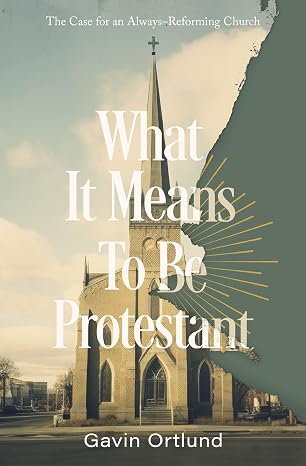
A Book Review from Books At a Glance
by Matt Pitts
The apparent increase in evangelicals converting to Roman Catholicism and Eastern Orthodoxy in recent years has left some evangelicals mystified, others wringing their hands, and still others wondering if perhaps the grass really is greener on the other side.
Ortlund’s chief claim is that both Roman Catholicism and Eastern Orthodoxy are locked-in to questionable theological claims that are not allowed to be questioned. Protestantism, on the other hand, comes with a baked-in means for questioning such claims so that reforming church teaching is not only possible but expected. For example, because of the Roman Catholic Church’s claim of papal infallibility and its insistence that official church teachings cannot be denied without risking damnation, there is no room for dissent and no process by which doctrinal accretions (Ortlund’s preferred word) can be corrected or rejected. By contrast, the central Protestant principle of sola scriptura means that church teaching can always be challenged and reformed by testing it against the only infallible standard, namely, scripture itself.
This principle of sola scriptura is often misunderstood and even maligned by those outside Protestantism, so Ortlund devotes two chapters to this essential Protestant distinctive. The first articulates the historic Protestant position on sola scriptura and the second answers objections often raised against it.
To be sure, there is much about which Protestants can and should agree with Roman Catholics and the Eastern Orthodox. This agreement includes not only moral issues like the sanctity of life but also theological issues like the doctrine of the Trinity. Those drawn to these traditions may in fact be drawn to them precisely because of the rich history of theological reasoning about central Christian doctrines as well as an ancient, reverent, and aesthetic approach to worship, all of which seem to be lacking in evangelicalism. However, there are other doctrines and practices much less central to the faith and yet no less mandatory for those who decide to embrace these traditions. Ortlund spends a full chapter addressing one such claim from each of these branches of the church. For Roman Catholicism he addresses the bodily assumption of Mary. For Eastern Orthodoxy he investigates the practice of venerating icons.
The bodily assumption of Mary is a teaching most Protestants have not even heard of. We know about Roman Catholic devotion to Mary and prayers offered to Mary, but the bodily assumption of Mary is not likely to ring any bells. This doctrine teaches that Mary was in some way taken up into heaven—not in the way that the souls of all believers who die enter into the presence of the Lord, but akin to the way Elijah was taken into heaven or even the way Jesus after his resurrection ascended bodily into heaven. Evangelicals will not be surprised to hear that Ortlund and others argue there is no evidence for this doctrine in Scripture. But what may surprise some who have been accustomed to blame Roman Catholic errors on their devotion to the church fathers is that even Catholic theologians have had to acknowledge there is no evidence for this claim anywhere in the writings of the early church. And yet, Ortlund notes, “immediately after the definition of the bodily assumption of Mary in Pope Pius XII’s Encyclical Munificentissimus Deus, the following consequence is attached: ‘if anyone, which God forbid, should dare willfully to deny or call into doubt that which we have defined, let him know that he has fallen away completely from the divine and Catholic Faith’” (160-61). Such a claim brooks no dissent or even doubt and leaves no room for reform. A doctrine with no biblical or early church support must be believed because a pope of the 20th century said so. This must be faced with eyes wide open by anyone considering leaving the Protestant tradition to join the Roman Catholic one.
The veneration of icons is perhaps the most visibly distinctive element of Eastern Orthodox theology and practice. As with the bodily assumption of Mary for Roman Catholics, Ortlund shows that the veneration of icons is a vital part of the Eastern Orthodox church. One may not become Orthodox and yet refrain from venerating icons. At least in this case it is not the decision of one man who made this doctrine and practice a binding necessity, but the result is the same. Icon veneration was affirmed by Nicaea II which proclaimed, “To those who do not kiss the holy and venerable images anathema!” (188). One of Orthodoxy’s chief attractions is its ancient pedigree, its liturgy unchanged for over a millennium, and its deep roots in the church fathers. Yet Ortlund argues that this distinctive feature of Orthodoxy not only lacks any evidence in the early fathers, but that the council which affirmed this practice “reversed the view of the early church on the veneration of icons” (218).
Ortlund’s conclusion is addressed “to those considering ecclesial changes” (219). This brief exhortation may be where some readers should start. Ortlund acknowledges the weaknesses of Protestantism but simultaneously affirms that “Protestantism is the most catholic and the most biblical of all the major streams of Christianity,” (221) in part because “Protestantism is not the creation of a new church, but the ancient faith in the posture of dynamic change and reform” (220). Ortlund closes with practical counsel for those considering a major change in their ecclesiastical allegiance. He counsels patience and perhaps most importantly he encourages readers to “read and engage the best of each tradition” including our own because “we must be careful not to assume that we understand the best arguments for a particular tradition just because we grew up in it” (223).
Ortlund does not guarantee that he can talk young men and women out of moving from Protestantism to Roman Catholicism or Eastern Orthodoxy. But he does counsel them to patiently consider not only the appeal of those branches of the church but also their less appealing and more problematic positions and practices. Ortlund’s gracious style and wise counsel make this a resource for which all those wading into these waters should be grateful.
Matt Pitts