A Book Review from Books At a Glance
by Matthew B. Tabke
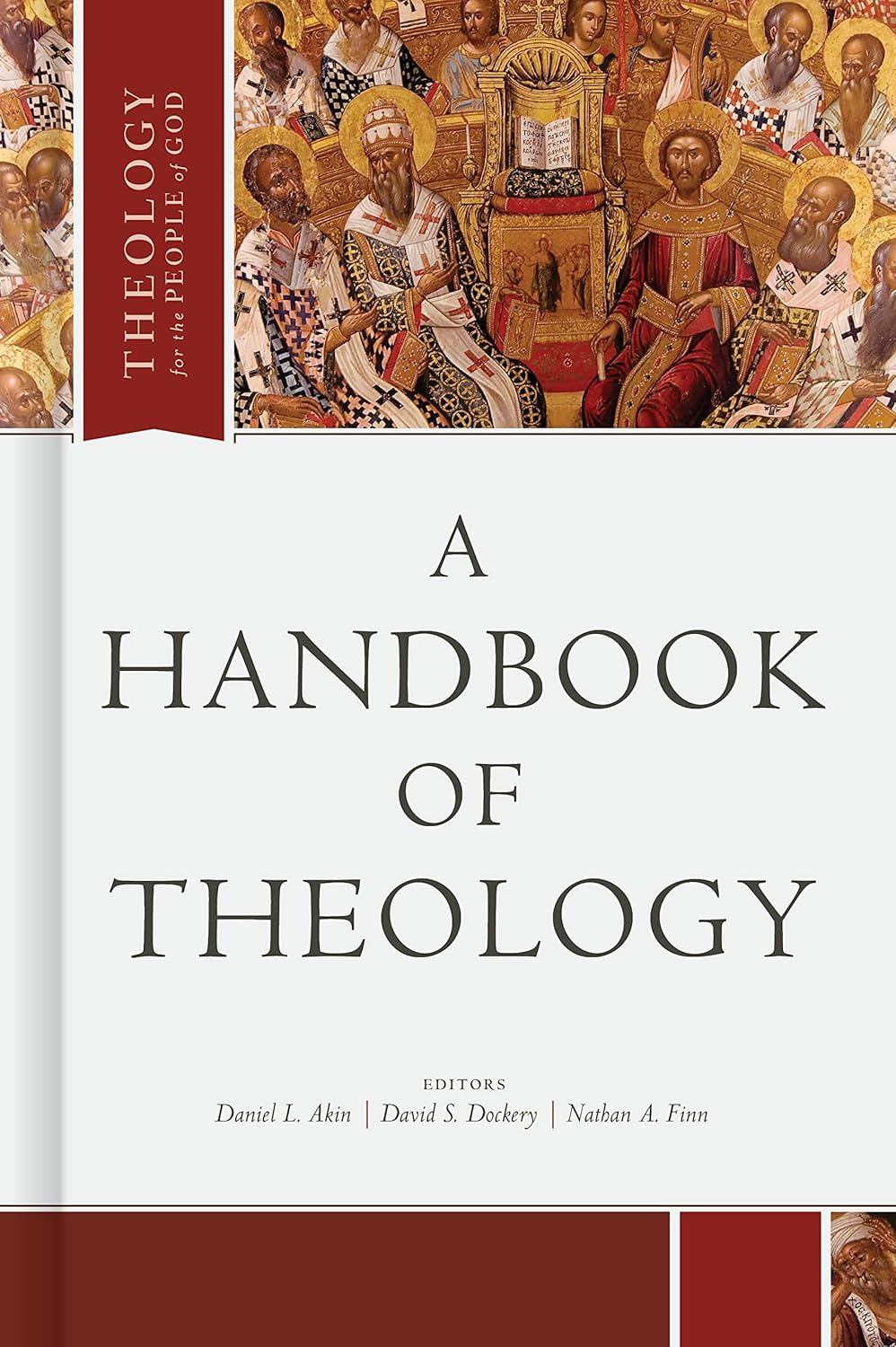
The importance of theology in the life of the church cannot be understated. As the new Handbook of Theology says, “once a believer reads more than one verse in the Bible, she will inevitably begin to put biblical teaching together” (153). As such, Akin, Dockery, and Finn have edited a compilation of essays from over 48 contributors to aid Christians in the task of theology and theological reasoning. The book is not meant to work like various introductions to theology that often work through major doctrines of the Christian faith in the realm of systematic theology. Rather, the book is meant to help Christians navigate the world of Evangelical theology with its presuppositions, major disciplines, practical outworkings, and interactions with the cultural conditions of our day. It is also meant, as the preface states, to serve as the introduction to a series of multi-authored volumes called “Theology for the People of God” and “is grounded in a calling to serve the church” (ix). What some may notice from the outset is that the book is published by B&H Academic and therefore attempts “to be faithful to the best of the Baptist and evangelical heritage” (x). As such, the Baptist perspective on theology is assumed in the various topics covered.
The introduction to the Handbook lays the foundations for the essays contained within. Operating from Ephesians 4, a threefold goal is set forth for the task of the church’s teaching ministry: (1) to build up the church, (2) to lead the church to maturity in faith, and (3) to lead the church to unity (p. 1). These three goals are meant to impact the head, heart, and hands of Christians. The authors operate from a commitment to the Reformation principle of sola Scriptura and attempt to study the Bible and its interpretation through Christian history and doctrine with a heavy emphasis on the practical application of theology. Christian theology is not to be considered the whole of the Christian life, nor merely the work of specialists. It is however, meant to lead to a doxological response, a missional attitude, an awareness of history, and offer endurance for times of trial.
Following the introduction, the work is laid out in six distinct parts, each containing numerous chapters: (1) theological foundations, (2) types of theology, (3) theology, history, and geography, (4) Christian doctrines, (5) theology and the Christian life, and (6) theology and culture. Part 1 deals with topics that impact the presuppositions upon which we construct our theological structure in treating God’s existence, revelation, Scripture, faith and reason, hermeneutics, tradition, and Christian experience. Part 2 moves into the major types of theology considering theology from the categories of biblical, historical, philosophical, systematic, and pastoral. Part 3 works in some ways like short summaries of each major period of church history: patristic, medieval, reformation, modern, and global. Part 4 deals with the major Christian doctrines of Trinity, the attributes of God, covenants, creation, providence, humanity, sin, the Person and work of Christ, justification, sanctification, glorification, the Holy Spirit, ecclesiology, and the last things. Part 5 brings theology into the Christian life by addressing the Gospel, church membership, baptism and communion, discipleship, worship, preaching, missions, spiritual gifts, prayer, and stewardship. The final section of the book addresses Christian response to culture in dealing with religious liberty, the church and state, the sanctity of human life, racial reconciliation, marriage and sexuality, and theology as it impacts the arts and literature.
Though the content of each essay cannot be addressed, nearly every essay addresses the broad contours of theological discussion present in the modern-day Evangelical academy. In considering the complexity of the various issues, the essays then move into Baptist conclusions with a strong emphasis on practical implications. While all the essays address some major area Christian theological conversation in the academy, there are several essays of note that speak to some of the hot-button issues of our day and others that include areas of theology that some Christians are perhaps unaware of. For instance, Owen Strachan’s essay on faith and reason helpfully explains four common frameworks on the relationship between faith and reason before critiquing Aquinas’ view that reason can lead to faith, positing instead that faith stands over reason even though the Christian faith is the most reasonable perspective one can hold. Following Strachan’s essay, Andrew Streett tackles the issue of hermeneutics helpfully addressing how one must be intentional about discerning the human author’s intent in writing a certain passage but must also consider the necessity of theological presuppositions before coming to the text especially concerning the Divine Author’s unified purpose in the Biblical corpus. One will note the inclusion of an essay on philosophical theology by R. L. Hatchett which has tended to be a discipline Baptists or perhaps Christians generally are less familiar with; this essay helpfully draws out the major developments and influence of philosophy on Christian doctrine through history. An essay is also included on global theology which is a relatively new area of theological conversation.
What may be emphasized in the Handbook is a watchful eye on how these various theological conversations impact the Christian life in a practical way. Again, according to the editors, theology is meant to move from the head to the heart to the hands. Some disciplines such as the study of God’s attributes or philosophical theology may be difficult to move from the theoretical to the practical, but even where practical implications are absent, the application of theology has been set forth as an overarching purpose of the essays. Therefore, the reader who is unfamiliar with some of the topics addressed in the essays will likely be primed by the preface and introduction to keep an eye toward application.
The book is not without fault, however. First, it is not exactly clear who this book is for. If it is for theologians, they may find the conversations overly simplistic concerning the reasonableness of varying viewpoints. That is not to say of course, that one should not expect the authors to be convictional in their conclusions. Rather, if the book is meant to address theologians, academics of other theological stripes will likely find their own positions underrepresented or represented in a sloppy manner at times. As such, we might ask then if the book is for the lay person. If the book is for the lay person, we might expect a shorter volume with less technical theological jargon, some of which is not always explained clearly.
Second, part 2 deals with the types of theology, but not in the historic categories that are often utilized by the academy. The two major divisions that have arisen in history seem to be between Biblical studies and theological studies. Under these two headings four other types of theology have traditionally defined the discipline of theology: exegetical theology, systematic theology, historical theology, and practical theology. It may be that the traditional categories are not universal and are perhaps a thing of the past, but an explanation of the distinctions mentioned here might help introduce readers who are less familiar to academic theology to how the academy has worked in previous eras.
The two critiques above should be considered minor, but a third critique seems pertinent that may give one caution concerning this collection of essays. The final section of the book on theology and culture (part 6) is likely to leave a careful thinker dissatisfied. For instance, when Jonathan Leeman writes concerning the church and state, he sometimes conflates categories of potential government responsibility and follows with inconsistent argumentation. Leeman asks, “should (governments) criminalize all sin and force people to worship (God) with the power of the government, like Charlemagne did in the ninth century? No” (p. 572). One might notice, that criminalizing all sin is not the same as criminalizing certain sins, and that criminalizing sin and forcing people to worship God are not the same thing and might therefore be treated separately. In addition, he says God, “does not authorize governments to prosecute crimes against him (such as blasphemy or false worship) or to criminalize every sin imaginable (such as adultery, homosexuality, lust or gluttony). Indeed, it would seem that governments must tolerate false religions, so long as they cause no direct harm to human beings…” (p. 574). However, following this statement he also suggests that “anything that harms, hurts, oppresses, exploits, hinders, tramples upon, degrades, or threatens human beings as God-imagers arguably becomes a target of the governments opposition” (p. 574). According to Leeman, it seems as though adultery and homosexuality do not harm, hurt, exploit, or degrade human beings. More details could be pointed out here, but to a careful reader, Leeman might appear to be speaking out of both sides of his mouth, suggesting that sin should not be the government’s target, but some sin should, but not sins that do not cause physical harm, but also sin that harms or hurts human beings (which is all sin). Leeman’s conclusions on church and state along with many other elements in section 6 might be frustrated by the questions many Christians are asking today concerning our relationship to the world.
Critiques considered, this handbook will likely be helpful to some. Southern Baptists and nondenominational lay Christians will find helpful introductions for thinking theologically within their tradition. Those outside of these two theological streams and perhaps even some Reformed Baptists may be less interested in the handbook’s contents. Scholars will likely find the book useful as a source to use in their theological conversations with the contributors. A Baptist or nondenominational pastor will likely be the greatest beneficiaries of this work. The book seems to be written for those who have a somewhat stable familiarity with theology rather than scholars or those who have never engaged in some type of formal theological training. It seems as though the book was meant to be for all Christians, In sum, the awkward intentions of this work make it difficult to recommend.
Matthew B. Tabke