A Book Review from Books At A Glance
by Matthew B. Tabke
How are Christians to approach the discipline of Historical Theology? At times we are tempted to set aside our biases as though they should have no effect on our reading of history. One wonders however if this approach is genuinely Christian. If we attempt to set aside our theological structures to read the historical development of doctrine from a so-called “unbiased,” “objective,” or “presuppositionless” perspective, are we still operating as Christians? In fact, it seems men who become Christians are aligning themselves far more with God’s original design for human beings. We are meant to have an orientation towards the God Who exists and made Creation ex nihilo, which seems far more plausible if we receive the indwelling Spirit of God. Therefore, perhaps a Christian reading of history is a more “objective” reading of history than a secularist reading, merely because true objectivity exists in God alone.
If we are not to set aside our theological convictions when we read the development of doctrine through history, we quickly encounter another problem. Which doctrines are we to consider and which people are we to bias as the correct voice in history? For instance, are the voices of the papists correct or the Orthodox? Are the Protestants correct or the papists? If we have accepted the Protestant position, are we to choose between a Baptist, Lutheran, or Reformed view of doctrinal development? As it relates to the historical development of doctrine, ought we to isolate a single doctrine such as the sacrament of the Lord’s Supper and trace its understanding through history as though one doctrine is isolated from all the rest?
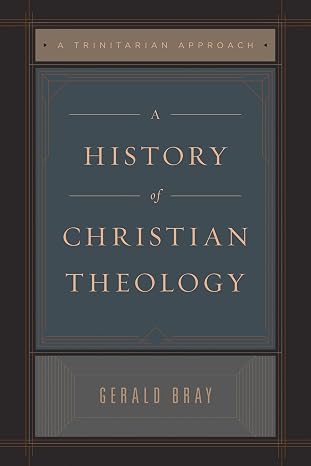
In A History of Christian Theology: A Trinitarian Approach, Gerald Bray maintains we can approach historical Christian doctrinal development on the basis of Trinitarian theology (17). At the young age of 76, Dr. Bray maintains his position as Research Professor of Divinity at Beeson Divinity School. Bray completed a bachelor’s degree at McGill University and went on to earn an MLitt and DLitt from the University of Paris-Sorbonne. He has served as the librarian of Tyndale House, Cambridge and was ordained a priest in the Church of England in 1979. Bray teaches church history and historical theology at Beeson while actively engaging in writing and speaking ministries across theological disciplines. His many published works include The Doctrine of God in the series “Contours of Christian Theology,” Biblical Interpretation: Past and Present, God is Love, and God has Spoken. The work under review is an updated and retitled version of God has Spoken. Dr. Bray continues to serve the church in a variety of other publishing, academic, and ministerial endeavors.
As mentioned above, Bray explains his approach to historical theology in relation to the doctrine of the Trinity. Before doing so however, he establishes the context of historical theology, “until the nineteenth century, there was no such thing as the ‘history of Christian doctrine’” (13). The reason such a discipline did not exist in former times was due to the nature of Christian theology. The Eastern Orthodox and Roman Catholic church were generally in agreement about the content of Christian theology, but not about the “nature of the authority” that defined it (13). During the Reformation, Protestants rejected papal authority as the Orthodox did, but not in the same way and especially not by appealing to historical theology as a reason for their differences. Instead, the history of Christian doctrine came about in the post-enlightenment world that recognized many of the doctrines that come down from an institutionalized church were not in the Bible. Therefore, fastening themselves to the principle of Sola Scriptura, modified by man-centered Enlightenment thinking, men saw theology as something that ought to be set aside, and developed the “history of Christian doctrine” as a way to explain the so-called “corruptions” of post-Biblical Christian teaching.
This reading of the history of Christian doctrine was highly promoted among liberal Protestants, but soon became vogue for all Protestants, though the argument that doctrine was “corrupted” by post-biblical teaching remained under debate. It appeared that recognition of the historical development of doctrine (rather than merely corruption) was something that could no longer be denied. Rome dealt with the matter by declaring papal infallibility in 1870 so it could suggest the revealing of doctrine through history by the pope under the guidance of the Holy Spirit for the confrontation of error. The Eastern Orthodox accepted the view of historical development in a similar way as Rome but viewed it as a way of preserving the Gospel against the popes, ancient heretics, and liberals.
This background information for Bray is necessary to illustrate so that he can explain two crucial points: (1) historical development of doctrine is no longer considered a corruption of Jesus’s teachings, and (2) “it is no longer possible to write a history of Christian doctrine whose main purpose is to debunk or defend a particular denominational tradition” (15). Bray continues by arguing that a person who states only they are right in all matters while everyone else is wrong is “regarded as a propagandist, not as a historian – and is dismissed accordingly” (15). At this point it might be suggested that Bray is not quite accurate. A good question to ask here is, “dismissed according to whom?” It seems in the modern day that particular traditions (Orthodox, Reformed) maintain their reading of history and Scripture above all others and publish works to defend such matters. At times, other traditions (Baptists, Churches of Christ, Church of God) seem to believe they are void of tradition and continue to view their understanding of history and theology as a perspective worth propagating as the Biblical view. It seems Bray means that they are dismissed according to the broad tent of the Evangelical (generally) conservative academy, yet this suggestion may be conjecture.
At any rate, in opposition to Gregg Allison and others like him, Bray opts for a reading of historical theological development centered around the doctrine of the Trinity rather than a singular doctrine’s development through history. Part of the reason for such a reading is the popularity of Trinitarian theological discussion in our current climate, as well as the fact that belief in “one God, Father, Son, and Holy Spirit” is currently confessed by every branch of genuine Christianity and has been generally confessed by every Christian since the days of the early church (17). Every sect of Christianity maintains there is one God Who is three Persons and that each of these Persons is active in a way distinct from the others. And yet, “everyone agrees that the doctrine of the Trinity as we know it did not spring fully grown out of the New Testament” (17). As such, Bray opts to explain the continuity of the Trinitarian position with Old Testament Israelite theology and deal with the doctrine of the Trinity as it unfolds in history.
The preface functions as a sort of microcosm for the book, particularly on pages 18-22. Much of what has been said above is contained in this preface as well as what Bray considers to be the essence of historical theology. Various doctrinal aspects came to the forefront of Christian theology, often in the form of controversy and demanded resolution. As such, “the essence of historical theology…is to explain how and why this happened” (18). Therefore, we can read doctrinal history in terms of what theological controversies needed to be resolved by the developing church. For instance, Christian theology received a Jewish inheritance that was to be understood through Jesus Christ. The Early Christians had the difficulty of maintaining the monotheism of the Old Testament while dealing with the teaching of Jesus that the Father was a Person distinct from the Son and Spirit. Once the Fatherhood of God had been established, the incarnation of God in the Person of the Son needed an explanation that could maintain He was equal in divinity to the Father. Once the divinity of the Son was established, in the Medieval Era the Divine Son had to be linked to His work. Trinitarian doctrinal development, therefore, is Bray’s approach to reading Christian doctrinal history.
The author lays out his work in eight parts stretching 1264 pages. Part one deals with the Israelite legacy that Christians received from the Old Testament. Part two focuses on the Person of the Father and how believers sought to explain that attributing fatherhood to the Creator was an adequate designation for His Christian children. The third part of the book deals with the work of the Father, explaining how it was possible to present the Father in Scripture as a unique Person Who acted in ways the Son did not; in the end, the Father is in a sense, “eclipsed” in His work, not in the sense that He was not distinct from the Son and the Spirit, but that the latter two Persons of the Trinity were also to be considered “the Almighty” (207). Parts four and five tackle the Person and Work of the Son. Heretical challenges to the church’s position of the Son’s divinity required responses that maintained the Son was true God, which were manifest in the Nicene Creed and Chalcedonian Definition. Furthermore, we understand through these controversies and the context that followed how the Lord’s Supper became central, the sacramental system developed, and purgatory was invented. Part six works through controversies concerning the Holy Spirit, not least of which was the filioque clause. The seventh section of the book considers the work of the Holy Spirit, dealing with post-Reformation and Revivalist preachers like John Wesley who argued for a second work of the Holy Spirit following conversion. Finally, the eighth part of the book finds itself in the modern era where Trinitarian theology is being revisited because of the damage done by Enlightenment thinking that moved the center of the universe from God to man.
Bray is a masterful writer who demonstrates with impeccable syntopical skill and acute details how doctrinal developments in Trinitarian theology came to be. For example, in the first part of the book, the author deals with the Jewish theological inheritance received by Christians who maintained the authoritative nature of the Old Testament writings. He explains that the expansion of God’s kingdom into the Gentile world is the reason Christians developed theology rather than creating new laws as the Jews had done in previous eras (33). Because the Christian message extended into the Greek world, new questions began to arise that Jews had simply never asked. Greeks and Romans, with their distinct philosophical heritage, would have difficulty maintaining that the transcendent immutable God could incarnate as a human being encapsulated by flesh and enter a realm bound by time and space; these questions demanded answers. Furthermore, Jewish methods of Biblical interpretation, including allegorical interpretation, were adopted by Christian writers, even as Bray suggests, by those who penned the New Testament (45-51). Early Christians received from Jews, what we might call an unflowered version of the modern-day Reformed Covenant theology, viewing history as happening under one covenant (what modern Reformed theologians call the Covenant of Grace) with many administrations (93). Such methods and theological constructs derived from the Jewish heritage were acceptable because Early Christians fully identified themselves with ancient Israel (67).
Another fascinating chapter which is in some respect, coupled to the whole of the work, is chapter 10 which deals with theological language. In previous chapters, Bray explained the doctrinal developments of the first few centuries of the church and their inherited Jewish tradition. The context of post-Biblical theological development was a multilingual context that spoke Greek, Aramaic, and Latin, with ancient Hebrew as a nearly deceased language by Jesus’s day. Greek was the chosen the language of the New Testament, but how would such a choice come to be and is there any uniqueness to the choice of Hebrew for the Old Testament? Apparently, Jews did not see the language of Hebrew as necessary to maintain the message of the Old Testament (unlike Islam) which is why they felt it acceptable to translate it into Greek (the LXX) and craft Aramaic glosses (the Targums). The New Testament writers quote almost exclusively from the Septuagint and seem not to have any questions about the authority of the Hebrew text over the Greek text. It appears Greek became the language of choice for New Testament writers in part because it was almost universally spoken in Jesus’s day, and because it had a more colorful vocabulary (unlike Hebrew) useful for making theological distinctions. Many Greek words received an expanded “religious element” to their once “ordinary” meaning (297). The effects of such modifications in Greek and especially in Latin are felt today in that nearly all Western Christians speak with theological vernacular developed from Greek and Latin terminology. This chapter serves as a clear example of Bray’s monumental cross-disciplinary learning.
The book ends with two chronological lists of unparalleled value. The first is a list of significant figures in church history. This resource will help a student identify which people were the major players of Christian theology in which era, even if many of the dates contain question marks because their births and deaths are only known with relative certainty. The second is a list of significant events in church history. These events are not merely a list of councils and synods but also contain significant historical happenings such as the Gothic invasion of the Romans empire and the Arab Muslim invasion of Syria, Palestine, and Egypt. These lists will be of high value to students and scholars (as well as laymen) who need help putting the history of Christianity together in a more succinct way.
Bray has seemingly written this work with a view towards Christian unity and accessibility. First, as the author perceives it, the modern church is in a sort of “Babylonian exile” where the Trinity must return to the forefront (21). He argues that Christians of different traditions must come together and indeed in some respects have already, “realizing that if they do not hang together they will be hanged separately” (21). It appears Bray believes the church, having been dismissed from the secular academy and society, would do better to affirm with unshakable unity, what we all agree on. Second, Bray states clearly, “the aim of this book is to make the history of Christian theology comprehensible to nonspecialists while at the same time providing a useful resource for those who want to take the subject further” (22). Bray has done just that in this work. Broad audiences will find his work to be a tremendous aid in their studies, helping them to see how Christian theological history fits together.
Matthew B. Tabke