A Book Review from Books At a Glance
by Matthew B. Tabke
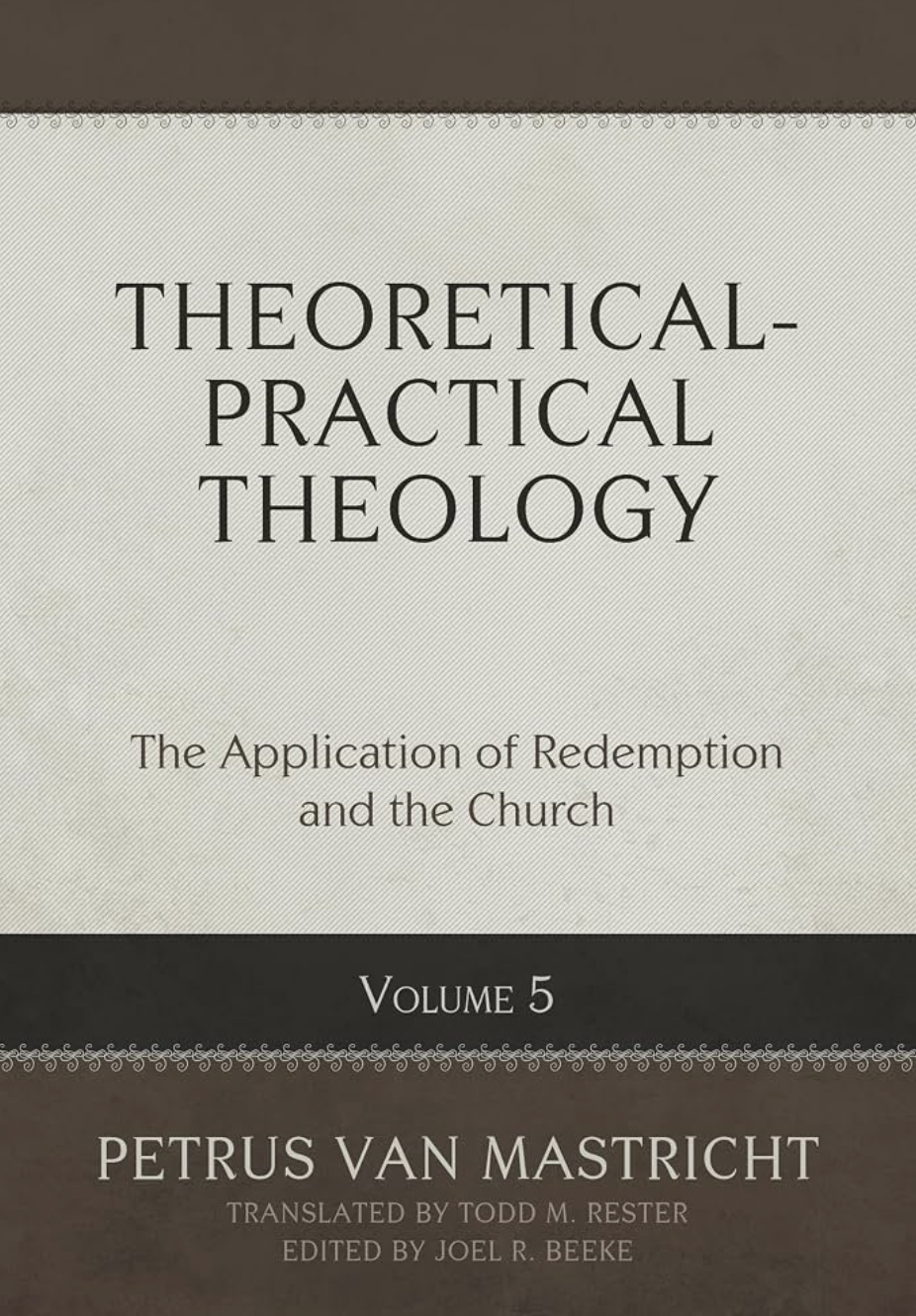
In 2018, the first English volume of Theoretical-Practical Theology by Petrus van Mastricht appeared from Reformation Heritage Books. The Dutch Reformed Translation Society commissioned a translation of van Mastricht’s magnum opus headed up by Joel Beeke as the project lead and editor with Todd Rester as the translator. The volume under review constitutes the fifth volume of van Mastricht’s work with more to come. Two more volumes are planned for this series by Reformation Heritage Books. Van Mastricht’s Theoretical-Practical Theology spanned 15 volumes in its original printing.
Petrus van Mastricht was born in Cologne, Germany in November 1630. Van Mastricht attended the University of Utrecht beginning in 1647 and took a study tour at Leiden University, possibly visiting Oxford and the University of Heidelberg as well. He completed a Master of Arts and Doctor of Theology at the University of Duisburg in 1669 while serving as a pastor in Germany. In contrast to some of his contemporaries, he was considered to have been more ecumenical, perhaps due the blending of educational influences from Gisbertus Voetius and Johannes Cocceius. Van Mastricht served as professor of Hebrew and theology at the University of Duisburg from 1670 to 1677 before succeeding Voetius as professor of Hebrew and theology at the University of Utrecht. He continued to serve as a professor, elder, and supply preacher in Amsterdam, Netherlands until 1700 when he became too ill to teach at the university. After teaching from his home for a few years, he died in February of 1706.
The translator of van Mastricht’s work, Todd M. Rester, serves as the associate professor of Church History at Westminster Theological Seminary. He completed his Ph.D. at Calvin Theological Seminary and has been a post-doctoral research fellow at Queen’s University Belfast since September of 2016. He serves as a guest lecturer in the History of Religion department at Westminster Seminary and has served as an adjunct professor at Puritan Reformed Theological Seminary, Kuyper College, and Calvin Theological Seminary. His research interests include the history of the doctrine of Scripture, early modern and Enlightenment conflicts between the theology and philosophy of general and special revelation, and early modern and post-Enlightenment missiology. He served as a ruling elder in the Orthodox Presbyterian Church from 2011 through 2016.
Joel R. Beeke is a pastor at the Heritage Reformed Congregation in Grand Rapids, Michigan and serves as the chancellor, professor of systematic theology, and professor of homiletics at Puritan Reformed Theological Seminary. From 1995 to 2023, Beeke served as the school’s president. He edits the “Puritan Reformed Journal” and a magazine called “Banner of Sovereign Grace Truth.” He also serves as the editorial director of Reformation Heritage Books, president of Inheritance Publishers, and vice-president of the Dutch Reformed Translation Society. Beeke has written or co-authored over one hundred books. He published a four-volume Reformed Systematic Theology with Paul M. Smalley. His editing and publishing work are extensive totaling over 2500 books, journals, periodicals, and encyclopedias. Beeke earned his Ph.D. in Reformation and Post-Reformation theology from Westminster Theological Seminary in 1988.
Van Mastricht’s fifth volume is a continuation of the previous four and covers the topics of the application of Redemption and the church. The preface to the volume was written by Todd Rester and functions as a microcosm of the contents. According to Rester, volume five is “van Mastricht’s treatment on the application of the benefits purchased by Christ as well as the context in which those benefits are realized – the church” (xxv). The work divides nicely into two parts with the first covering the application of redemption and the second covering the doctrine of the church. The two parts of the volume are respectively termed “book six” and “book seven,” thus indicating the continuation of the previous four volumes. Each book is divided into subsequent chapters that contain four different approaches to the topic covered in the chapter: exegetical, dogmatic, elenctic, and practical.
Each chapter of the work begins with Scripture. These Scriptures are taken from the King James Version and are part of a verse, a full verse, or a longer passage. For instance, book 6 chapter 1 begins with 1 Peter 1:2a, “Elect according to the foreknowledge of God the Father, for the sanctification of the Spirit, through obedience and sprinkling of the blood of Jesus Christ.” Likewise book 6 chapter 4 uses Jeremiah 31:18b-19, Turn me, and I shall be turned, because you are Jehovah my God. For after I have been turned, I will repent; after I knew myself, I struck my thigh; I was confounded and also ashamed, because I bore the reproach of my youth.” These passages serve as proof text foundations from which van Mastricht will build his doctrine.
Before beginning the exegetical part of each chapter, the author includes a short paragraph that connects the subject covered in the chapter to the previous work. For example, he begins book 6 chapter 6 by referencing what has previously been considered before stating “it remains for us to pass on to the benefits to be applied, and thus to the communion of benefits, which flows from union with Christ, in the order that we spoke of in the preceding chapter…wherein justification obtains the first place” (161). In this way, van Mastricht aids his readers in remembering what they have previously read and pushes them to what is coming next.
As mentioned above, each chapter contains an exegetical, dogmatic, elenctic, and practical part. The exegetical part is a discussion of the passage of Scripture that the chapter begins with. The text functions as a pathway into the dogmatic part of the chapter because in van Mastricht’s view, it contains the main idea he hopes to discuss. These exegetical sections are highly detailed, discussing the contents of the passage phrase by phrase and draw out the ideas that relate to the coming sections. The author employs the full use of his theological training, discussing any relevant Greek and Hebrew terms as well as their Latin translations with careful precision. Relevant original language terms are left for the student of the Bible to see. For instance, on pages 222-223, van Mastricht writes about the adoption that 1 John 3:1 references in that it speaks to “the adoption itself: ἵνα τέκνα θεοῦ κληθῶμεν, ‘that we should be called the sons of God.’ Theodorus translates τέκνα by liberi, children, as he thinks the term extends more broadly than filii, sons; Beza by proles, progeny; the Syriac, the Arabic, Erasmus, and others by filii, sons.” This quotation demonstrates two details. First, van Mastricht’s writing is highly technical and deals with the various sources of Scripture available to him. A lay person may find some of this language difficult to navigate. Second, however, we may also note van Mastricht’s (and Rester’s) inclusion of a vernacular translation of the technical terms he is using. As such, while some who do not possess skill to read Greek, Hebrew, and Latin may have difficulty, because the author and translator have included vernacular translations of the source languages, they may be able to navigate van Mastricht’s exegetical writing.
The second section of each chapter is the dogmatic part. This section deals with various aspects of the doctrine dealt with in each chapter. For instance, in the dogmatic part of book 7 chapter 1, van Mastricht’s discussion of the nature of the church includes the following topics: (1) redemption as well as its application are occupied only with the church, (2) a consideration of the name (of the church) with respect to its etymology, homonyms, and synonyms, (3) what the church is, (4) the procuring causes of the church, (5) the people who constitute the church, (6) the faith whereby the church is constituted as its form, (7) three properties of the church, (8) the universal church divided into the church triumphant and church militant, (9) the communion of the saints, and eight other topics (325-339). The extensive coverage in the dogmatic sections illustrates the author’s attempt at a comprehensive systematic exposition of the Reformed faith. He cites other sources throughout, but far more infrequently than his citations of Scripture. An example of the author’s vigorous commitment to Scripture can be found in any section of the dogmatic part of his chapters. For example, his section on the members of the particular church includes 29 Scripture references in a paragraph stretching about a page in length (335-336). Readers committed to the authority of Scripture need not worry about where van Mastricht’s Scriptural commitments lie. The author clearly sees the Bible as the sole authority from which to build doctrine.
The next part of each chapter is the elenctic part. “Elenctic” as a term refers to a method for refutation of an argument and is often associated with Socratic cross-examination whereby an argument is shown to be invalid based on contradictions in its conclusion or that it runs contrary to accepted belief. As such, the elenctic part of each chapter asks questions that may refute the exegetical and dogmatic conclusions van Mastricht has drawn in the previous two parts. These questions also demonstrate the author’s attempt to answer comprehensively, objections raised against the Reformed expression of Christianity. For instance, the elenctic part of book 7 chapter 3 contains eight questions regarding the sacraments of which the answers stretch about ten pages. Other elenctic parts of various chapters sometimes ask over a dozen questions of a certain Reformed position. Many of van Mastricht’s refutations are leveled against the papists, but they are also geared towards refuting other various groups like Socinians, Arminians, and Anabaptists, all groups that the author considers Pelagians (xxv). Even Lutheran objections are occasionally dealt with (151). Van Mastricht’s commitment to the Reformed expression of the church will offer helpful proofs for those in agreement with him as well as considerable arguments to be dealt with by those of different traditions. As a final note on the elenctic part, it was mentioned above that van Mastricht is considered a bit more ecumenical than other authors of his day. This ecumenicism can be seen in his refutation of various objections raised against the Reformed faith in that he does not necessarily employ the same flavor of rhetoric that Beza and Polanus did in their essays on justification.
The final part of each chapter is a practical part. Here van Mastricht moves the doctrinal discussion from intellect to application. He offers several practices in these sections by explaining the implications of the doctrines developed. For example, in book 7 chapter 5, the practical part of the author’s exposition of the topic of sacraments being nourishment for the believer, van Mastricht explains that believers are to commend the dignity of the Lord’s Supper, that they are to condemn contempt and neglect of the meal, that they should religiously enjoy the supper, that they should not come hastily to the table without preparation, that they should approach the table in a suitable manner, that they are to discharge the duties that a believer has after taking the elements, and that they ought to have an abhorrence toward the Mass. Once again, these sections are often laden with Scripture in a heavy way. A half page paragraph on page 520 for instance, contains 18 Scripture references in support of the author’s reasoning. Van Mastricht’s thoughts are not merely the result of a good logician, but of an ardent student of Scripture.
Van Mastricht’s fifth volume is a welcome addition to the English translation of his Theoretical-Practical Theology. He is an incredibly careful systemetician, firmly rooted in Scripture and the Reformed Protestant tradition. Some aspects of his work will be difficult for untrained readers of theology, but this should come as no surprise given the author’s attempt at a comprehensive systemization of Christian doctrine. Furthermore, the author’s approach to systematic theology is not merely to ask what the Scriptures say but also ask about the implications of conclusions drawn from Scripture. This aspect makes the work of van Mastricht invaluable for those who hope to abide within what has come to be known as the “classical tradition.” The most likely readers of this work will be students and scholars of theology, but lay people may be able to access the rich theological reasoning of the author. This volume, along with the other four and the forthcoming volumes will be an excellent addition to theological dialogue in the modern English-speaking world.
Matthew B. Tabke