A Book Review from Books At a Glance
by Michael D. Mock
I am unsure about the typical reader, but I think that most readers are not thrilled to see another book on Leviticus. “Why,” they wonder, “should I care about a book on a book I don’t read?” Perhaps the most major objection from a Christian to reading the book of Leviticus is a supposed lack of relevance. After all, Jesus said he came to fulfill the law, didn’t he, so why read a book that’s no longer relevant? It may prove historically interesting (but the historical interest likely extends only to chapter 10 with the death of Nadab and Abihu), but why spend any time studying the text? Isn’t it enough to have to read it once a year? It’s one of the 66 books of the Bible, but, the reasoning goes, it is about as relevant as Obadiah, and too long. This attitude is seen in the longstanding joke (is it a joke?) that every Christian begins to read the whole Bible in a year, but breaks his commitment only a few chapters into Leviticus. The book breaks him. And with two chapters on leprosy, and so many foreign systems and symbols, can the broken Christian really be blamed?
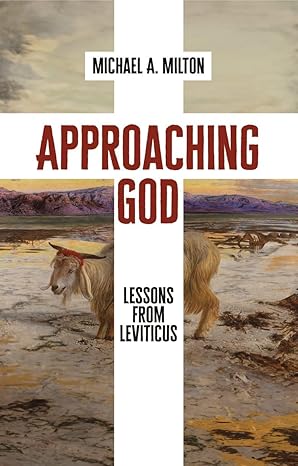
I, for one, was overjoyed to see yet another book on my favorite Old Testament book. I was not disappointed. Even though Milton doesn’t delve deeply into the book of Leviticus (at least, for the reader to observe), his short book should have a seat at the table of teachers of Leviticus, even if the table is lamentably smaller than desired. Milton offers sound explanation, wise insights, and practical application to anyone, teacher and student, interested in studying and learning from Leviticus.
Explanatory
A strength in Milton’s book is his clear explanation for the oft-confused reader. He spends a sixth of his book providing the introduction to Leviticus, along with a ten-page defense of sorts for why we should read it. The defense is found in an excursus, but it probably should have been his opening remarks as a way of securing engagement from the reader. Nevertheless, in Part 1: Introductory Notes, Milton clearly communicates the essence of the book: the title, authorship, time, and structure, as one would expect. Not earth-shattering, but faithful and expected. The start to the book shines in the middle wherein he explains why he’s not going to blunt the sharpness of the text, and also wherein he connects Leviticus to Christ (14-16). Fundamentally, we read Leviticus because it speaks of Christ. In Milton’s words, “From Levitical offerings, priestly requirements, and holiness codes, Leviticus is a choice feast of Christocentric truths that glorify God and bring healing to the pathologies of the human soul” (16). It’s no wonder, therefore, that Milton concludes his introductory remarks thus, “Leviticus is really one of the more exciting books in the Bible” (25). Milton is certainly convinced of this, but his readers may remain skeptical. However, throughout his commentary, Milton offers solid explanations of the text, which show his understanding of the Hebrew, the theology, the intertextuality, and the Christ of the book. With a book topping off at 165 pages on a 27-chapter Old Testament book, his book is bound to behold the forest more than the trees. Most readers will likely find his length to be a mercy and not a limitation. As someone who loves books on Leviticus, I wished it was longer. As someone who is expecting to teach and preach a robust series on Leviticus sooner than later, it would have been pleasant to read more from Milton. I wanted more, not necessarily because there aren’t other books out there on Leviticus (there are, and I have them!), but on account of his insight.
Insightful
A reader conversant with the theology and make-up of Leviticus, and one who sees the length of Milton’s lessons on Leviticus, may be tempted to ignore it. To fall into this temptation would lead to the loss of insight. For its size, Milton regularly offers sound, Bible-based insights. Essential to Leviticus is the sacrificial system, the various offerings that are gifts from God for the sinner to access divine presence and blessing. Milton explains clearly the major sacrifices, for instance, so that the reader from a different world will see his sin-problem and his problem-solver, the Savior. At the same time, we can consider Milton’s remarks on one of the two most popular passages in Leviticus, chapter 10 (with chapter 16 being the other), the account of Nadab and Abihu. If we think that it’s a story just about an angry God who forces silent submission from the deceased’s dad, we’re not seeing what underlies divine wrath. Instead, Milton puts it plainly, “In a phrase, Chapter 10 of Leviticus is the story of human religion. We must approach God on His terms, not ours” (70-71). This is the kind of big-picture insight that Milton is known for giving time and again in these lessons. Of course, Milton’s just a man, and as such, he may not have given all the insight available in any given text, but he is truly and reliably helpful here. (As an example of a missed opportunity, if you know the birth narrative of Jesus in Luke, you will notice the absence of Milton’s Christ-connection in his remarks on page 82 on Leviticus 12, surely a favorite Advent passage.)
Relevant
To be truly insightful, the remarks must be based on the Bible and they must carry relevance. Such is the case in Milton’s lessons. Returning to Leviticus 10, by way of illustration, Milton applies the text this way, “Novelty in theology proper and theology applied, whether in worship or teaching, is a perilous presumption and invariably leads to human suffering” (71). Certainly, this is a word needed to be heard by ministerial leaders the world over! To take another text as an example, Milton connects the sin offering with our own baptism. In the sin offering, we see that whatever touches the offering “shall be holy” (6:27). Our minds may not immediately be drawn to the waters of baptism, but Milton makes the connection: “so, too, God’s holiness will bring blessing upon anyone that it touches” (54, emphasis original). He then cites the account of the Philippian jailer in Acts 16, finishing the application with these words, “When the head of the household is baptized into the body of Christ, his influence over the home is pervasive. This is not because of any giftedness of powers within the head of the household. Rather, his identification with Almighty God through the Lord Jesus Christ radiates through his person, his teaching, and his new life in Christ…” (55). These two examples are par for the course in these lessons. In sound expositional and homiletical fashion, Milton explains the texts, connects it to Christ, and provides insightful application to the believer. I recommend this book both to pastor/teacher and student of God’s Word. There’s a lot for both audiences. Pick it up and learn some lessons on Leviticus. You’ll be better for it. Or, I should say, you’ll be holier for it.
Michael D. Mock