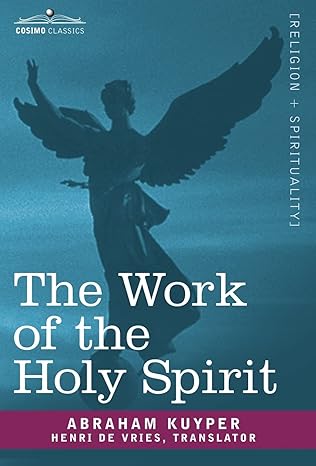
A Brief Book Summary from Books At a Glance
by Steve West
Editor’s Note
Abraham Kuyper’s famous three-volume work on the work of the Holy Spirit remains a classic, holding high acclaim in its first publication with a Foreword from B.B. Warfield. We don’t know why it took us so long to feature it here on Books At a Glance, but we’re eager to provide this summary of volume two today!
Table of Contents
1 Introduction
2 The Sinner to be Wrought Upon
3 Preparatory Grace
4 Regeneration
5 Calling and Repentance
6 Justification
7 Faith
Summary of Volume Two
Chapter 1: Introduction
The first volume in this set considered the Spirit’s work for and in the church, but this volume focuses on the Spirit’s work in individuals. The church is Christ’s body, and individuals are the members of his body. We must not go beyond Scripture or probe mysteries that are too deep for our understanding, but Scripture clearly reveals that God elects and regenerates his people in sovereign grace in a way which is fitting to their human nature (i.e., he does not treat us as stones or a block of wood). The outpouring of the Spirit reveals in individual people the objective work of redemption and events of salvation. Although we can analyze grace and parse its workings for clarity, we need to always remember that God’s work of grace is one indivisible unit. When we experience the outpouring of God’s love into our regenerated hearts, we respond with love and praise. This love is shed into our hearts by the Holy Spirit who is given to us. It is the Spirit who has the closest contact with the creature, and he is the one who brings God’s works to perfection. He gives life and quickens, uniting us with Christ; for this reason, the Spirit is to be praised.
Children do not need to know and understand every technical term and concept, but adults are held to a higher standard. More than others, ministers of the gospel must understand theological propositions and terms. Human beings were made in the image of God, and thus they were in a different category than the rest of creation; they were made higher, and their glory was found in a close, relational bond with their Creator. Reformed theology humbles the sinner but has the highest view of sinless human nature as originally created by God (and ultimately restored in salvation). It is only because Adam was created so gloriously that his fall has been so ruinous. Contemporary people celebrate the glory of man as a fallen creature, but we know that currently man is in a ruined state. In aspiring to be God, man loses his glory. In the fall we lost original righteousness, but not our nature; we retain our human nature, but it is marred by sin. Our excellence was not lost but perverted, so that now instead of being excellently useful and good we are excellently bad. We still have our human nature, but we now move in the wrong direction. We are like a ship that still has an engine, but it steams towards evil instead of righteousness.
Roman Catholicism, Lutheranism, Arminianism, and Calvinism have different views on the meaning of the nature of man as the image bearer of God, and in starting from different locations, they end up in different places. The Reformed view has “taught that the image of God, being one with His likeness, did not consist only in the original righteousness, but included also man’s being and personality; not only his state but also his being.” The divine image is not an attribute added to man, but something which applies to the whole of man. It is best to translate Genesis 1:26 so that the sense is clear that we are made after the image of God, so that we are his image-bearers on earth. It is not Adam alone, but every human that bears the image of God. Christ is the perfect image of God, and redeemed humanity will be transformed into Christ’s image. Human beings will always be the image, never the original (i.e., we are never made divine). We are called to transform ourselves into the image of Christ—a work which God will complete in the consummation—but this is the transformation into the image of the incarnate Word, not into the deity of the Son (i.e., we are never made God). We will not be made deities, but we will be made perfect humans without sin. In his original state, Adam was complete, whole, and holy. If Adam had not been originally righteous and holy, he could not have had such intimate fellowship with God in the Garden. . . .
[To continue reading this summary, please see below....]The remainder of this article is premium content. Become a member to continue reading.
Already have an account? Sign In