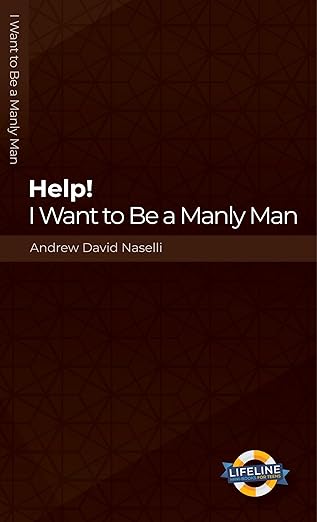
A Book Review from Books At a Glance
by Michael D. Mock
If you are a male teen, a father, or someone who regularly interacts with or ministers to future men, this book is an excellent resource. It’s brief, so my review will be brief. The booklet is part of the Lifeline series directed at teenagers. Even so, Naselli is uncomfortable with the term “teen” (8), because he is not interested in countenancing this time as a phase of fun, a period of wasting one’s life. The teen years, instead, are pivotal for becoming men. He urges young males not to waste these years, as they are truly formative for the kind of person God calls them to be: Manly Men.
The manly man is dominant, that is, most powerful of human creatures (5). This doesn’t mean that men are superior to women and children in every way. Dominant in itself is a good thing of nature according to God’s design, which means it can be used well or poorly. Naselli introduces two kinds of the unmanly man: the harsh macho man, and the soft girly man. One of the joys of reading this book as a man is Naselli’s direct, manly speech. He’s not harsh, but he is clear and feels no need to coat his readers with sugar. He will often speak of inappropriate or unmanly conduct as “lame,” “soft,” “girly,” and “effeminate” (7, 9). For instance, he calls out porn and masturbation as “effeminate and wicked” (34). This speech is attractive to future men. Men need this kind of speech. We need to toughen up and toughen each other up.
The manly man, as Naselli pictures, is on mission, responsible, hardworking, and strong. The manly man’s mission is God’s mission for him as male, and as a manly male. Naselli is wise to frame manhood in a Godward direction. Young males are encouraged to discover and own their mission, both general and particular, not to worry if it’s not been hammered out yet, but neither to delay in figuring it out. Godly ambition is a gift from God and part of manhood. Manly men glorify God and honor women (13-14). Most men do not have the gift of singleness, and they should assume they don’t have this gift unless in God’s providence it turns out this way (15-16).
The manly man is responsible. He keeps his word, he sacrifices for others, he owns his mistakes, and he assumes responsibility for himself (18-22). His word is his bond. He avoids the temptation to objectify women, which is wicked. When he messes up, he acknowledges it, even if it’s people under his care that made the mistake. He rejects the victim mentality. Instead, he pursues more and more responsibility from his father as he gets older.
The manly man works hard, both mentally and physically. He loves his Lord with all his mind and in/with all his body. The manly man resists the flesh’s urge to be lazy. He also refuses to be ruled by work. He works hard and plays hard, and he never confuses the two (23-27). He rests so he can run (28).
Finally, and working from the previous chapter on hard work, the manly man pursues strength. Naselli uses this chapter to recommend specific things for young males (all males, really) to do sooner than later in an effort to become strong in body: eat well, do strength training, do cardio, and sleep 8+ hours a night (30-31). He summarizes several benefits of strength training. Then he calls young males to cultivate godly, manly virtues such as strength of soul, sober-mindedness, dignity, self-control, and courage (32-37). Rather than waiting for the time to be right, now is the day to create godly, manly habits (37). Appealing to man’s innate commitment to fight and build, Naselli concludes with the reminder that as men, we are a “jolly warrior” (39). We build and we fight, all with the joy of the Lord that is our strength.
I highly recommend this book not only to males becoming men, but also to young ladies who need to know what to look for in a godly, manly man to marry one day. I will have my teenage daughter read this soon. Naselli’s end-of-chapter questions for reflection and end-of-booklet recommended resources apply his exhortation for teenage males both to think and to do. These are helpful and can be used by other men to facilitate a discussion or encourage their sons to put the content into practice. Now that I’ve written my review, I am passing this booklet on to my oldest son, and then will share it with my younger boys, as I keep working on raising up future men. For the length of this booklet, it packs a punch and will serve our young, one-day men quite well.
Michael D. Mock