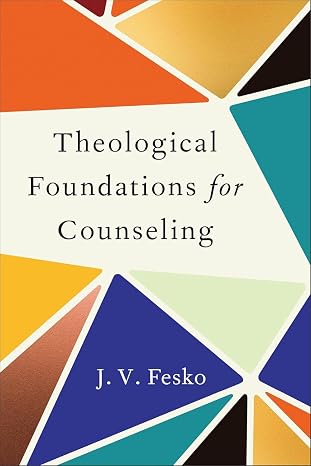
A Book Review from Books At a Glance
by Michael D. Mock
As an ACBC-certified Biblical Counselor and soon-to-be Fellow, this book has been one of the highly anticipated books that we Biblical Counselors were looking forward to reading. Moreover, when I learned from Fesko that he had taught a class on theological foundations for counseling, my interest was piqued even more, for I, too, have taught a class with the same title. Needless to say, I was eager to get my hands on the book, and I prioritized Fesko’s book. Fesko writes of his less-than-stellar impression of Jay Adams and the Nouthetic (later ACBC) movement. He found the man’s work and his movement wanting, primarily in the issue of suffering, especially that of mental illness (ix).
A lot is at stake. Truth is at stake. The ministry to souls is at stake. It is reasonable, therefore, to lay doctrinal foundations for counseling, the overarching aim in Fesko’s work. Fesko attempts to build a firm and flourishing counseling ministry by laying solid bricks of biblical doctrine. He proceeds in each chapter by introducing the subject, summarizing the particular doctrine, connecting it to counseling, then concluding the teaching. Its structure is easy to follow for most readers who are even slightly familiar with the theological truths that undergird biblical teaching.
Strengths
There are strengths worthy of commendation despite the significant weaknesses noted below. From the metric of structural clarity, Fesko shines. A tried-and-true authorial adage is, “Tell them what you’ll tell them. Tell them. Then tell them what you told them.” Fesko follows this ancient path of wisdom. His book begins with laying out his theses quite clearly and succinctly (xxiii-xxiv). He tells us what he’s going to teach us. Each chapter summarizes the relevant doctrinal foundation. He tells us. At the end of each chapter, he outlines what he taught. He tells us what he told us. I found this helpful both as an anticipation of what he thinks, and as a handy reference to return to if I use it later. Fesko deserves all the gold stars for literary clarity. Knowing the diversity of readership, before moving on, he lists some resources for the reader to delve into the doctrine deeply.
Fesko’s first chapter is essentially the rationale for the rest of the book. He considers our present context. He boldly begins with ancient philosophers, mentioning names common to the first-year philosophy student but hardly household names for most readers: Francis Bacon, René Descartes, Immanuel Kant, Friedrich Nietzsche, and Ludwig Fuerbach. Merciful to most, he doesn’t labor long, just long enough to highlight the relevant role they’ve played in bringing us to where we are today: to the “widespread rejection of…truth,” the rejection of worldview-thinking (9), and so the pressing need for “Christian counselors… [to] challenge counselees by presenting them with God’s truth that appears in creation and Scripture” (11).
Another strength is Fesko’s aptness to summarize philosophy and theology well. The book is not long, and Fesko’s economy of words does not sacrifice clarity for brevity. Philosophy and theology can become complex fast, but Fesko manages the material well by accurately explaining the salient subjects without getting bogged down into the details. For the most part, his theology is sound (more on this below). This is not a surprise, of course, given his vocational and ecclesiastical pedigree. His professional and literary credentials, no doubt, give credence and warrant to his writing a book on theology. His application to counseling, however, is seriously wanting (more below).
A strength in his book that is often missing in others on a subject like this is the inclusion of lesser-utilized doctrines. Two stood out to me. First, one of the bricks he lays is that of covenant theology (chapter 4). Fesko summarizes the Covenant of Redemption, the Covenant of Works, and the Covenant of Grace, and in doing so, proves that “counselors must be aware of the covenantal context both for God’s revelation and for their counselees” (40). Not everyone will agree with this run-of-the-mill, covenantal cornerstone. But this Presbyterian rejoiced to see this chapter in a book like this. Knowing the covenant can help the counselor issue warnings to unrepentant and/or unbelieving counselees, and it will settle troubled hearts with comfort and assurance from God’s eternal purpose. A solid chapter. Second, it’s not common to see a chapter on the mystical union that believers have with Christ through the Spirit. Nevertheless, the material is essential, foundational even, to ground all enduring change in the life and ministry of the Son of God. His brief itemization of the kinds of union (union of decree, incarnation, representation, application, and eschatological) helped clarify the variegated aspects of joining with Jesus (104-105). As a bonus addition, his chapter on the Word of God was strong. What I appreciated about this chapter was his mention of the several manifestations of God’s means of grace and their utility in counseling: Preaching, Sacraments, and Prayer (93-97). Christian counselors are filled so that they can fill up their counselees. As the Word of Christ dwells richly in them, they have something to offer sinful and suffering saints. The Word of God is the counselor’s bread and butter, so it was pleasant to see that emphasis in its very own chapter.
A final strength noted (but is a qualified mention), but not the last strength of the book, is his distinction between proximate and ultimate goals in counseling. A proximate goal would be real but temporary relief, whereas an ultimate goal would be conformity to Christ. It’s in this distinction that Fesko takes issue with the Biblical Counseling world, but his shots miss the mark. However, what he calls proximate Biblical Counselors call presenting problems or circumstantial trials; what he calls ultimate Biblical Counselors call heart matters. Every counselee, for instance, comes to the counselor with a presenting problem, the reason s/he is seeking the help of the counselor to provide relief. Biblical Counselors give attention to this presenting problem, but they always work at a deeper level, drilling into the cardiac crevices, exposing the counselee’s heart-posture toward God. Fesko won’t disagree with an appeal to the heart, but he is often content with counselors helping only at the proximate level, if that’s all they can address. His strength is in seeing the difference and in helping counselors to be aware of the difference.
Fesko’s book could have been stronger if he had laid other biblical bricks on the foundation. I was surprised to see that he had no distinct chapters on Pneumatology (the Spirit), Hamartiology (Sin), Christology (Christ as Mediator in his two estates), Ecclesiology (Church), and Eschatology (Last Things). In truth, Fesko touches briefly on all of these doctrines throughout the work, but including chapters on these rich and necessary subjects would have provided a fuller picture and thicker foundation.
Weaknesses
Piggy-backing on my last statement, I found it rather strange that his book concludes with the subject of suffering. To end a book on counseling with the message of suffering is, in one sense, a dose of biblical realism. Fesko’s final thesis in part is, “Suffering is the way that God manifests his presence in Christ and conforms us to his image” (141). This thesis overstates his case. I’d replace “the way” with “a way.” But more than this, his book ends on a weak note (pun intended). Admittedly, Fesko shows how God grows us in our weaknesses and through our suffering. At the same time, because our estate of humiliation is not our final state, the book would have served counselors and counselees better by concluding on a note of victory, explaining an eschatology of hope and showing how the future can be used in the present for both counselors and counselees. Concluding this way leaves the reader short-sighted.
Another weakness of Fesko’s treatment is his attempt to include all audiences. He intentionally avoids using the language of biblical counseling in explaining his position, and we’ll see why below. Instead, he uses the language of Christian counseling. He uses this nomenclature broadly. Fesko uses it in reference to Christians who counsel, not restricting the description to the practice of counseling in a uniquely Christian way. This is important to note, because he countenances and excuses Christians in non-Christian settings, or Christians with non-Christian counselees, offering counsel unto proximate, not ultimate, ends. What becomes confusing, then, is that this book is “Theological Foundations for Christian Counseling,” yet its content is expected to be applied to the lives of non-Christian counselees. Of course, Christian (and Biblical) counselors offer counsel to non-believers, and when they do so, their counsel is built on theological foundations. However, the impression the reader gains from reading Fesko is that there’s some legitimacy to employing these foundations in a fairly fruitful way even to non-believers. If, for example, granting physical, temporary relief is all a Christian counselor can do, he shouldn’t feel guilty for ending at proximate aims. This approach shows that what Fesko has in mind and what Biblical Counseling, or soul care, has in mind are two different aims. The latter has set its sights on the heart (not to the disservice of the embodied person), and the counselee’s worship, loves, and actions regardless of circumstances. What undergirds Fesko’s approach is his understanding of general revelation and common grace, but as noted below, he gets these doctrines wrong.
A significant weakness is Fesko’s assessment of Jay Adams, ACBC, CCEF, and the wider Biblical Counseling movement. At first, Fesko tries to show that Adams was in part dependent on the worldview he (Adams) would reject, saying that Adams would find common ground with some secular psychiatry or psychology (x). He asks, “How much does Adams’ revolution in counseling owe to this non-Christian psychologist?” (xi). This perspective of Adams is both common among integrationists and critiqued by Biblical Counselors. It’s an old argument that’s been proven wrong for decades, even by Jay Adams’ own writings, if one would dare to read them in context. This is a problem I’ve noticed in some of Fesko’s writings. He does not always represent other people’s views rightly. This was seen in his book Reforming Apologetics in which he criticized Van Til. If anyone fairly conversant with Van Til read Fesko on Van Til, he’d regularly find himself saying out loud, “But, Dr. Fesko, that’s actually NOT what Van Til taught.” I found myself saying the same thing reading this book whenever Fesko would touch on Jay Adams. Fesko is just wrong when he makes such statements as these: “Some committed to so-called biblical counseling, however, have in the past argued that Christian counselors have no need of the data or insights of unbelieving psychologists and psychiatrists” (57); that Jay Adams believed that “all counseling problems lie in unconfessed sin” (57); that the only thing biblical counselors do is tell counselees to “pray, read Scripture verses that address the topic, and then dismiss them” (122); and that these biblical counselors “compartmentalize all counseling problems as originating from sin…[and so] unintentionally sideline the body. Counseling becomes little more than treating the soul—administering the right passages of Scripture, telling the troubled person to go home, repent, pray, and read their Bible. In short, counseling is reduced to saying, ‘Stop sinning!’” (135). I found myself regularly asking these questions: (1) “Does he know what we Biblical Counselors even do?”; (2) “Does he think that Biblical Counselors are supposed to be Physicians or Medical Doctors?”; and (3) “What is Fesko’s view on the power of prayer, Scripture intake, and repentance? Aren’t these the means of grace God has given us in counseling?” The “stop it!” approach is a caricature of Biblical Counseling, and it was sad to see it repeated by a fine theologian and pastor. And the means of grace are the power of God for justification and sanctification, so it was sad to see a fine theologian and pastor sidelining the body of work in the Scriptures.
The above criticism highlights what, in my estimation, is the major defect in Fesko’s book. It relates to his commentary on the sufficiency of Scripture. The doctrines of General Revelation, Common Grace, Sola Scriptura, and Sufficiency are all interrelated. Naturally, then, his views pop up throughout the book. His point is clear: The Bible is not sufficient for matters of counseling. In fact, he argues that to adopt a Bible-only approach is “biblicism” (he labels pejoratively), and it limits the counselor to only one of the two supposed books on counseling. There is the Word of God, special revelation. There is also the book of nature, general revelation, and accessed by the use of reason and discovery of common grace insights. To be sure, these insights must be taken captive to the Scripture. But once they’ve been dusted off or the vision corrected, it’s all fair game for counseling.
To be fair, Fesko rejects the label of integrationist, even though his views are right at home with Integrationism. He rejects the label because (1) he believes what he promotes is biblical, and (2) he is “not seeking to integrate two things that do not otherwise belong together” (xii). He believes (2) because of his view of general and special revelation. He believes that counselors are unduly restricting themselves in the counseling room when they do not avail themselves of scientific and psychological discoveries made available through common grace. Because of this position, he says, “The sufficiency of Scripture does not mean that counselors should use only Scripture in counseling” (67).
To say that Scripture is not enough for counselors is a rather bold and shocking statement. It’s also wrong. More than this, he even writes that it’s sometimes the case that general revelation is the interpretative lens for understanding the person’s struggle. He writes, “Scripture, however, usually takes interpretative priority over general revelation” (13). Usually, but not always? The sad state of his book shows that he never actually makes a case for general revelation priority over special revelation. He never guides the reader on how to discern when a matter of general revelation or common grace would be the criterion or lens. This statement goes beyond the typical integrationist view that special revelation is the lens for general revelation and common grace, even contrary to what he wrote himself (67). I would love to know how to discern and when to prioritize supposed insights or discoveries from nature over against the eternal Word of God in the Scripture.
Without using this review to teach the biblical testimony of the relationship between general revelation, special revelation, and common grace, a word or two are in order. Fesko’s major blunder here is that he views common grace as valid, appropriate, and even at times necessary for counseling. However, common grace is not a means of grace. By common grace God restrains sinners and prevents them from being as sinful as they can be. God provides for all his creatures with food, resources, even intellectual abilities. Nevertheless, this divine benevolence is not revelation for his creatures to discover and then reappropriate in the counseling room.
As for general revelation, also known as the book of nature, this is knowledge about God through creation, not knowledge about humans through creation. God has surely made himself known in the things that have been made, but in counseling we’re talking about how to help others be conformed to Christ in all areas of life. Fesko offers illustrations that to him prove the importance, even at times necessity, of incorporating supposed insights from sources outside of Scripture. For instance, in the case of a gluttonous guy, Fesko thinks that counselors are helped in knowing that the makers of the Flamin’ Hot Cheetos intentionally made them addictive (109). Why would counselors want to limit themselves only to the Bible when dealing with someone struggling with an unhealthy diet? Or in another case, the Bible is useful for people with mild anxiety (122) but falls short in cases of deeper, more complex anxiety. In a third instance, Fesko argues that biblical counseling is limited in certain cases of depression. He writes of a young lady who may be depressed because of an unhealthy comparison to others on social media (136-137). He believes that Bible-only counselors won’t take this information into account and so their counsel will be hampered by a misguided application of Sola Scriptura. With respect, Fesko’s arguments and illustrations do not prove his point. Counseling is about life and godliness. Counseling is about growing in righteous thinking, feeling, and acting. The Bible is sufficient for all of life and godliness, for every good work (teaching, reproving, correcting, and training in righteousness) (2 Peter 1:3; 2 Timothy 3:16-17). If the Bible is sufficient for people like Abraham, Moses, Joseph, David, Habakkuk, Jesus(!), Peter, and Paul, I trust that the Scripture is all that the gluttonous guy, the deeply anxious woman, or the young lady full of the fear of man will need to glorify God and grow in Christ.
At bottom, his foundational thesis is incorrect, which makes much of his counsel misleading and not helpful. Would I recommend this book? Yes, but only to a limited audience. I think it will help college and seminary students, along with pastors and elders, to know the variety of views on the subject. However, Fesko’s work was not a fully faithful laying of the foundation for sustaining soul care. He should have sent it off to any number of ACBC or Biblical Counseling men for some iron-sharpening. In the end, much of this book will result in a blunting of care, not a buttressing thereof.
Michael D. Mock