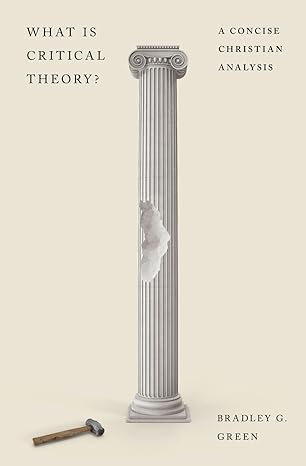
A Brief Book Notice from Books At a Glance
It has become imperative for today’s Christian, especially in the West, to understand critical theory. Without this understanding we will not understand rightly what is happening in our culture.
We can think of no simpler or better introduction to the subject than this by our friend Brad Green. Get a copy!
Table of Contents
Part 1 – Whither Critical Theory?
1 A Brief History of Critical Theory
2 A Short Introduction to Marx and Marxism
Part 2 – Understanding and Engaging Critical Theory
3 Creation and Reality in Critical Theory
4 Sin and the Human Dilemma in Critical Theory
5 Redemption, History, and Eschatology in Critical Theory
6 Critical Theory and the Contemporary Anti–“Hate Speech” Movement
7 Theological Reflections
Conclusion
Selected Quotes
- “This book argues that if Christians are to respond fully and properly to critical theory, their response needs to be rooted in a truly Christian biblical-theological framework. Such a Christian response must recognize that critical theory is in effect an alternative theology or religion and that it is helpful to understand critical theory as just such an alternative theology or religion.” (8)
- “My contention is that when we read the critical theorists, we can see in their various convictions, arguments, and theories an echo of various Christian themes—even if in critical theory they are often distorted, twisted, and rejected. In short, critical theory is, in a sense, parasitic on Christianity.” (19)
- “At the heart of a Christian vision of things is an affirmation that we live in a created world. It is the thesis of this book that one way to wrap one’s mind around critical theory is to see it as a kind of alternative—indeed, parasitic—religion.” (41)
- “To be fair to Reich, there is more than simply sexual realities at work here, but the centrality of sexual expression and experience is certainly key. The basic line of argument is quite clear: The restraint of basic sexual desire and longing creates a certain kind of society—the fascist society. If one wants to avoid fascism, one must dismantle those forces in a society (e.g., the traditional family, the church) that impede one’s basic sexual desires and longings.” (77)
- “…the issues of sex and sexual experience and ideology are perhaps the most obvious connection between the older critical theory and the things we are seeing at the present.” (117)
- “If biblical Christianity proclaims that God accomplishes his redemptive purposes through the blood of his Son, critical theory teaches that all will be made right through revolutionary activity.” (125)
- “But the Christian critique is deeper and more profound. My suggestion is that when the Christian reads Marcuse or his intellectual heirs opposing free speech (in the name of stopping oppression or keeping fascism from getting a foothold), one is hearing (read most charitably) a twisted and confused version of the Christian and biblical notion that language, under God, was meant to be used for certain purposes.” (148-149)
- “Perhaps the deeper problem of critical theory’s understanding of culture is simply an anemic and malnourished and inadequate understanding from the very beginning of what culture actually is and what the purpose of culture actually is.” (163)