A Book Review from Books At a Glance
by Osbert B. Wei
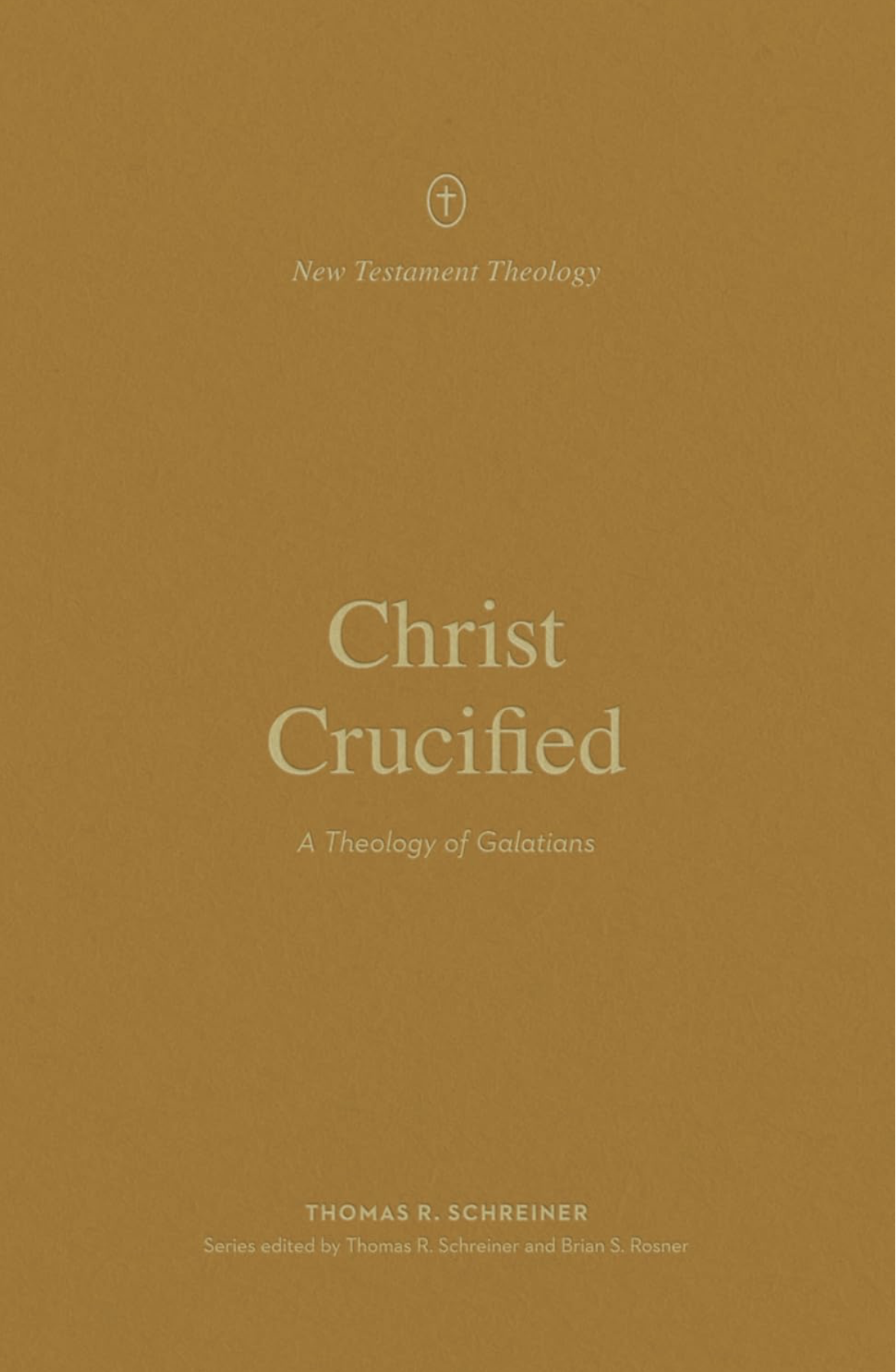
As a young Christian, I struggled to understand the interplay between God’s divine work and my responsibility in spiritual growth. I knew that faith in Christ and his atoning work saved me, but I was unsure of my part from justification onward. I chose to read Thomas Schreiner’s Christ Crucified because I wanted a refresher on the significance of Christ’s death and resurrection for the Christian life. After reading Schreiner’s book, I am happy to share that I have a stronger understanding of the necessity of Christ’s death and a clearer understanding of the relationship between God’s divine work and man’s responsibility in sanctification.
Schreiner’s book is organized after Paul’s logic in his letter to the Galatians. True to the structure of Galatians, Schreiner structures his book in three short parts: 1) The Conflict, 2) The Gospel, and 3) The New Life. Under the first heading, The Conflict, Schreiner reminds readers why Paul started his letter the way he did. Paul needed to defend his apostolic authority against accusers who believed his gospel was not true (p. 3). More specifically, Paul faced two charges: that he depended on the twelve apostles for his gospel and distorted it (p. 22). Schreiner rigorously uses Scripture to claim that both accusations against Paul, his dependency and distortions, fall flat (pp. 22-27).
Having showcased Paul’s successful defense of his apostolic authority, Schreiner evaluates Paul’s corrective to the circumcision mentality that plagued his readers: circumcision is required for salvation. To begin his section, The Gospel, Schreiner argues to view Pauline theology as both eschatological and apocalyptic. The significance of having this two-fold view of Paul’s theology is that justification, a forensic declaration of one’s right standing before God, is both a fulfillment of the Old Testament prophecies and a future reality. In Schreiner’s words, “Through the death and resurrection of Christ, the eschaton has now penetrated the present evil age, and thus believers receive God’s verdict on their lives before the final day of judgement” (p. 45). Being justified by faith in Christ means receiving the future declaration of right standing before God in advance while anticipating the future verdict (p. 44).
Paul emphasizes justification by faith because there were two separate pathways to God in conversation among the Galatians: circumcision or the cross of Christ (p. 47). Paul taught that one can be made right with God only through faith in Christ and his atoning work. Faith is the means of justification, while the basis for one’s justification is Christ’s death and resurrection (p. 70). Furthermore, the cross of Christ sets believers free from the Law, which does not justify (p. 75). God demands perfect obedience, and no human can completely fulfill the requirements of the Law (p. 80). Paul teaches the inauguration of “the law of Christ” (Gal 6:2) and equates it with the law of love (p. 92). Christ, who lived an others-directed life, is the greatest example of the law of love (Gal 5:14; Rom 13:10; Mk 10:45).
Lastly, in the New Life section Schreiner details Paul’s implications for the gospel. Rather than a gospel that is anti-nomian or licentious, the gospel has practical individual and corporate implications for the people of God (p. 124). Salvation in Christ is inclusive of people from all social backgrounds. In Christ, all kinds of people are united (p. 109). The people of God include those whose faith is in Christ, transcending gender and societal roles (Gal 3:28). Furthermore, the people of God are to “keep in step with the Spirit” (Gal 5:25) which produces the fruit of the Spirit (Gal 5:22-23). Only those who have the Spirit can keep in step with it (p. 115). Looking to the final day of judgement, Schreiner writes, “Our boasting is a result of God’s gracious and transforming work in us, and yet at the same time we are rewarded for how we have lived. We see the delicate tension between divine sovereignty and human responsibility” (p. 118, emphasis added). What stands out most to me about Schreiner’s book and my research is how Schreiner brings together the sufficiency of Christ crucified and the implications for a responsible Christian life. Paul boasts in the cross of Christ (Gal 6:14) but not at the expense of remaining idle following justification. Elsewhere Paul notes that Christians must work out their salvation, though it is the Spirit that enables the Christians with the power to do so (Phil 2:12-13). Apart from Christ crucified, humans cannot receive eternal life.
In the Appendix, Schreiner reviews John M. G. Barclay’s book Paul and the Gift, which he describes as “one of the most important books on Paul in recent years” (p. 124). Scholars interested in Pauline studies, such as the New Perspective on Paul, would do well to give Schreiner’s review a read (pp. 125-136). While my specialization is in Christian spirituality and not Pauline theology, I have benefited greatly from Schreiner’s treatment of Galatians in Christ Crucified. Schreiner compellingly showcased the importance of the book of Galatians in salvation history and powerfully explicated Paul’s theology throughout his letter, benefiting both Bible scholars and Christians seeking to live a more faithful life.
Osbert B. Wei