A Book Review from Books At a Glance
by Michael D. Mock
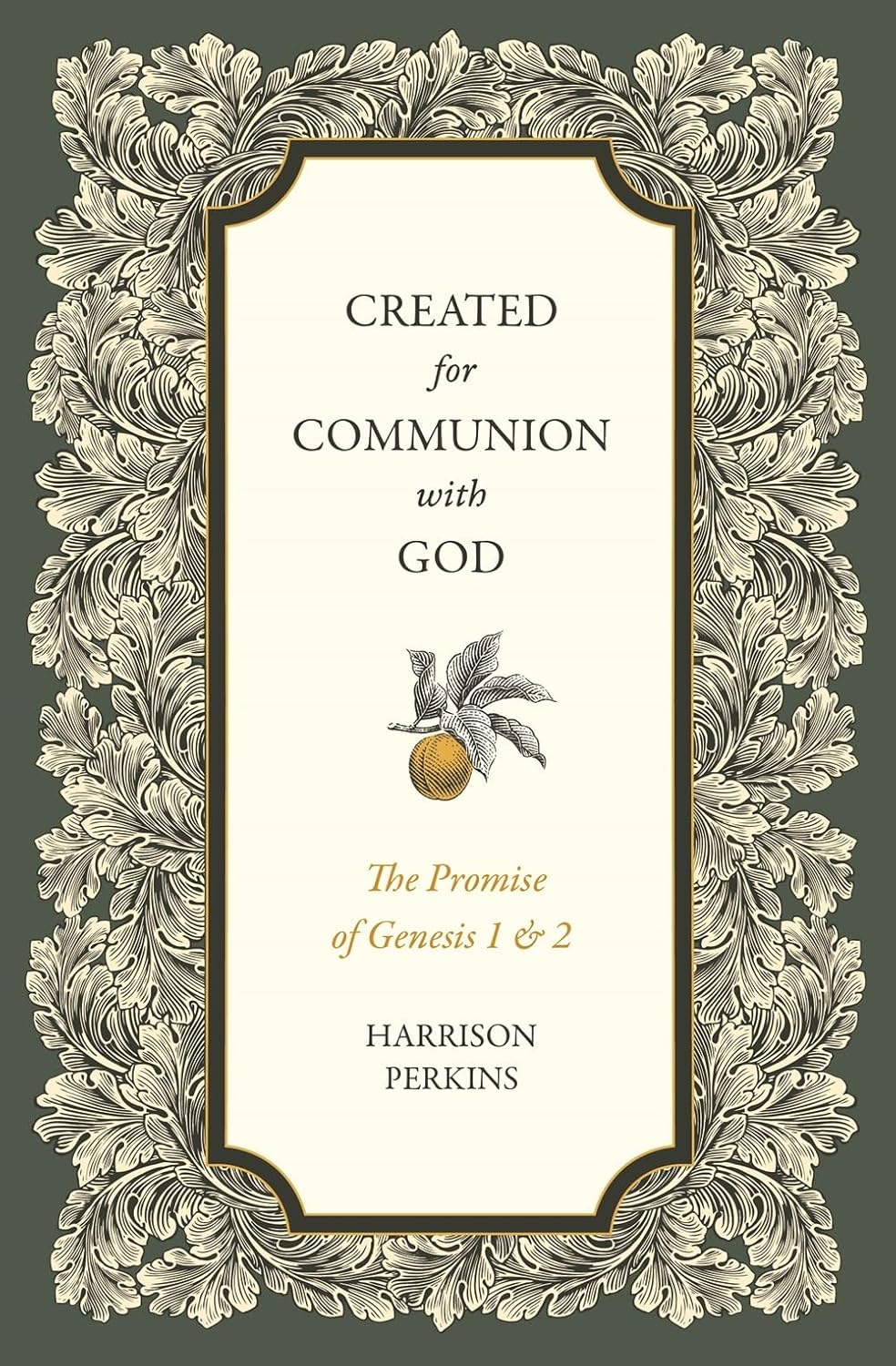
What’s the joy of every longing heart? Is it not communion with the triune God? Creatures crave communion. Yes, even you introverts! Communion is an in-built factory setting for all image bearers. Perkins builds on this creaturely impulse from God’s opening chapters. In a section of Scripture that is often the center of controversy, Perkins places it at the center of communion, just as God intended. This book on Genesis 1-2 is not your typical commentary, even though there is sound exegesis of these opening passages. Instead, it is a call-back to true communion with our God who eternally communes as Father, Son, and Holy Spirit, and who has communed with his creatures through a saving union with Christ, God with us. Overall, Perkins grounds communion in good ol’ theology.
Theological
It is true that anyone coming to this book should not expect a verse-by-verse exposition of Genesis 1 & 2. Countless books exist to do that very thing. But what those books often lack this book supplies. Perkins places theology front-and-center to ground his application. When we use the word “theology,” we must have in mind the study of God and the relevance of this study for his creatures, so that we would worship and live according to his will. Perkins’ book is full of insights gleaned from a well-studied search of the Scripture. Perkins shares the scope of his book: “…these studies intend to set your attention on God to stir up your soul to a joyful consideration of the One who made you” (3). To accomplish this soul-stirring work, attention must adhere to the words of the Creator of these souls.
Perkins reveals his attention to the text of Scripture throughout his book. He offers many redemptive-historical insights as he follows the analogy of faith, letting Scripture interpret Scripture. All the necessary biblical themes are present: God, creation, man, image of God, the fall of man, sin, corruption, covenant, reconciliation, and the two Adams. His exposés on beauty, the garden of Eden, the two trees, clean and unclean, and a theology of nakedness all contribute to a robust view of God and his purpose for mankind. His explanation and defense of a pre-fall consumption of animals gave me something to chew on (pun intended, of course, 64-68).
His grounding of the Creator-creature communion in the eternal communion of the Father, the Son, and the Holy Spirit was necessary and precise without offering an overly complicated or creature-heavy commentary. That is, the Persons of the Godhead are first eternally, unbreakably, and joyfully in communion with each other. They don’t need man, animals, trees, insects, or anything else to add to either their existence or exultation. God remains God, entirely distinct from his creation, independent of his creation, and immutably unaffected by his creation (16ff). This truth is a good thing for his creation. It means, for instance, “that since God does not need you, …he wants you” (23, emphasis original).
Perkins, in chapters 3 and 4, summarizes the activities and relevance of the days of creation. Here we see his sympathetic adoption of the best of the Framework theory. He may leave some stones unturned in his explanation of the days of creation, but his work ably aids the reader to feel the contours of creation. Indeed, anyone looking to study the days of creation deeply may want to consider starting with Perkins. There is much in every chapter for all readers. Even well-practiced practitioners of the Word of God will learn from the sound theology set out by Perkins.
Practical
Theology without practice, like faith without works, is dead. Pastor Perkins lives off this adage, it would appear. The more familiar I have become with Perkins, the more I see how he blends good theology with good application. Perkins both commences and concludes his book with application. Contrary to widespread practice, Perkins starts off with a prayer to God (xi). He sets the tone of the book as an image bearer dependent on and grateful for the God who made him. Perkins closes up shop with a call to communion. Chapter 12, noticeably the shortest chapter, is Perkins’ plea to take to heart the preceding chapters that highlight the good of communion with God and others. Perkins bookends his book with Bible-based application.
Perkins makes sure to fill the pages, not just the start and end, with application. Indeed, at the end of each chapter, Perkins offers a concluding paragraph or two, then raises thought-provoking, soul-stirring questions. He is invested in driving the content of the truth into the cranium and every cardiac crevice of his readers. For instance, he doesn’t want us merely to know that the Sabbath is a gift from God, holding in our minds a doctrine of the Lord’s Day. Instead, he presents us with the beauty, good, and usefulness of the Sabbath as a gift from God for us to commune with him (chapter 7). He challenges us, “God’s presence is not a boring or a trivial matter, so gathered worship is neither optional nor irrelevant if we understand that it is the time that God has appointed for us to encounter him in blessed fellowship” (101). The Sabbath is a gift. Do we know this? Do we believe this? Do we feel this?
Moreover, Perkins’ words connect the vertical with the horizontal when he urges us to commune with others. We may be tempted to commune with God alone, but we’re designed for togetherness (ch. 10). His counsel reaches our hearts and calls us to follow Christ. For example, he writes, “You may not need someone else’s fellowship, but someone else might need yours” (160). This was one of my favorite lines by Perkins. Even if we were self-sufficient (which we’re not!), following Christ is others-oriented. At the same time, others can offend us. Sin divides and conquers relationships. Perkins warns, “Second, because division is a curse, we need to work hard not to be critical or derisive” (160). He offers words of biblical peace-making. In his penultimate chapter, Perkins takes communion deeper and presents a mini practical-theology of marriage, explaining how Christian marriages are good for everyone, married or not. His Christ-centered, God-glorifying commentary on this topic, albeit brief, is a sure foundation for husbands and wives who desire to glorify God and serve others through their marriage.
I remember hearing Perkins talking about one of his other books. In this interview, he mentioned how he struggles with illustrations. I will not call him a liar. But in my estimation, his perceived struggle is a strength. If it is a struggle, then through his literary wrestling match he has shown himself the victor. A feature of his writings is his quantitatively and qualitatively significant illustrations. The reader will not be disappointed, struggling to hang Perkins’ doctrine on the hooks of illustration. His literary house is full of these hooks. To my shame (and to the shame of certain publishing companies that charge exorbitant prices), I’ve not read every book Perkins has authored. Nevertheless, I have thoroughly enjoyed and learned from all the ones I’ve read. Perkins is an excellent communicator, insightful commentator, and skillful pastor. Created for Communion is a witness to these truths.
Michael D. Mock