A Book Review from Books At a Glance
by Ryan M. McGraw
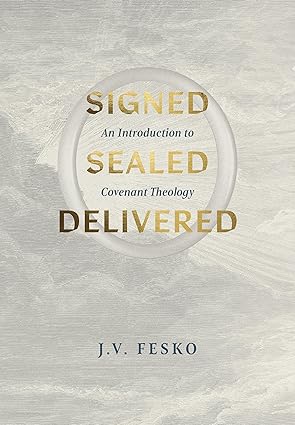
Covenant theology should be important if for no other reason than the fact that churches of every denomination remember “the new covenant” in Christ’s blood every time they observe the Lord’s Supper. More broadly, anyone grappling with the mere vocabulary of the Bible quickly discovers the need to develop a covenant theology. While both historical and modern books on covenant theology abound, surprisingly few of them match the genre of this one. It is commonly the case that books on the covenants are either works on covenant theology that are old, large, unwieldy, and overwhelming, or they are overly-nuanced, complicated, innovative, and discontinuous with historical models. Yet Fesko offers readers a straightforward, clear, largely non-controversial, brief presentation of the Bible’s narrative, proclaiming Christ and seeking application by the Spirit. While readers might have minor differences with the author’s account of the covenants, this “primer” (3) on covenant theology is an excellent place to start for those wanting a clearer understanding both of the acts of God in Scripture and of the God who acts in Scripture.
The six chapters in this work are straightforward and easy to trace. After defining what covenants are, Fesko moves from the eternal intra-Trinitarian covenant of redemption, through the covenant of works between God and Adam, to the story of the covenant of grace and human redemption in Christ. Following these foundational chapters, the final two chapters explore sacraments as covenant signs and the relationship between covenant theology and living faithfully in God’s church. The author begins the book well by rooting covenant theology in marriage; specifically, the marriage between Christ and his church (1-2). Though “not all theologians agree on a definition,” he opts for the older Reformed definition of covenant as “an agreement between two or more persons” (4). Combined, the ideas of marriage and covenant as agreement carry multiple advantages. Marriage as a covenant is broad enough to encompass every biblical element of a covenant while avoiding the implication that a contract or agreement between parties is unavoidably sterile and impersonal. Readers do not need to choose between legal and personal relationships because covenants often include both sides of the coin. By rooting divine covenants analogously in marriage, Fesko is able to encompass various kinds of covenants in Scripture, avoiding a definition that is either overly broad or narrow. Though introductory, starting the book in this way makes it easy for readers to follow the author’s storyline through every stage of Scripture.
In addition to the valuable way in which Fesko defines covenants in Scripture, readers will find the illustrative and explanatory aspects of his work powerful and effective. The introduction to his treatment of the covenant of works in chapter 2 is a prime example. Many in recent theology have objected to the so-called covenant of works between God and Adam because Genesis 2-3 does not include the term covenant. Yet Fesko’s book trains readers rightly to think covenantal, not only where the term appears in Scripture but where the idea is present. His brilliant illustration of overhearing a friend on a phone call is worth citing in full: “You sit quietly and see her nod and then ask a series of questions: ‘Has the caterer confirmed?’ ‘How about the minister; what time will he arrive?’ ‘What about the guest list?’ ‘Has the bridal party confirmed their reservations?’ ‘What time will the florist arrive?’ Your friend smiles and then ends her phone call. You heard only half the conversation, but what conclusion would you draw? Was your friend planning a picnic? A hockey game? Or a wedding?” (37). Just as deducing wedding planning from this imaginary conversation is easy because we know what to listen for, so “we need to do more than look for the term” covenant in the Bible to grasp covenant theology (38).
The only minor substantive difference this reviewer has is with Fesko’s assertion that “the Noahic covenant serves the purposes of the covenant of grace, though it is not, in and of itself, the covenant of grace” (68). The idea is that the Noahic covenant preserves the entire creation as the stage on which the covenant of grace would find fulfillment. I would rather put things the other way around: the Noahic covenant was an administration of the covenant of grace, resulting in common grace benefits for the preservation of the world as God’s story of covenant salvation unfolds. Peter appears to have reasoned precisely this way from God’s during the flood and afterward and his current preservation of the world as the Spirit gathers the elect leading up to Christ’s second coming (2 Pet. 3:5-9). However, the difference between mine and Fesko’s opinion is small at this point, since both views focus on the preservation of the world for the sake of the gospel. Anticipating a related question that some readers will have, Fesko affirms that “the Mosaic covenant is an administration of the covenant of grace” (72). Though bearing a “legal character” (73), the Mosaic covenant only became a covenant of works to “unbelieving Israelites” (74). Despite the small difference over Noah, this point illustrates well Fesko’s desire to unify Christians around a united and clear biblical narrative.
Fesko’s simple definitions of covenant theology, his unifying theme of marriage, and his clear, down-to-earth illustrations and examples alone make this book abundantly worth it. These features of his work will serve as vehicles carrying both teachers and students down a smooth path towards understanding and proclaiming the Bible’s message and the Bible’s God more effectively. This is certainly one of the first books beginning students of Scripture and of covenant theology should read.
Ryan McGraw
Greenville Presbyterian Theological Seminary