A Book Review from Books At a Glance
by Ryan M. McGraw
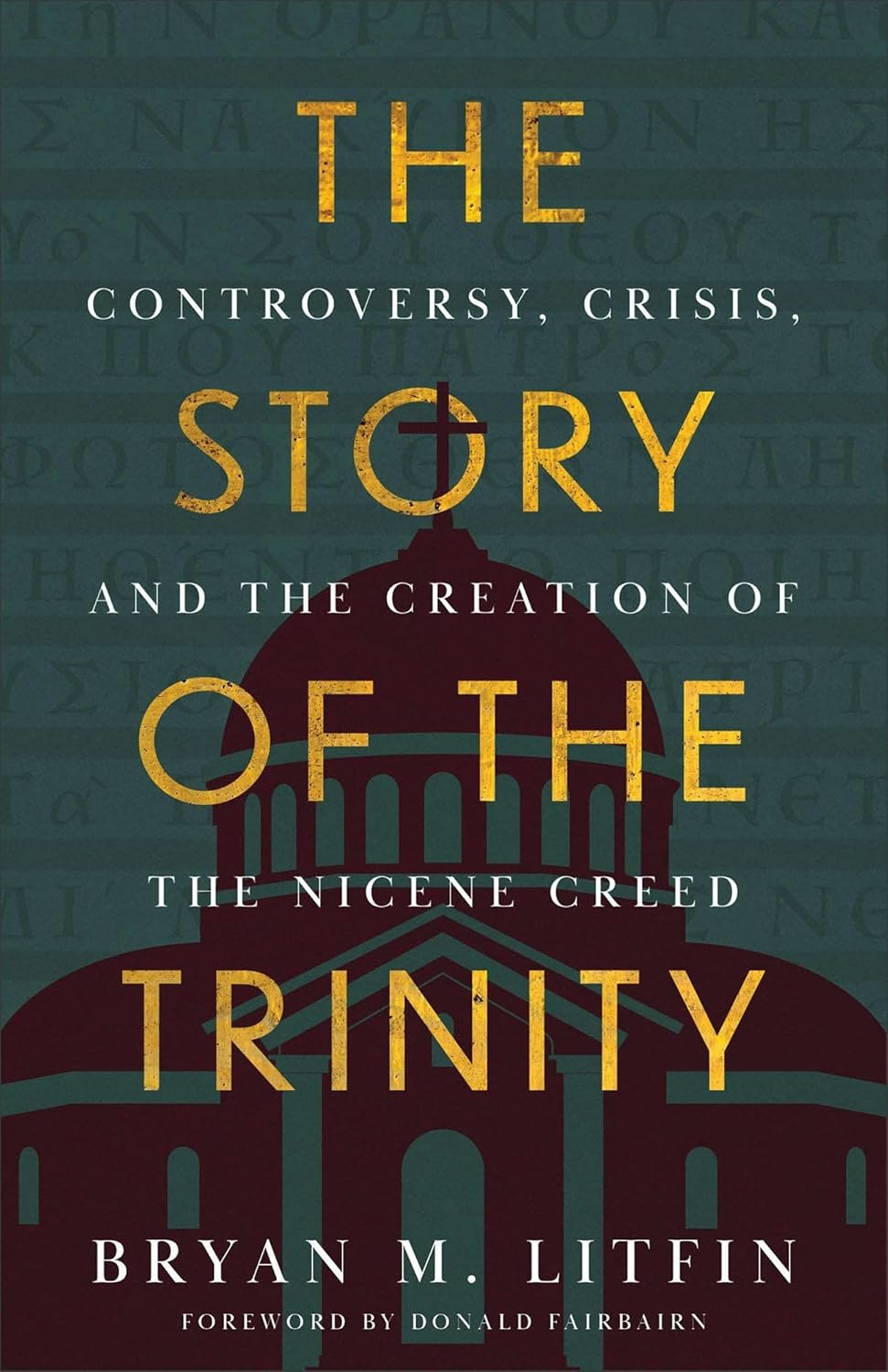
Marking seventeen-hundred years after the Council of Nicaea in 325, a proliferation of books and articles have appeared on the Trinity this year. As Donald Fairbairn says in his foreword to this book, the Nicene Creed is worth our attention because it is the only statement outside of the Bible received by “the whole Christian church,” East and West, Protestant and Roman Catholic, (13). Rather than offering a commentary on the clauses and content of the Creed, Bryan Litfin leads readers new to Nicaea by the hand to see how and why the Trinity lies at the heart of the gospel and how the church gradually came to see and know the Triune God more clearly. Drawing from an appropriate range of early church authors for his intended audience, Liftin takes readers on an easy-to-follow tour from the Old Testament, through the New, into the making of the Nicene Creed and beyond. Though readers will likely miss nuances that a clause-by-clause treatment of the Creed would yield, this is a good short introduction showing why the Trinity is even more fundamental to the gospel than salvation itself.
Litfin’s fourteen roughly ten-page chapters progress historically in four stages. After rooting creeds, or brief statements of core beliefs, in Scripture itself in chapter one, part one outlines the nature of Old Testament monotheism. The three chapters in this section (chs. 2-4) detail the idea that false gods are “real” in the sense that demonic powers stand behind them, yet the Lord is the one true God of heaven and earth, and that this God has an eternal Son. Risking overstatement, he writes, “Psalm 33:6 is the most Trinitarian verse in the Old Testament” (50) because the Lord made the heavens by his Word and by the Breath (Spirit) of his mouth. While clearly Trinitarian, parts of Isaiah’s Servant Songs and many other texts are viable competitors with Psalm 33:6. Yet Liftin’s arguments from the Old Testament flow naturally into the four chapters in part two, which include the New Testament witness to Christ and the Trinity as well as some early problems rising with modalism and Arianism. He illustrates that Arius, who taught that there was a time when the Son was not (102), was “something of a biblical literalist” (105), highlighting clearly that merely quoting Bible verses without explaining the meaning of Scripture in creedal terms is rarely enough to distinguish orthodoxy from heresy. Chapters nine through twelve (part three) sketch the church’s tumultuous path towards clarifying the Trinity between Nicaea in 325 and Constantinople in 381, from which we receive the Nicene Creed that we continue to use today. This gripping narrative is filled both with political intrigue, errors in every direction, and the chilling tale of how heretics often seemed to gain the upper hand. Part four wraps up his treatment of Nicaea in two chapters, showing the aftermath of Nicaea, including the insertion of the filioque (163-167), or the Spirit’s procession from the Son as well as from the Father in the West, and why the Trinity is the gospel. Among other things, he notes that only Baptist and other independent churches often fail to receive and confess the Nicene Creed in worship, which he hopes to dissuade them of (169).
Despite Litfin’s clear narrative, readers should be aware of a few deficits. First, verging on importing subordination into the eternal Trinity, he says that the Word “is an obedient agent of the divine will” (52). Were this an isolated assertion, one might think that he had the incarnate Son in mind, but unclear statements to this effect recur (e.g., 71-73, 94). In traditional theology proper, will belonged to the divine nature, precluding three wills in God, which would be prerequisite to the second and third persons doing whatever the first person “commands” (94). While Litfin warns against confusing order in the Trinity with ranking the persons (99-100), Christ’s submission to the Father’s will and commands is an incarnational rather than a Trinitarian category. The church has taught that Christ has two wills, divine and human, precisely because will should be classed under nature rather than personhood; the Son assumed a human will precisely so that he could be under the law and be obedient to death (Gal. 4:4), which things are properly human rather than divine.
Second, he extends too far in writing, “the fundamental truth of the gospel isn’t ‘Jesus died on the cross’ but ‘God became man’” (174). While 1 Timothy 3:16 does prioritize Christ’s person in incarnation over his work on the cross, Paul still included the totality of his person and work here. Elsewhere, he used Christ’s cross as the sum of the gospel that he preached (1 Cor. 2:2-4; 15:3; Gal. 6:14; etc). True, without the incarnation, any talk about the cross is a non-starter, but the New Testament often uses Christ crucified and risen as shorthand for the gospel. Some versions of incarnation as the gospel also go further than Litfin does, teaching ontological union with God in ways that make redemption from sin and reconciliation with God minor themes, pulling the gospel away from its New Testament moorings.
Third, he states that “Barth almost singlehandedly recovered the centrality of Trinitarian dogmatics” (178), overstating Barth’s influence on Trinitarian thought. Undoubtedly, Barth lies as the heart of many modern conversations about the Trinity. Yet if the Nicene Creed is as widely received and used as Litfin says, then perhaps other authors warn us rightly against giving Barth too much credit. Roman Catholics like Karl Rahner got the ball rolling in their own ways, and earlier American Presbyterians like W. G. T. Shedd and Dutch Reformed like Herman Bavinck always kept it rolling. Moreover, it is striking that most modern authors recovering classic Nicene, medieval, and post-Reformation Trinitarianism are not couching the doctrine of the Trinity in Barthian terms, since Barth veered towards subordination in the Trinity, suffering in the Godhead, and (arguably) subjecting Trinitarian dogma to incarnation and Christology. Perhaps Litfin’s hints at subordination in the eternal Godhead and the gospel as incarnation themselves reflect Barth silently guiding the conversation to some extent.
The Nicene Creed is, and should be, here to stay. Recapturing the church’s biblical reasoning leading to the Creed is vital for retaining the Creed as the most unifying confession of Christianity the church has ever known. The gospel is more than the Trinity, but it is never less than the Trinity, because the God of the good news is more fundamental than the good news he offers sinners. Serving as a useful entry point, this book can help readers learn what, or rather who, matters most, and why.
Ryan M. McGraw
Greenville Presbyterian Theological Seminary