A Book Review from Books At a Glance
by Thomas Haviland-Pabst
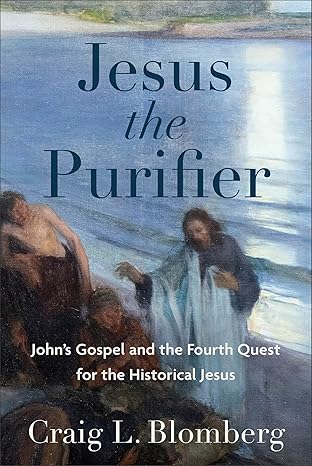
In the introduction to this book, Blomberg, a senior NT scholar and author of numerous books (e.g., A New Testament Theology [Baylor, 2018]), notes two primary aims for this work. First, to provide a brief survey of the first three quests for the historical Jesus. This survey is covered in chapters 1-5. Second, to explore how to “make further progress in the quest” (p. xviii). This exploration takes place in chapters 6-10. Here, he argues that a fourth quest ought to give the gospel of John equal footing alongside the Synoptic Gospels. One specific result of doing so is to discern the connection that exists between Jesus and purity, “including ritual purity” (p. xix).
There are a number of strengths to his survey of the various quests. This survey gives the unfamiliar reader some footing as to the developments that have occurred regarding the quest for the historical Jesus. Blomberg, further, provides evaluations of each quest along the way, showing some key developments as well as some key deficiencies (the latter of which we’ll discuss below). In the discussion of more recent developments in the third quest, he brings the reader’s attention to such promising gains in scholarship such as the recognition that oral tradition was much more accurate in the ancient world than has been previously understood. Most importantly, however, the second primary goal of this work is Blomberg’s observation that exploration of the gospel of John, the so-called Fourth Gospel, is noticeably absent in the various quests for the historical Jesus.
After discussing attempts by scholars such as John A. T. Robertson, Paul Anderson and Richard Bauckham to rehabilitate the gospel of John in the sixth chapter, Blomberg arrives at the conclusion that the Fourth Gospel ought to be seen as a source of equal merit alongside the other three gospels. Chapters 7-9 give attention to the gospel of John to give the reader a sense of how the Fourth Gospel can give us glimpses of the historical Jesus. The final chapter then turns to the Synoptic Gospels to see how the theme of purity is portrayed.
Noting the introduction of John the Baptist (John 1:19-28), the miracle of water turned to wine (2:1-12), the spiritual cleaning wrought by the Spirit (John 3); the cleaning of the temple (2:12-22), and the mention of living water with the Samaritan woman in John 4, Blomberg rightly perceives and compelling demonstrates that “[i]ssues of purity, especially ritual purity, appear explicitly and implicitly throughout John 1-4” (p. 257).
As the gospel narrative moves forward with John 5-11, Blomberg argues that “issues of ritual purity” begin to recede “further into the background” (p. 275). This is because Jesus continually points to himself as “the ultimate fulfillment of [the existing ritual cleaning practices] truest meaning” (p. 273). The fact, Blomberg argues, that “references to ritual purity” (p. 289) are seen in this section of John is truly remarkable since that is not the primary focus of John’s gospel at this point. Given that these instances of ritual purity were incidental to rather than intentionally placed there by John’s editorial hand serves to further establish the historical authenticity of John’s gospel.
Discussing John 12-21, Blomberg suggests that though there is not a linear move away from ritual purity and toward moral purity, this development is scattered throughout this section of John. For example, commenting on John 17:17, 19 (“Sanctify them”), he writes, “we have language and concepts from a background of ritual purity applied wholly in the moral and ethical realm” (p. 330). Following his overall discussion of the gospel of John, Blomberg states that even one working from critical assumptions would have to agree that “purity remains the older layer” (p. 331). Moreover, though not a major theme of the Fourth Gospel, the move “from ritual to moral purity occurs often enough that we cannot dismiss it” (P. 331). As such, a comprehensive articulation of a fourth quest approach to the historical Jesus, one which seeks to rehabilitate the gospel of John alongside the other three gospels, would need to include a discussion of Jesus and purity. Thus, Blomberg’s preliminary exploration along the fourth quest lines shows significant promise.
In conclusion, for those familiar with critical approaches to the gospels, with some pitting the allegedly more historical Synoptic Gospels against the more theological (think: theological biased, i.e., nonhistorical) Johannine Gospel and others drawing from the Fourth Gospel of John to present a case for high Christology in the early church while seeing the Synoptic Gospels as offering a portrait primarily of the humanity of Jesus, Blomberg explicitly corrects the assumptions of the former approach and implicitly challenges the assumptions of the latter.
By showing the significant lack of attention to the Fourth Gospel by historical Jesus questers and by showing the fruit that emerges from an investigation of the same gospel, Blomberg demonstrates that a fourth quest which rehabilitates the gospel of John as a historical source on par with the Synoptic Gospels is both a warranted and necessary move for scholars working the field of historical Jesus research. Personally, I am excited to see what the fruit of the efforts will be following what is in many ways Blomberg’s groundbreaking work. His work is a model to critical scholars and believing scholars alike as he takes pains to carefully and clearly work through the insights and deficiencies of the prior quests as well as provide a working example of some of the insights a fourth quest can add to the discussion. I would highly recommend this book for three reasons: (1) it provides a clearly written yet succinct survey of the quests for the historical Jesus up to our own time; (2) he makes a compelling case for the gospel of John as a historical source; and (3) he writes with humility and charity and, at times, humor. Take up and read!
Thomas Haviland-Pabst