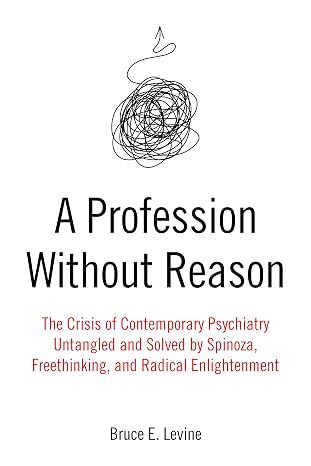
A Brief Book Summary from Books At a Glance
by Benjamin J. Montoya, PhD
About the Author
Bruce E. Levine, Ph.D., is a clinical psychologist and has been in private practice since 1985 in Cincinnati, Ohio.
Editorial Note:
The Books At a Glance Statement of Faith states clearly our commitments to the authority of Scripture as God’s Word written, including its teachings regarding morals. For various reasons on occasion we offer a “bonus” Book Summary of a book whose author does not share these convictions. Dr. Levine is one such author. We include a summary of his work here for its unusual insights regarding his profession that in many ways has gone awry.
Table of Contents
Chapter 1 Introduction
Chapter 2 Freethinking
Chapter 3 Fear
Chapter 4 Ultimi Barbarorum
Chapter 5 Science
Chapter 6 Unethical
Chapter 7 Two Bibles
Chapter 8 Three Noble Lies?
Chapter 9 Tolerance and Stigma
Chapter 10 Brain Disease
Chapter 11 Genetics
Chapter 12 Coercion
Chapter 13 Madness and Scientia Intuitiva
Chapter 14 Icarus and Recovery
Chapter 15 Pals and Peers
Chapter 16 Freedom from Bondage
Chapter 17 Tractatus Psychiatrico-Politicus
Chapter 18 Bento’s Conclusions
Summary
Chapter 1: Introduction
Being a free-thinker is a popularized concept nowadays, but being one, even in recent historical past, could be cause enough for someone to be banished from their community, or worse. Such was the case for Baruch de Spinoza (1632-1677). He is commonly remembered for applying rationalism to the study of the Bible to dispute its sacredness but seeing him only in that light would be an injustice. Authorities were using the Bible as a billy-club of sorts to enforce obedience, suppress free-thinking, and institutionalize intolerance. This book is written in a similar vein because despite how psychiatry presents itself, “it ain’t working.” Psychiatry has labeled mental illness what they consider it to be, but this book aims to apply freethinking to this area with the hope of making gains toward greater enjoyment in this world that seems to provide so much pain.
Chapter 2: Freethinking
Freethinking is a costly endeavor, often historically resulting in excommunication and banishment in an effort to suppress ideas that went against the proverbial grain of authorities, be it political or religious. In Spinoza’s day, there were three camps of freethinking:
- There were those who rejected freethinking in favor of keeping the status quo of faith in traditional authorities.
- Other moderates valued freethinking, but they sought to limit its application to avoid posing any kind of threat to ecclesiastic and state institutions.
- Yet another group sought to promote freethinking to seek to push for democracy instead of the authorities of their day having the kind of absolute authority that is uncommon nowadays.
When it comes to the current consideration of psychiatry, despite the years of treatment and medication, individuals are not improving. Serious matters such as suicide, mental illnesses, and mortality among those with mental illness are all worsening. Clearly, it would be a logical mistake to assume that correlation automatically results in causation, but the employment of medication can be clearly seen as the cause for increased suffering, not the alleviation of said pain. This is all cause enough for the spirit of freethinking to be further applied to psychiatry. . . .
[To continue reading this summary, please see below....]The remainder of this article is premium content. Become a member to continue reading.
Already have an account? Sign In