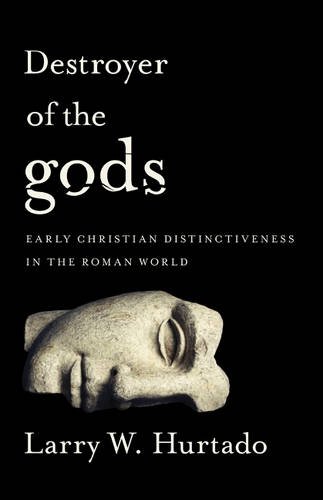
A Brief Book Summary from Books At a Glance
by Steve West
Table of Contents
1 Early Christians and Christianity in the Eyes of Non-Christians
2 A New Kind of Faith
3 A Different Identity
4 A “Bookish” Religion
5 A New Way to Live
Conclusion
Summary
Introduction
Whether we are Christians or not, we have to account for the cataclysmic shifts that took place in culture and history through the rise of the church from its tiny, insignificant origins. In Rome where the church began, the early Christian movement was considered a bizarre, or even dangerous, superstition. Today, where so much of what we think about religion is owing to Christianity, it can be difficult to recognize how odd and discordant the Christian message seemed to many people in the surrounding culture. Around 30 AD, Christianity began to rise as a new religious movement, centered on the belief that Jesus was the crucified and resurrected Lord and Messiah. Over the next three centuries, Christians grew from thousands to millions. Friction and even persecution occurred, and Christian apologists had to defend their lives by defending their beliefs. In due course, under Constantine Christianity became Rome’s official religion. Christianity did not triumph because of Constantine; on the contrary, Constantine adopted it because it had survived and flourished.
This book does not focus on the reasons for Christianity’s rise and unprecedented growth. Without denying that there were similarities between Christianity and other traditions, the focus is on some distinctives that set Christianity apart in the first and second centuries AD. In order to grow as it did, Christianity had to be different, but it could not be completely alien. We see that the Christian apologists in the early church labored to show that Christians were not altogether foreign in their beliefs and practices; they highlighted many of the similarities that existed between themselves and others in society. Those outside the church, however, certainly thought that Christianity was very different. Although there are questions today about various forms of Christianity, the focus here will be on “proto-orthodox” Christians (i.e., what we find in the New Testament writings). The proto-orthodox Christians were far more successful at winning converts than other types of Christianity, and it was their churches that were in view when pagans attacked Christianity.
Chapter 1: Early Christians and Christianity in the Eyes of Non-Christians
Looking at early Christianity from the eyes of outsiders is one of the best ways of seeing how different it looked to many cultural observers. The Christian movement began as an offshoot of the Jewish tradition, so it can also be helpful to look at how it was perceived by other Jews. All the first Christians were Jewish, but at least some powerful non-Christian Jews were hostile to the church. In the New Testament, we see that Saul (the Apostle Paul) was zealous for persecuting the followers of Jesus. Analogously to Phineas in Numbers 25, Saul saw himself as honoring God and upholding the holiness of God’s law by attacking Christians and trying to destroy the church. He clearly saw the church as a threat to the truth of God and the Jewish religion. Saul at first believed that Jesus was cursed by God because he had been crucified. Jesus was condemned by the Jewish religious leaders as a false messiah and false prophet. It is likely that the Christians’ high reverence for Jesus was seen as blasphemous by Saul and others.
Many religious Jews found Christianity highly objectionable and alien, and so did many pagans. We find writers like Tacitus and Suetonius making negative comments about Christians, and Nero exercised a pogrom against the church. Christians were accused of scandalous ritual practices, and they were deemed the followers of a new and wicked superstition. Pliny the Younger was unsure precisely what crimes Christians were guilty of, but he saw them as sufficiently guilty to deserve punishment, including torture and execution. He wrote that Christians held to “a perverse and extravagant superstition.” If they didn’t recant and worship other gods, they were to be punished. Since Christians did not worship other gods, they withdrew from offering sacrifices at pagan temples. This kind of sacrificing was part of communal and economic life, so withdrawal was considered antisocial and damaging. Christianity could have been tolerated if it was syncretistic.
In the second century, some pagans expressed guarded admiration for some of the practices of Christians, but there was also a lot of hostility and disdain. The Christians’ refusal to worship traditional gods, and worshiping Jesus alone, was a main reason for pagan scorn and disapproval. Over time, pagans became more acquainted with the doctrinal distinctives of the Christian faith, and they mocked the cross and resurrection. The amount of invective shows that Christianity was not merely marginal in society, but was influential and attracting attention. Besides the outlandish charges of scandalous behavior (like cannibalism and incest), Christians were mainly criticized for their unwillingness to worship other deities and engage in socially accepted religious behavior. . . .
[To continue reading this summary, please see below....]The remainder of this article is premium content. Become a member to continue reading.
Already have an account? Sign In