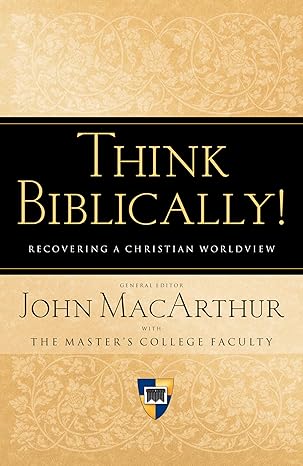
(Note: There is a revised second edition of this work from Crossway that released last year.)
A Brief Book Notice from Books At a Glance
Table of Contents
1 Embracing the Authority and Sufficiency of Scripture – John MacArthur
2 Cultivating a Biblical Mind-Set – Richard Mayhue
3 Comprehending Creation – John MacArthur
4 Coming to Grips with Sin – John MacArthur
5 Having an Eternally Right Relationship with God – John MacArthur
6 Viewing the Nations from God’s Perspective – Mark Tatlock
7 Understanding our Postmodern World – Brian Morley
8 Profiling Christian Masculinity – Stuart Scott
9 Profiling Christian Femininity – Patricia Ennis
10 Enjoying Spiritual Worship and Music – Paul Plew
11 Why Biblical Counseling and Not Psychology? – John Street
12 Why a Scriptural View of Science? – Taylor Jones
13 Why Christian Education and Not Secular Indoctrination? – John Hughes
14 Reflecting Honestly on History – Clyde Greer, Jr.
15 Developing a Biblical View of Church and State – John Stead
16 Proposing a Biblical Approach to Economics – R.W. Mackey, II
17 Glorifying God in Literary and Artistic Culture – Grant Horner
Selected Quotes
- “A worldview comprises one’s collection of presuppositions, convictions, and values from which a person tries to understand and make sense out of the world and life.” (13)
- “A truly Christian worldview begins with the conviction that God Himself has spoken in Scripture. As Christians, we are committed to the Bible as the inerrant and authoritative Word of God…Scripture, therefore, is the standard by which we must test all other truth-claims.” (21)
- “Obviously, an authentically Christian worldview hinges on a right knowledge of the Gospel. Therefore, the person whose understanding of the Gospel is inaccurate has no Christian worldview.” (101)
- “If understanding postmodernism is challenging, constructing a Christian response is more so.” (149)
- “Where entertainment and a self-satisfying individualistic attitude prevail, there is a misunderstanding of what worship means, who is involved, who the audience is, what the responsibilities are, and who receives the glory.” (188)
- “Even though modern science touches the life of virtually every person on earth, how science functions philosophically to produce the progress from which we all benefit is poorly understood, if at all.” (222)
- “It should be recognized that the Bible was not written for the specific purpose of being a teacher preparation textbook, an exhaustive school curriculum outline, or a vocational training manual. However, the Scriptures do provide clear authoritative principles that can form a solid foundation and framework for the development of a God-honoring educational philosophy.” (245)
- “Believers in Christ need to stand in every way—spiritually, intellectually, morally, and politically—as the vital, separated alternative to a world system that glories in materialism, self-indulgence, and political power.” (295)
- “The crucial starting point in the Christian’s engagement with any aspect of culture must always be a biblical anthropology. One must have a scriptural understanding of humanness, derived from the explicit doctrine and implicit principles of Scripture.” (319)