A Brief “Bonus” Book Summary from Books At a Glance
by Steve West
Overview
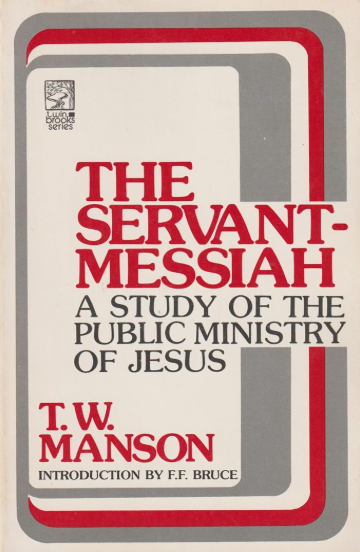
The Servant‑Messiah, first published in 1953, is a theological and historical analysis by T. W. Manson of the public ministry of Jesus, focusing particularly on how Jesus reinterprets and fulfills Jewish messianic expectations by combining the roles of “Servant” and “Messiah.” Manson was the renowned scholar of the New Testament at the University of Manchester. His book follows a series of lectures he had previously given. The book features a Foreword by F. F. Bruce.
Manson’s thesis is that Jesus’ life, teaching, actions, and especially his suffering and death must be understood not by the conventional and popular messianic hopes of his day (political deliverance, national restoration, etc.) but by a deeper, more radical, servant‑model drawn from Jewish Scripture (especially the “Servant of the Lord” in Isaiah and related texts) fused with notions such as the “Son of Man” and the kingdom of God. Manson argues that Jesus “transforms” messianic expectation rather than simply rejecting or ignoring it.
Structure & Key Arguments
- Messianic Hope in Judaism
Manson begins by surveying what Jewish messianic expectations were like in the period just before and during Jesus’ time. He shows how it was widespread among Jews to long for a Messiah, a liberator, a kingly figure who would restore Israel, defeat enemies (political or spiritual), and reestablish national and religious unity. - Jesus’ Reinterpretation
Into this environment Jesus comes, and with John the Baptist’s preaching, and then his own teaching, there is a shift. Jesus does not fit the popular mold exactly. For example:- He rejects political revolution or violent uprising as a messianic strategy.
- He uses imagery of servant‑ship: humility, self‑giving love, suffering, self‑denial. These are central to his understanding of what the Messiah must be.
- He also affirms that certain messianic prophecies and traditions are fulfilled in him, but in a transformed way. What many expected as external, visible deliverance is reinterpreted in spiritual, moral, and eschatological terms.
- The Servant and Son of Man Traditions
Manson pays special attention to the Old Testament “Servant of Yahweh” (e.g. in Isaiah) and to apocalyptic Son of Man expectations (such as in Daniel). He argues Jesus draws upon both: the Servant ideal gives the pattern of suffering, humility, redemptive suffering; the Son of Man gives eschatological glory, final vindication, authority. Jesus unites these in his mission. . . .
The remainder of this article is premium content. Become a member to continue reading.
Already have an account? Sign In