A Book Review from Books At a Glance
by Brian Borgman
As a new believer, at age 13, I was constantly wrestling with the age-old question, “Can I lose my salvation?” The church I attended said, “Maybe.” An older man in our church, who was a Free-Will Baptist, said, “Absolutely.” Dr. J. Vernon McGee, who I listened to regularly on the radio, said, “Never.” My pastor had his texts, my Free-Will Baptist had his texts. Dr. McGee had his texts. I vacillated through my teen years and that wreaked havoc on my assurance. When I went to college (Biola University) I jumped into the easy-believism of Charles Ryrie and Zane Hodges. When I started to read Reformed writers in seminary, I began to see I wasn’t dealing with the threats and conditional passages honestly. Although I came through the debate with a Calvinistic understanding of the preservation and perseverance of the saints, my convictions were infused with the necessity of constantly asking, “Was my conversion real? Was his conversion real?” Self-examination became the norm. Some of the conventional Calvinistic explanations of the threats or warnings led me back to the notion that these are not for real Christians, they are for false professors. The result was, make sure you are not a false professor. Although I still believe false confessions of faith are a problem in the church, my approach was to weed out false believers and in doing so, I probably wounded many true Christians. Then I read a book and it was life changing. That is not a cliché; that is true. That book was The Race Set Before Us.
It is not that common to write a review (or a tribute) for a book that has been out for 25 years, but The Race Set Before Us is not a common book. Although there are some good books on the perseverance of the saints, I was not prepared for the exegetical and biblical-theological rigor I encountered in this 337-page book. I heard Ardel Caneday (co-author with Tom Schreiner) at a Pastor’s fraternal. I remember the PPT slides of the different views, I remember the exegetical insight, and thought to myself, “I need to read this book.” I took the book with me on a short vacation, and I immediately realized that this book was not a short vacation read. It demanded to be read carefully, slowly, pen in hand. It took me a while to finish it. Since that time, I have read it a couple more times. It shaped the way I read the warning passages and the conditional passages of the N.T., and the way I understand the perseverance of the saints.
As a pastor and theology instructor, I take the text seriously. My conviction is that the text has priority. This was challenging to me as a Reformed pastor and teacher when I would read the unconditional passages on preservation (John 10:27-30; Rom. 8:38-39; Phil. 1:6, to name just a very few) and know that God keeps His own, all the way to end and then read the conditional passages (e.g., Rom. 11:22) and the warning passages (e.g. Heb. 6:4-6). What troubled me was how they fit together. I was sure I couldn’t take one set of texts and ignore the others. I also was frequently uneasy about the standard Calvinistic readings of the warning passages. They were not always the most satisfying, although I believed a true believer would persevere. But things changed when I read The Race Set Before Us. It brought the various views of the perseverance into perspective with very helpful diagrams. There was a clarity about what the other views teach, the diagrams were no small part in giving visual intelligibility to the views. But the exegesis was what gripped me. When one reads The Race Set Before Us, he better have his Bible at hand. This book, like few others, got me into the text. In addition to that, the biblical-theological skill was compelling. The result was a clear presentation on how the threats and the conditions harmonize with the promises. Again, the diagrams brought it visually together.
Schreiner and Caneday begin by explaining the basic four views of the warnings and threats in the Bible. Those views are the loss-of-salvation view, the loss-of-rewards view, the test-of-genuineness view, and the hypothetical loss-of-salvation view. The authors do not set up strawmen, they explain each view, quoting the best representatives of each view. But then they ask a question, “What is the function of biblical admonitions and warnings?” (38). This question goes deeper than “do these texts teach us that we can lose our salvation?” When we start with that question our theological commitments take over and we by-pass good exegesis and biblical interpretation. The authors then present a view that they call, God’s means-of-salvation view of the warnings and admonitions. The explanations are compelling. Salvation is an already and not-yet reality. The warnings and admonitions are designed to spur on faith so that the believer continues in the faith. These threats and conditions function as means to keep the Christian running the race and, in the end, crossing the finish line.
The authors explore, in great detail, the present and future of salvation, which forms the framework for the function of the warning passage. Next, the nature of saving faith as obedient faith is exegetically defended. (As a pastor, I found the exegetical treatment of the various texts to be a virtual commentary! I made a mental note, “check the Scripture index when preaching!”). Saving faith is a gift of God’s grace, and saving faith is indeed persevering faith. Perhaps one of the most helpful and exhilarating chapters is chapter 4, “Running to Win the Prize: Heeding God’s Admonitions and Warnings.” Two features stand out in this chapter. The first is the treatment of the warning passages in Hebrews, indeed, the most troubling of all warning passages! But the second is the use of Acts 27 (Paul’s journey to Rome aboard a ship) as an illustration of how promises, conditions, and threats get the believer safely home. The warnings are not meant to frighten us so that we conclude we will never finish the race, but rather they strengthen faith through both assurance and admonition. The last few chapters deal with those who fall out of the race, the grace of God in endurance in the race, and being assured that we will finish the race. The final chapter ties together election and perseverance, answering the question, “Who are those who run to the end and win?”
I use an illustration of the function of the warnings with our congregation frequently. Between us, in the Carson Valley (Nevada) and Sacramento, there are the Sierra Nevada mountains. Highway 50 takes you through the mountain pass. It is treacherous. There are several warning sights posted along the highway. Some show sharp curves; others show tractor-trailers tipping over. The signs can be scary. But the signs serve a function and that is to get the driver safely through the treacherous roads, to the destination. The signs do not cause drivers to come to a screeching halt, screaming “I am going do die! I will never make it.” That is not their function. In fact, the warning signs don’t even indicate that the completion of their journey is in doubt. The signs function to keep the driver safe on the road. The Race Set Before Us brilliantly explains the warning passages, and their many implications, in terms of their divine design. The result of this book is a view on the warnings and admonitions that are not immediately bogged down in the theological question of “can I lose my salvation.” Rather, the message of the warnings is set in the context of function and that function is to keep the Christian running the race. What I learned in The Race Set Before Us is woven throughout my expositions and theology classes. It has made an invaluable contribution to my biblical and theological understanding, as well as my ministry.
On the Silver Anniversary of this book, I can say, without reservation, that this book needs to be read and digested. The topics are truly matters of life and death. Ardel Caneday and Tom Schreiner have given a gift to the church, and to pastors and teachers, that helps us to understand the Bible and these difficult topics. In The Race Set Before Us, the text of Scripture speaks louder than historical theology or the presuppositions of theological conviction. I have no doubt that this book will be around for the next 25 years.
Brian Borgman
Pastor and author
Grace Community Church, Minden, NV
Buy the books
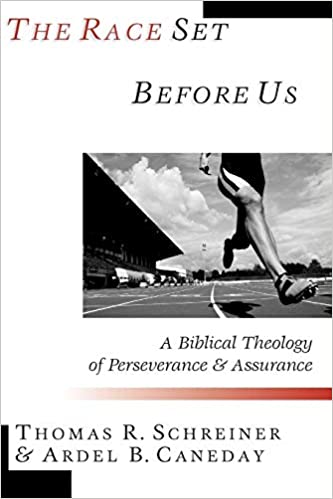
THE RACE SET BEFORE US: A BIBLICAL THEOLOGY OF PERSEVERANCE & ASSURANCE, by Thomas R. Schreiner and Ardel B. Caneday