A Book Review from Books At A Glance
by Matthew B. Tabke
Fred Malone was the founding pastor of Heritage Baptist church in Mansfield, Texas where he served as Senior Pastor for 11 years. He moved to Clinton, Louisiana in 1993 and became the senior pastor at First Baptist Church in 1993 before retiring in 2020 as Pastor Emeritus where he still serves in this capacity. He completed a B.S. from Auburn University, an MDiv. from Reformed Theological Seminary, and a Ph.D. in New Testament from the Southwestern Baptist Theological Seminary in Fort Worth, Texas. Malone was also one of the founding Board Members of the Founder’s Ministry where he served for many years. He is presently a founding Board Member of Covenant Baptist Theological Seminary. He has authored A String of Pearls Unstrung and The Founders Study Guide Commentary on Romans.
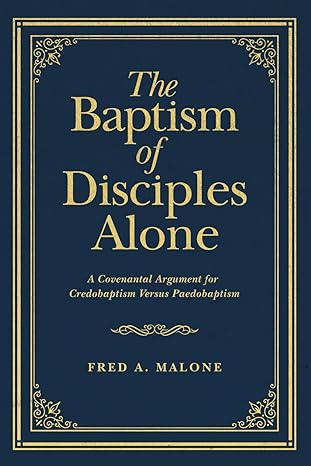
As the subtitle of the book states, The Baptism of Disciples Alone is “a covenantal argument for credobaptism versus paedobaptism.” Malone introduces the book by laying out his thesis and follows with a personal story of his upbringing in a Baptist context, his training, ordination, and service as a pastor in the Presbyterian Church of America, and his subsequent internal turmoil and return to a Reformed Baptist position. The introduction then moves on to lay out in brief, the Covenantal Baptist position. Following this, Part I lays out Malone’s perspective of Reformed hermeneutics and the authority of Scripture as they relate to baptism. Part II is largely a Covenant Theology from a Reformed Baptist perspective that addresses many particular arguments of the paedobaptist position versus the Baptist position. The final chapters of the book consider the difference credo versus paedobaptism makes in the life of the faithful and ends with a final appeal to Baptists who have an affinity towards Reformed Theology not to give up on their Baptist churches that reject the tradition of Covenantal Reformed Baptists. The book has six appendices that include Spurgeon’s position on baptism, a brief consideration on the proper mode of baptism, an appendix from the 1689 London Baptist Confession, two book reviews, and an essay on the rejection of extreme covenantalism.
Malone’s thesis is concerned primarily with answering the question, “Who are the proper subjects of baptism?” Given that this is the case, the book is disinterested in the mode of baptism and thus his consideration of the subject is limited. He posits that two primary problems present themselves to paedobaptists: the regulative principle and Biblical hermeneutics. In considering the regulative principle Malone suggests the regulative principle disallows infant baptism because there is no Biblical evidence whatsoever in favor of infant baptism. Regarding hermeneutics, Malone cites the Westminster Confession as the sole reason for infant baptism because it allows “good and necessary consequence” as the justification for their paedobaptist practice. These two ideas are returned to frequently throughout the book.
In assessing Malone’s argumentation, there are several aspects to take note of. First, the book is primarily a critique of Westminsterian paedobaptist practice. While this is perhaps one of the strongest of all historically tested and established confessions, this pathway of argumentation poses problems because it does not address Lutheran or Catholic arguments for paedobaptism. There are some caveats to Malone’s refutation of the Westminster that are necessary. It is likely that a convinced Reformed Baptist like Malone, who holds to the 1689 London Baptist Confession with an iron grip, is unlikely to give much consideration to the Catholic arguments given that the confession largely leads one to conclude that Catholics aren’t Christians. Still, Lutherans and Catholics have their own developed body of literature regarding the subjects of baptism that ought to be addressed if one desires to make a prolonged defense of credobaptism. It is also true that Malone is not trying to make an exhaustive case for credobaptism from every angle and thus does not find the need to consider other arguments than that of the Westminsterian Presbyterians. And yet, there are other types of Presbyterians so one would expect (if the argument is for a Reformed Baptist perspective) to also interact with the Three Forms of Unity which Malone does not. Again, even if similar, there is a body of literature developed from another stream of Presbyterian theology that advocates for paedobaptism. One would have expected Malone to answer these arguments even if he were only considering the subjects of baptism in his book. So then, this book is largely an argument between the 1689 London Baptist Confession and the Westminster Confession and Book of Church Order exclusively. If you are hoping for exhaustive research and answers to the question of infant baptism from the myriad perspectives that exist, you will not find it in Malone’s book.
A second critique comes from the title of chapter one: “no straw men.” The implication and explanation Malone gives within this chapter is that “Christian love and integrity require that we avoid building ‘straw men’ when representing the views of those with whom we differ” (3). This is a beautiful statement and should be taken seriously by all who hope to graciously disagree with others concerning matters of doctrine that might be considered second or third tier issues. Unfortunately, I did not find Malone’s statement represented in his writing. While this chapter does lay out the arguments of John Murray in his Christian Baptism in significant detail, there are other times when Malone engages in the very strawman argumentation tactics he decried. For instance, Malone uses the fact that paedobaptists have division among themselves on the validity of household baptisms in chapter six to say that there is no Biblical evidence for such a practice. He moves on to discuss each passage exclusively, but the division of paedobaptists does not constitute a reasonable premise for weakness in their claims. Unfortunately, Malone uses the continuous theological discourse and disagreement among Presbyterians as proof that the matter of infant baptism is confused more than once in the book.
Now a final critique concerning Malone’s work relates to the first critique. Just as Malone was not exhaustive in answering the arguments of Lutherans, Catholics, and other types of Presbyterians, so too he does not fit his argument into the whole body of doctrine developed by Presbyterians. Presbyterian dogmatics (at least those Westminsterians whom Malone is addressing) is an outgrowth of their confession which sets forth a position not just on baptism, but on a host of doctrinal topics they consider essential to the Christian faith. In other words, Presbyterian paedobaptism is affected by their established doctrines of sovereignty, providence, free will, position on the civil magistrate, church polity, etc. One might frame these questions within the relationship of exegesis, Biblical Theology, and Systematic Theology; the disciplines must be careful not to talk past each other. I do not mean to suggest that Malone needs to address all the issues present in detail; he has after all, purposefully opted for a limited scope. Simultaneously, it is perhaps because Baptists do not have a consistent confessional history that he is unable to see things through the scope Presbyterians do. The issue does not seem to be merely baptism for Presbyterians, but a whole perspective on the Scriptures. For instance, Ian Hamilton once suggested in an interview that the best argument of infant baptism is the immutability of God. Perhaps Malone is attempting to address an argument such as Hamilton’s by tackling the twin issues of the regulative principle and hermeneutics, but the inability to assess the whole system is a lack in Malone’s work which may be cause for some disappointment. This is further demonstrated by other (traditionally Baptist) positions that Malone holds such as congregationalism or separation of church and state. One might be bothered that a book review should bleed these arguments into the question of baptism, but Malone clearly states throughout the book that he is attempting to retain Baptists with an affinity towards Reformed Theology in his theological camp. It seems disingenuous to suggest that Baptists are leaving their tradition merely because of Covenant Theology and Calvinism. It could be the historic Baptist position of congregationalism or separation of church and state in favor of the Westminster’s elder-ruled polity and government discipleship. It could be the lack of strong Baptist confessionalism or the favor of patriarchalism over complementarianism which is not even official within Presbyterianism, but tends to be more easily found. It appears that baptism may not always be the primary hurdle that Baptists are traversing when entering Presbyterianism. They may have considered the totality of issues rather than just the one, or have opted for change based on a single issue other than baptism.
Now in conclusion, it is abundantly clear that I have been somewhat hard on Malone’s book. Hard enough in fact that one might take me for a paedobaptist. Before discussing this matter, I might commend Malone’s book for being thoroughly Biblical. He deals with a myriad of texts in an exegetical and scholarly way, attempting to maintain consistency throughout. Furthermore, though I have been hard on Malone’s methods of argumentation, I might also say that he has done good research and attempted to present others’ positions as best as he can. Certainly his style and tone of argumentation is not as fiery as the Reformers and Protestant Scholastics arguing against Catholicism, though I appreciate the convictionalism present in his writing. The book is very readable, thought-provoking, and lays out several important angles and perspectives concerning the issue of baptism.
Commendations given, I must say Malone’s last chapter pulls at my heart quite significantly. I grew up in a Methodist paedobaptist context with formerly Mennonite (credobaptist) parents, was sprinkled at 10 years old with my infant sister, did not accept the Gospel until I was 20 through the influence of both Reformed (paedobaptist) theologians preaching on the radio and the robust expositional preaching of a Southern Baptist Church; I was immersed at 21. One might say then that I am from neither tradition and both. Since becoming a Christian, God has slowly exposed to me the joys of Reformed Theology and has me continuing in a Baptist context as of now. From my position as a Ph.D. student at a Baptist seminary with a high affinity to Reformed Theology, I have criticisms of the Southern Baptist Convenation and find it difficult at times to continue in a non-confessional context. I also have no historical Christian roots in either theological camp to fall back on (which of course are always meant to come secondary to the Scriptures). I mention these details not simply to display some internal struggle concerning the issue of baptism, but because I anticipate that there are many like me who are in a similar place. What advice then ought we to receive? First and obviously, we must read our Bibles and pray, followed with study of the issue by other historical voices, and become as convinced as we possibly can of our position. Second, as Malone suggests, we must be wary not to leave our theological heritage because of our frustration with it, but only because we have become convinced of the opposite position by the Bible. Finally, if we are to move camps, we must be gracious towards those who disagree, all the while submitting humbly to our leadership and remembering that millions of Christians have lived faithfully, died, and gone to be with Christ from both contexts. If you are one who is working through questions of Reformed theology, baptism, and doctrinal fidelity, I recommend you read this book as one position to help inform your conclusions, but as always, read with a critical eye.
Matthew B. Tabke