A Book Review from Books At a Glance
by Ryan M. McGraw
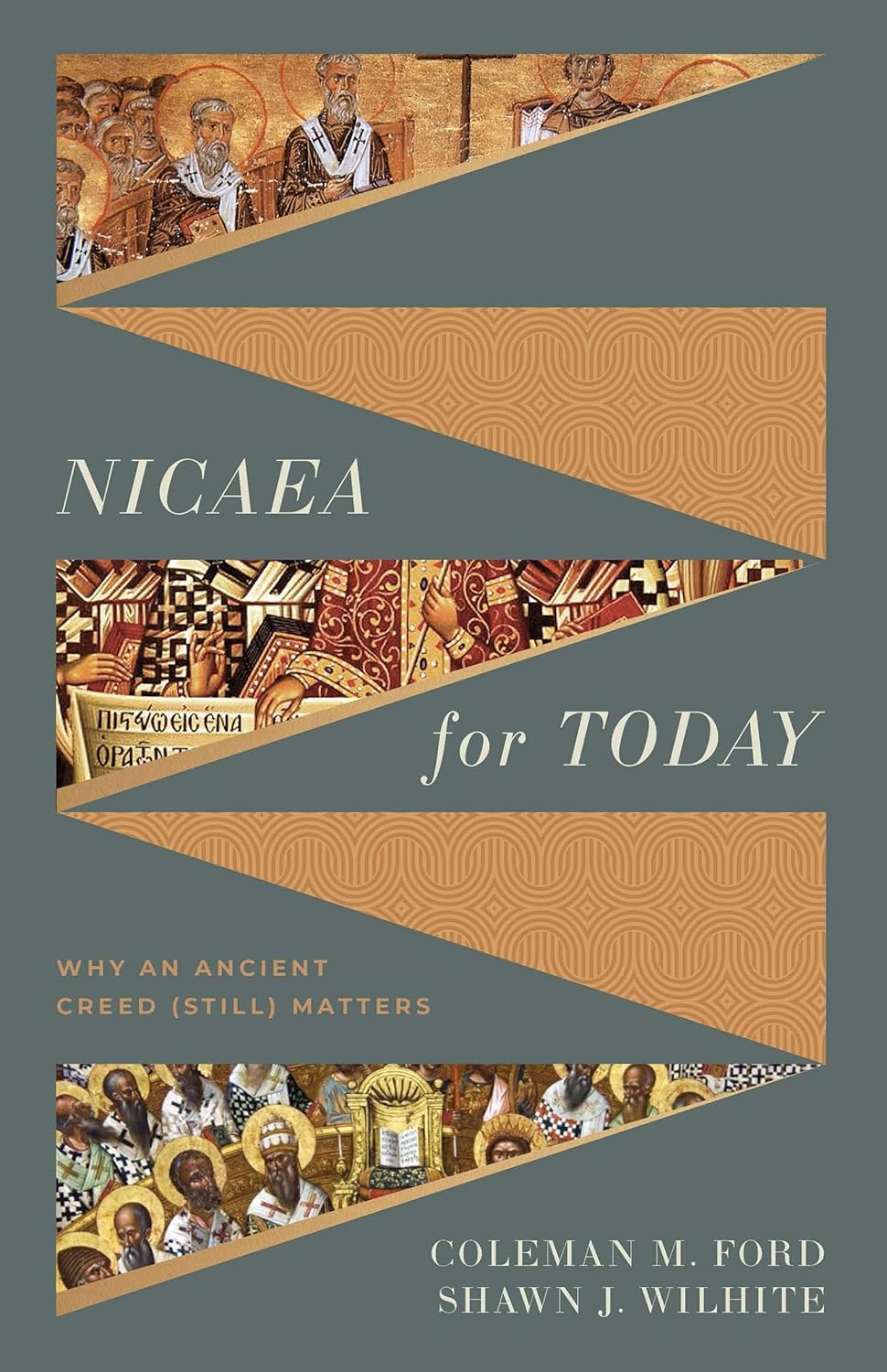
Until recently, the Nicene Creed has been notably absent from evangelical churches. Despite the fact that this Creed, with the Apostle’s Creed, is the most widely accepted confession of biblical Christianity in the history of the Christian church, it has become a casualty of a “no creed but the Bible” culture. Yet the cost of the virtual loss of the Nicene Creed is hard to estimate. No other science or discipline starts by saying that because the facts we study remain the same, we don’t need to become familiar with what anyone else has learned from them before we got here. Ignoring historical results of research, debate, and trial and error would put both science and theology in a dark age, if not a dead age. Resulting from two ecumenical Councils, representing the entire Christian church, in 325 and 381, what we call the Nicene Creed sums up the basis of our salvation in the Trinity and Jesus Christ. Coleman Ford and Shawn Wilhite seek to show Christians, as their subtitle indicates, “why an ancient Creed still matters.” Though not including every detail here about the Creed, and maybe not needing to, this book is a fine invitation to see why the Nicene Creed is vital for a vibrant Christianity (5).
Brief and easily digestible, the three sections of this work move through the Creed’s context, its teaching about Christ, and its relevance to Christians. Setting a basic historical context, part one introduces the Council of Nicaea (325) on the backdrop of Arian assertions that there was a time when the Son was not (chapter one). Chapter two explains why the Council would not have happened without Roman Emperor Constantine’s professed conversion to Christianity, rounding out the basic historical setting of the development of the Creed. Consisting of two chapters as well, part two outlines Christ’s divine identity as God the Son and his incarnate work in his humiliation and exaltation. Beauty dominates part three, moving from context, through Christ, to Christians in relation to their salvation, spiritual formation, and church and worship practices. Directly countering the “no creed but the Bible” mentality, chapter eight reminds readers that “there is a right way and a wrong way to read the Bible” (143) and that the Creed both flows from Scripture and helps direct how we read Scripture (151). The main vehicle through which they suggest we do so is “partitive exegesis,” through which we recognize that the one person of Jesus Christ is both God and man, and that some passages highlight his divine nature, others his human, and some both, all in one Person (148-155). They close with a call to begin using the Creed in public worship again, and to recover greater theological precision in understanding God and the gospel (167). Along the way, the authors treat key authors like Athanasius, Rufinus, Cyril of Jerusalem, Basil the Great, Gregory of Nyssa, and Gregory of Nazianzus, and key debated texts like John 1 and Proverbs 8 and many more. Each chapter includes sections on “thinking Nicenely” and “Biblical connections,” seeking both to encapsulate the main ideas of each chapter and to ground them solidly in Scripture. By the close of the book, readers unfamiliar with the Nicene Creed and Nicene theology will get a wholesome introduction to its main points, hopefully spurring them on to dig deeper, which the authors facilitate through giving a good list of books to start with.
Lots of strengths stand out in this work, with a few minor areas requiring supplementation. Simplicity, a Christ-focused view of salvation, and public worship stand out, helping readers grasp the basics, look at Christ rather than his benefits alone as the heart of the gospel, and using the context of worship as the training ground for cultivating Trinitarian theology. Occasionally, the author blurs categories, such as saying that remaining in Christ is a “passive and active act” (66). There are no passive acts because a patient is acted upon by an agent, which is important because preserving us in salvation is something that God does and persevering in faith is something that we do. In the one case, God acts upon us, and only then do we act in response. Additionally, while they state rightly that theosis or deification language in the church fathers was largely equivalent to our sanctification and glorification (97), subsequent medieval and modern historians often meant something more than this, fraught with ambiguities and difficulties, which warrants a little more qualification. Perhaps the most notable issue is that the book almost entirely omits the Filioque (“and the Son) controversy, which divides East and West to this day, and omitting it is both a strength and a weakness. A strength because the authors press what unites rather than divides Christians. Yet a weakness because the Filioque is primarily relevant for western theology where soteriology is a larger issue than it is in the East. In the end, the issue is less about how to interpret specific texts about the Holy Spirit as it is about how we connect the economy of salvation and what God does to save us in time to who he is in eternity. Is salvation really from the Father, through the Son, in the Spirit so that we might come in the Spirit, through the Son, to the Father? The filioque is relevant to how God justifies, adopts, sanctifies, and glorifies Christians. Some of these issues are foreign to eastern Christians, who are often more concerned with becoming something more than merely human, but less than God. For us, however, it matters that the Spirit who glorifies Christ does so because he proceeds from Christ, as well as from the Father, and in knowing how the Spirit unites us to Christ to bring us to the Father, we actually come to know God himself (as far as creatures can). These issues, however, highlight why this is a first book on the Nicene Creed rather than a final one.
Nicaea for Today helpfully shows the value of the Nicene Creed for evangelical Christians unused to a creedal tradition. The Nicene Creed is not the only Creed we should get to know to help us grasp the Bible and the gospel better, but it is the Creed without which we would have few others. Instead of turning back the clock, reading this book gets us up to speed for understanding how we got where we are and where we should go from here. Taking up this book may introduce some readers to a much bigger, and better world, of Biblical Christianity by teaching us not to try to move forward while forgetting the basics.
Ryan M. McGraw
Greenville Presbyterian Theological Seminary